




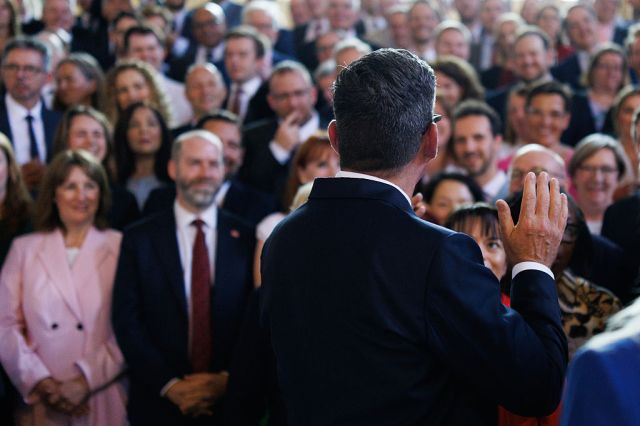
‘Andy is their last hope.’ (Dan Kitwood/Getty)





It ended not with a bang but a whimper. It came from the back of the Prime Minister’s throat, as Keir Starmer promised to be a better husband and father. It’s a tough old game. A bloodsport, even. The former Blairite health secretary, Andy Burnham, clearly has more of a taste for blood than our hapless outgoing leader. Like Boris with the Tories, Burnham is a protean politician who grasps his party and its idiosyncrasies instinctively.
Where Starmer seemed perplexed by Labour politics, Burnham is Mr Labour, and now hegemonic in its structures. MPs have kissed the ring, and crowded for their selfie; once-hostile factions find themselves in strange, unprecedented agreement: “Andy” is their last hope, and the soft-Left, hard-Left and Blue Labourites are, for now, jostling behind an inchoate vision of “the productive state”, and other vague Labour things.
But Burnham must soon govern the country, not just his party. And he’ll find that compared to the unwieldy beasts of city-regional governance or the NHS, the pressures of No. 10 are of an entirely different order of magnitude even at the best of times. And these are not the best of times. We’re in the middle of a once-in-a-century fragmentation of the two-party system, while smartphones cheerily obliterate our collective sense of what reality even means. Add two decades of wage repression and a collapsing public realm; meanwhile, the tax and debt burden only ever seem to rise, and international gilt traders circle like sharks.
This, then, is Burnham’s unenviable inheritance. Which is why, if he wants to survive beyond 2029, the PM-in-waiting should call an early election.
Whether he likes it or not, Burnham’s strengths lie not in his policy platform, which is a confused set of woolly principles, but in his charisma — both within Labour and among the public. He should exploit that, during his Mr Labour honeymoon period, while he still is their unassailable king, before the cultural-political projections of his putative “Manchesterism” have been sullied by time and close reading. And he should hew close to the image that the public holds of him, with a manifesto stuffed with radical constitutional reforms: the replacement of the House of Lords with an elected Senate of the Regions; maximum devolution to municipalities and city-regions; proportional representation for the Commons.
The latter would lock in centre-left coalition governance for a generation. Labour’s existing record of incremental Leftward shifts could meanwhile be repackaged as the start of a genuine project of national renewal: encompassing nationalised rail, a public energy firm, a sovereign wealth fund, and a higher minimum wage. In addition to these nods to a more “pro-investment” political economy with greater public ownership — now painted in proudly progressive colours — a reforming constitutional package would allow for additional radicalism at a time of fiscal constraint.
Taken together, then, a Burnham manifesto could be framed as “taking back control”, as rebuilding Britain while giving power back to the forgotten places, the provincial Britain ignored by distant elites. Burnham’s task in all this would be to articulate a broad, positive vision for the country, one that adapts what the cultural theorist John Clarke has pejoratively called the “vernacular ventriloquism” of populist tendencies. For Clarke, this ventriloquism involves claiming to speak for England — for “The People” — while in practice pushing an agenda that blends turbo-Thatcherism with mass deportations (or at least their promise).
Against this, Burnham must set out a new paradigm for British politics: he’ll have to triangulate between a Right-wing populism on the march and the Left-wing instincts of many of his voters and supporters. In this space, he can root his normie populism, reassuring voters nostalgic for the imagined community of secure, social-democratic Britain, while also seeming positive and forward-looking. But he’ll have to unite discrete political positions into a coherent whole: seeming both patriotic and inclusive; both radical and insurgent, yet with operational competence; both comfortable with multiethnic diversity, but alert to the mess of a broken asylum system and the disordered chaos of a low-waged, low-productivity Deliveroo economy dependent on cheap foreign labour.
Could Mr Labour really pull it off? The vibes are currently in his favour. One Labour MP tells me that “Manchesterism” has the power to “take out the toxic component of nationalism” just like “the civic nationalisms of Scotland and Wales”. “Andy” they say, “has the potential to do that for England.” The “place-first politics”, the Northern identity, the soft-disruptor vibes, the unthreatening, mum-friendly pneuma — all of it can appeal to that sweet spot in the electorate which both despises the political classes yet remains largely anti-Reform. We saw a hint of this strategy in his invocation of “HMO Britain” during his next-day victory rally in Makerfield: this was as close to a dog-whistle as is safe to blow in Labour circles, shifting blame onto negligent landlords but also hinting at asylum seekers. In a similar vein, the return of utilities and natural monopolies to public ownership satisfies voters across the spectrum, initiating a kind of economic patriotism that leans Left but pleases many on the Right.
And, for now, the public is willing to buy into the story of Burnham-as-outsider. That might be ridiculous — given his New Labour pedigree — but his easy manner makes him the very opposite of Starmer. Which is why it’s only downhill from here. To be sure, More in Common has positive polling on the incoming Prime Minister, and focus group and survey data suggest he could give his party a second chance. But as Lenin said, politics is about “who does what to whom”. The moment Burnham enters Downing Street, he’ll learn that governing involves picking losers as well as winners, and that someone will always be alienated. Better, then, to snatch his mandate now, and attempt to secure a full term he can call his own, rather than run in 2029 and fail as a paid-up member of the dreaded Establishment.
That’s especially true when, at the moment, a mandate is so obviously lacking. Old tweets are already resurfacing from Labour MPs — including Burnham himself — demanding that new Conservative prime ministers go to the country rather than serving the rest of a parliamentary term. The longer he waits, the louder cries of hypocrisy from Britain’s hostile media will become, especially when Nigel Farage is cheering them on. The fact is that outrage sells, and the national atmosphere turns fast. At low ebbs, and during the inevitable crises that beset any government, the noise will become deafening: get “the squatter” out, the public must have their say. Indeed, Burnham can seek to appear magnanimous as he reintroduces himself to a public that already leans towards thinking that an election should be called. Any kind of radical programme, either a new path on the political economy or major constitutional reforms, will anyway need public consent.
The counter to all this, of course, is that we live in a parliamentary democracy, whereby the legislature can oust prime ministers at a whim. Yet it would be wrong to ignore the smuggling of presidential norms into our unwritten constitution. MPs have the right to change their party allegiance as often as they like. But this in-built malleability masks the fact that when most voters enter the polling booths to back a party, they’re in effect stating their preference for an institution represented and embodied by the leader-as-godhead, the personification of the party’s current values and political direction. Recall, if nothing else, that Labour’s abysmal showing at the recent local elections — the ultimate trigger for Starmer’s resignation — was largely to do with its association with the leader himself.
The mandate of a prime minister, then, is deeply personal. And not only with the electorate at large. Even before he’s officially prime minister, cracks are beginning to show (or reappear?) in Burnham’s strange parliamentary coalition. One Left-wing Burnham-supporting MP has complaints about the centrality of Josh Simons in Burnham’s operation: the former Makerfield member, who stood down to give the future PM his by-election, is “toxic, and it won’t end well”, they tell me. “I think,” they add, “he’s an Achilles heel.” The PLP as a whole isn’t much better. “There’s so many groups,” my source tells me, “so many factions.” The point of leadership, though, is to bind colleagues together by setting out a clear direction of travel, crafting a common project that each of Labour’s weird strata can, roughly speaking, get behind. “The fights have started”, according to the MP, but there’s still plenty of goodwill. “On the Left generally, the feeling is that we would have given our left testicle to be in this position six months ago.” Why, then, not take the plunge, trusting that a successful campaign — even with a reduced majority — would strengthen Burnham’s position in the PLP yet further?
Not every new leader triumphs after rushing to the voters. Theresa May’s doomed effort to “crush the saboteurs” is remembered as an instructive blunder, after which Corbyn’s Labour Party made up a large polling deficit to deny her the supermajority she needed to push through a Brexit deal. But on the other side of the ledger, we have Gordon Brown, who hesitated and eventually failed to call an early election in 2007, only to see his popularity plummet thereafter. Jim Callaghan, too, ploughed on after Harold Wilson’s resignation in 1976. By the time election day came round three years later, the Winter of Discontent was fresh in the memory, ensuring the avuncular, well-liked Callaghan, who easily out-polled the grocer’s daughter on his personal ratings, was beaten regardless.
In other words, an election would be a gamble. Many Labour MPs would doubtless be out of a job. The party has a dismal reputation after two years of hopeless, directionless dither. But there is unlikely to be a better time for Burnham: before too many difficult decisions have to be made, too many Labour tribes disappointed, too much of the general public frustrated by the slow untangling of Britain’s countless problems. Burnham has restored Labour’s hope and, at least in Makerfield, made his party normal again. His best chance to do the same across the country is now.
Jonny Ball is a Contributing Editor at UnHerd. He formerly wrote under the name Despotic Inroad.
 DespoticInroad