




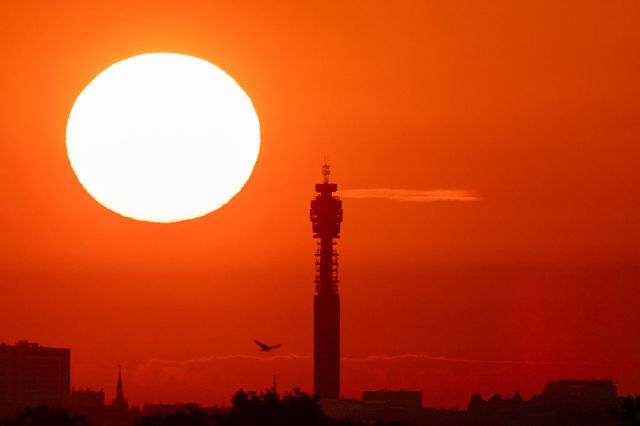
The country has been sweltering this week. (Brook Mitchell/Getty Images)





We think we want hot, then we get hot and we’re not so sure. We’ve got heat in our politics this week, and heat on our streets. We have people assuredly telling us it’s climate change, and people assuredly telling us it’s not. It’s certainly discombobulating. I remember the eviscerating heat of 1976, and wonder whether the rumbles from the Sex Pistols back then were the only reasonable response to its pressure. No pressure, no diamond.
When thunder does hit — as it did spectacularly this week — it’s seen in mythology as being the gods complaining. From a Greek point of view, all this storming and lightning is what happens when Zeus protests to Helios, god of the sun. Even Olympus gets rattled sometimes.
I’m currently picking my way from London to the hills of Italy, where I’ll be following St Francis, a rather more reasonable fellow. But under the terrible glare of the sun, I’m rattled too. I peer up, thinking about our mythic relationship with that coppery beast hovering above our heads.
The sun is pretty much the first thing we started to tell stories about. On the summer solstice, well-meaning folk gather at Stonehenge and chant, dance and praise the sunrise. It’s easy to sneer at such archaic behaviour, but I think it’s more instinctual than we may like to admit. It’s a sensual experience rather than a conceptual one: there’s no knotty theological issue to bend your head around. A First Nations friend of mine was once mocked by an evangelical for praising the sun in ceremony. “At least we can actually see it,” he grinned, as the pink-faced fellow jabbed his finger and ranted. My friend had a point. We are warm-blooded creatures and we love to look at beautiful things.
In Christianity, though, there’s an awareness of the difference between worshipping the creator and worshipping the created. Still, there’s a sense of a divine current that moves through this world. Whether beholding a heron lifting from the Dart river, or watching the dawn rise after an all-night rave in Shepherds Bush, it’s something to be alive to. And where I live, on Dartmoor, the old name for the sun is Belus. If you forget to praise Belus with a song or story once in a while your sheep may turn to stone.
In Jez Butterworth’s Jerusalem, we find an England still teeming with giants, sprites, luminous moons and rugged suns. Part of his play’s mesmeric hold is that it speaks to something we still bashfully recognise. It’s all still around if we pay attention: an earth that seeks our admiration. It’s a William Blake way of seeing, something quietly present beneath the hubbub of the World Cup and geopolitics. I walk the boundaries of my village most nights to sink into that sumptuous reality. I watch the sun come up and go down, then a pint in the Bay Horse. It’s almost too much.
Within myth, the sun in full beam is symbolic of fortune. Only last week I was in Dublin in a newsagent. I had a little time, so I let a lad in the queue before me. He looked as if he might not even have had a bank account. He promptly bought a scratch card and won half a million euros. As they say, “the sun comes out for him”. The whole shop shimmered at that moment.
That’s often the role of the sun in mythology: a life-giver. Think of characters like Helios, Greek god of the sun, who brings light to humans and gods by leathering his golden chariot across the sky. We have the Egyptian Ra, associated with the sun at noon, when heat is reaching its absolute fullness. Ra is out there encouraging things to grow, coaxing warmth from chill, sailing around the heavens in a celestial barge before heading down into the darkness to tackle serpents and demons after nightfall. The kind of thing we like our gods doing.
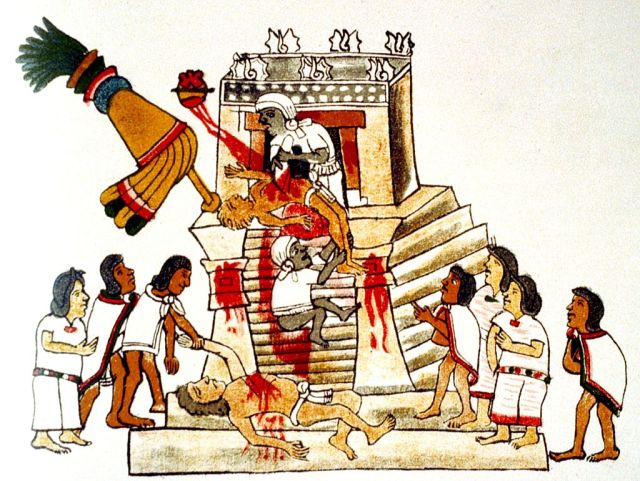
But that’s only one side of the picture. The Aztec deity Huitzilopochtli required nothing less than human sacrifice to keep distributing his rays. If he wasn’t charging about the heavens then he was down in the gunk and blood of battle, possessing Aztec warriors. His worshippers would take live captives so that they could sacrifice them afterwards.
It might not have been Huitzilopochtli’s doing, but a few weeks ago, Arthur’s Seat, the hill overlooking Edinburgh, caught fire. It was an apocalyptic sight. Were Arthur and his men about to erupt out of the turf and bring our squabbling nation to some kind of equilibrium? In truth, characters associated with the sun are rarely known for sagacity. They are usually hotheads.
Take Samson, whose name means Son of the Sun. He’s a judge — think a chief rather than a fellow with wig and gavel — of Israel at a moment when they have almost entirely lost touch with the best of themselves. In many ways, he represents the profundity of their lostness. He’s best known for his huge bursts of strength and his huge erotic appetite. He has a little of the Trickster about him, sometimes dispensing odd riddles before his next massacre, or making the odd quip as he holds aloft the donkey jawbone with which he slew 1,000 Philistines.
As a sun-associated figure, Samson doesn’t have a lot of obvious nuance. You probably remember Delilah, the woman who coaxed from him the secret of his strength: his long hair. Long hair has been perceived the world over as connected to both strength and the sun. The seven locks that are cut from Samson in the encounter with Delilah are often read as the seven rays of the sun.
The sun at midday, particularly today, reminds me of Samson: unrelenting. It’s a kind of strength that can incinerate but is also of tremendous power. Samson seems to arise from the lineage of the Sumerian wild man Gilgamesh, and there was a burst of comparative mythological work on him as a kind of solar deity in the late 19th and early 20th centuries. The village Beth Shemesh, which is referred to frequently in Samson’s story, owes its name to a “temple of the sun”. Like Heracles, Samson slew a lion with his bare hands, tore down the gates of a city, and was betrayed by a woman. It’s been argued that Delilah is Hebrew wordplay on “Layla”, which means night. With his capture, and his subsequent blinding, she functions as night.
In Christian thought there’s a distinction given between gifts from the Spirit and fruit of the Spirit. The gift is Samson’s tremendous strength, the fruit is what he does with it. Sun characters often have great charisma in stories, but there’s a lack of charity in what may grow from such talent.
As so often in myth, this apparent excess is part of a wider balance. In fairy tales, for example, there’s attention to three colours, red, black, and white. Think of the black of Snow White’s hair, the red of her lips, the white of her cheek. In the past decades both anthropologists and mythologists have made comparisons to the colours representing life stages.
The Red is the oomph of youth, individuation, getting ahead, being visible. It brings heat. It’s about success and causing the appropriate stir to get there. It’s dashing, heated and all about display. At its best, it’s inspirational, and at its worst it is crude and rather ruthless.
The Black is associated with midlife, with decline rather than endless success. The Black is about knowledge of roads not travelled. It means the insight of failure and the educative power of limitation. In mythology, real cultures are defined not by endless growth but a capacity to make a covenant with limit when needed. And the White is eldership. It’s the largesse that enables you to make decisions that benefit your wider community, not just your own ends. It doesn’t abandon the drive of Red and the sobriety of Black, but instead integrates them into something approaching wise choices.
When there’s too much sun, we tend to make overheated decisions. It’s worth looking at our own leaders this week and getting a sense of what colour they are speaking from. Do they need more black, or the expansiveness of the white? Maybe the drive of the red is what’s needed. But too much red leads to burnout, rashness and general chaos. Too much red is endlessly bragging, all hat and no cattle, all sizzle and no steak.
In the old stories, when things start to heat up excessively, you need to get the cool of the black into the mix, or the even-handedness of the white. Heat like this works on the irrational side of our nature, gets us muttering into our beer about the end times. As it happens, “apocalypse”, a Greek word, literally means “to uncover”, a revealing of some sort. And today, as our fractious country smoulders, it feels like the curtains are being ripped down. As a mythologist I’ll be keeping a close eye on the simmering of Arthur’s Seat as well as the hills of St Francis. I’ll hope for the saint’s patient sense of wonder rather than Samson’s jagged flare-ups. When things get hot, cleave to the cool.