




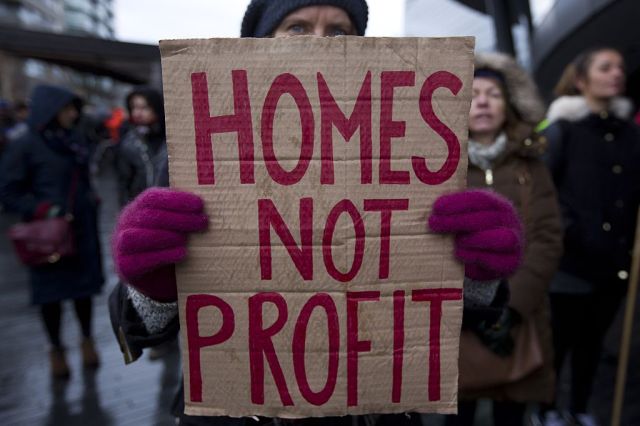
‘Heylo is a cautionary tale in a wider story: the rise of “for-profit” affordable housing providers backed by private capital.’ (Justin Tallis/AFP/Getty Images)





The Design Centre in London’s Chelsea Harbour is an unlikely base from which to operate a social housing empire. It’s an ultra high-end shopping mall for interior design, built in 1987 to cater to the international elite when they fit out their penthouses, hotels, restaurants and superyachts. Soothing piano music plays as I climb a spiral staircase, passing countless showrooms and a giant chandelier, to reach an office on the top floor.
I tell the impeccably polite receptionist that I’m here to speak to Giles Mackay. For the last three months I have been reporting on his affordable housing company, Heylo, which owns and operates 10,100 “shared ownership” homes (a type of affordable housing where you part-buy, part-rent your home from a social landlord) across the UK. Mackay, an entrepreneur who claims to have established 13 businesses, amassed these properties with debt, including at least £52 million of public money and £532 million from private investors. Earlier this year, something spooked the investors and they pulled out of the scheme. Now, Mackay’s portfolio is coming undone — and the cash he owes may not be recovered.
The receptionist’s answer is disappointing, even though it’s the one I expected. “He’s not in,” she says. “He lives in Monaco and comes into the office when his schedule allows.”
The crisis at Heylo has gripped the social housing world since March, when I revealed in Inside Housing that two asset-owning subsidiaries of the business had entered administration. Together these two companies own 3,450 homes, all of which are occupied and are now expected to be sold to new owners by the administrators. Heylo is therefore likely to lose a third of its homes at a stroke — and there is no guarantee they will end up in the hands of another social landlord. Residents have been assured that they will not lose their homes, but the administrators are not required to keep them in the social housing sector, so they could end up sold to a private owner.
Since they provide homes for people on low incomes, a level of responsibility is expected from social housing landlords. If you open your books to officials, and demonstrate good governance and sound finances, you can access the benefits of regulation including government grants to buy new homes. Heylo stretched this principle to breaking point. Mackay bought a dormant social landlord and created an elaborate structure where his homes sat in unregulated investment companies. The result was that Heylo could receive public funds and sidestep scrutiny, all while generating big profits. In its most recently published accounts, for 2023-24, the overarching Heylo Group recorded post-tax profits of £39.4 million. There is an extraordinary contrast between Mackay himself, whose personal life revolved around mansions and raucous parties, and his thousands of lower-middle income residents who now face an uncertain future. (Mackay was also approached for comment for this article by email.)
Although it may be the most extreme example, Heylo is one of a wave of “for-profit” affordable housing landlords in England backed by billions of pounds in private capital. Should ministers be encouraging this? Are big profits compatible with providing social homes? This debate will only intensify as new investors flood in, lured by the government’s new £39 billion grant programme for affordable housing. Heylo’s unravelling is a reminder that however genuine these investors’ social purpose may be, their residents will come second and their returns will come first.
Giles Patrick Cyril Mackay, now aged 64, was born in 1962. He passed the bar aged 21 and quickly moved into structured finance. In 1985 he founded Assettrust, the first in a series of companies that would help businesses such as Ford and Sainsbury’s sell and lease back their properties. In 1999 he founded Hometrack, a property data business which he sold to Zoopla in 2017 for £120 million.
In the last 15 years, newspaper coverage of Mackay has focused just as much on eye-popping stories from his personal life as it has on his businesses. In 2012, a court ruled that he had bullied the contractors building his Chelsea mansion and was ordered to pay £2.3 million. “My middle name is relentless,” he had warned the builders in an email criticising delays and defects. “Guess what, when I have forgotten about you in a year’s time enjoying my £100m home or sailing on one of my 40 metre yachts — you’ll still be trying to wind up some other poor unsuspecting customer with your brand of mediocrity — a sad loser.”
Mackay’s former wife Caroline accused him of not revealing his full wealth following the breakdown of their marriage in 2015. After they divorced, he became notorious for hosting parties at his London home with girlfriends including his now-wife, Yfke Sturm, a Dutch model, with whom he has at least one child.
Those who lived near Mackay called him the “poshest neighbour from hell”. In 2018, he held a Nostradamus-themed end of the world party with flamethrowers, dry ice and a laser light show. He was fined £7,500 for breaching a noise abatement order and accused of “total disregard for his neighbours”. He moved to Monaco in 2023, shortly after selling his Chelsea home to the president of the United Arab Emirates for £65 million.
There is considerable suspicion about Mackay among the senior leaders in the social housing sector I have spoken to. One describes him as “incredibly forthright with his opinions” and always focused on “what’s best for Giles”, although he concedes, with a note of awe, that he is “bloody good with numbers” and was ahead of his time on the importance of housing data and valuations. Another warily called his business model “not vanilla” shared ownership and “more of a DIY product”, with less regulatory oversight and protection for residents. All agree, though, that Heylo’s model is an outlier in the affordable housing landscape and that Mackay is trying to do something different, with a more aggressively “for-profit” structure than other social landlords.
A former associate takes a more sympathetic view. Mackay is a “very intense yet respectful guy”, he tells me, whose “mind works at a thousand miles an hour”. He comes from a “legal, banking perspective” which is the “opposite” of most of the social housing sector, a profession people traditionally enter to make a difference rather than to make big profits. “That alone doesn’t make him a bad guy, but I can see why it would fuel some negativity and concern,” he says. Affordable housing is “the biggest supply and demand opportunity” for a business and Mackay is “creating new supply” when cash-strapped non-profit housing associations aren’t buying new homes. Are Heylo’s residents being exploited? No, he says. They chose to live in their homes and got the chance to own a stake through the business.
Mackay’s involvement in the social housing sector goes back to 2003 when he founded Assettrust Housing, a precursor to Heylo. A 2004 article in The Times captures the pitch: “Let’s give a big hand to the company with a plan for building affordable housing in the most expensive parts of England, without any help from the taxpayer.” Mackay, the article says, “has a genius for creating financial solutions to complex problems”; his social housing venture, we are told, “is not a charitable gesture, but a serious business proposition”.
Like Heylo, Assettrust Housing was focused on shared ownership. The company used private finance from backers such as RBS to buy new-build homes from house builders. It amassed a portfolio of just under 800 homes before its 18 subsidiary companies fell into administration during the 2013-14 financial year. Mackay had got into a dispute with his investors, who appointed the administrators to protect their capital. Following the administrations, in 2014 Assettrust’s homes were sold to a mix of landlords within the affordable housing sector. One-third were sold to Heylo, Mackay’s new company.
Twelve years on, the situation at Heylo is strikingly similar. Once again, it was the lenders who pulled the plug. According to PwC, the Heylo subsidiaries defaulted on their loan terms, which led the investors to conclude that a consensual solution was “no longer achievable”. The same person who did the administration of Assettrust Housing — David Baxendale at PriceWaterhouseCoopers — is now leading the Heylo administrations. (PwC has assured the residents they will not lose their homes and should continue to pay their mortgage and rent as usual.)
Yet the collapse of the Heylo subsidiaries is on a different scale to Assettrust. The two affected Heylo companies owe £532 million to BlackRock, the giant US asset manager, and two pension funds, Phoenix Life and the Universities Superannuation Scheme. There is another crucial difference: the two Heylo companies owe a total of £52 million to Homes England, the government’s housing agency. This cash was granted to Heylo between 2018 and 2022 to help purchase its homes. Public grant for shared ownership housing is typically repayable once residents have “staircased” up to buy full ownership of their home, but it will be lost if a buyer is not willing to pay a sufficient price for Heylo’s homes.
Attention is now turning to the value of the 3,450 homes hanging in the balance. The administrators have appointed an independent valuer to estimate how much the homes are worth, and therefore how much the companies’ creditors will be repaid. According to Heylo’s own estimate, its homes were worth enough to repay both companies’ debts in full. PwC’s estimation may differ. But valuations are only a guide, and how much the creditors — including the taxpayer — will receive back will be decided by the ultimate buyer of the homes and how much it is willing to pay.
What are the lessons from all this? First, regulators were powerless to stop the Heylo crack-up. England’s Regulator of Social Housing (RSH) has expressed reservations about Mackay’s model for years. Assettrust had tried to use a registered social landlord to access the benefits of regulation, including bidding for public money, but was rebuffed by the regulator, which criticised its governance and viability. However, under a deregulation package introduced by the government in 2017, Heylo was able to buy an existing registered provider and attach it to its investment structure — bypassing the need to go through a registration process. Eventually, in 2022, the regulator deemed Heylo’s registered provider non-compliant, warning it did not sufficiently safeguard its social housing assets. But regulators never had oversight of the wider Heylo Group, or the investment companies that actually own the homes public money paid for.
A spokesperson for the RSH says: “This case reinforces the importance of meeting debt obligations. It also shows the importance of landlords having robust risk management arrangements and control over the social housing they provide. It highlights the need to follow our full registration process, rather than acquiring an existing provider, so we can identify potential issues with a landlord’s business arrangements at the outset.”
Second, Heylo is a cautionary tale in a wider story: the rise of “for-profit” affordable housing providers backed by private capital. Since 2008, successive governments in England have encouraged investors to enter the social housing sector on the basis that public money alone will not be enough to address the huge demand for affordable homes. There are now 85 for-profit registered providers, backed variously by high-octane private equity such as Blackstone and more “patient capital” such as local government pension funds. They own just 1.6% of England’s total affordable housing stock, but were responsible for 13% of new completions last year. Heylo may be unique or it may be a harbinger of things to come. Either way, its size — it completed 804 homes in 2024-25, making it England’s third-fastest growing for-profit provider — means it cannot be ignored.
The RSH says it does not have a problem with for-profit providers per se; it points out that it has awarded other large for-profit providers owned and operated by Legal & General, Universities Superannuation Scheme and M&G top marks. These companies are not charities. To me, at least, profit is not in and of itself a bad thing; but what is crucial is how for-profits are structured, and where their profits flow. In the case of L&G, for example, an affordable housing investment structure is enriching thousands of pension policyholders. In Heylo’s case, the structure is set up to enrich one enormously wealthy man.
“The team at Heylo Housing is working closely with the administrators, and our customers remain our top priority to ensure a smooth and orderly transition,” Heylo said in its original statement on the announcement of the administrations last month. “As this is an ongoing matter, we are unable to comment further at this stage.”
Mackay will be alright: relentless is his middle name, after all. But his story should be studied closely before the government opens the door to more state-backed super-rich social landlords. If you mix social housing with profit-chasing, the biggest winners could be the ones in Monaco and Chelsea Harbour.
