




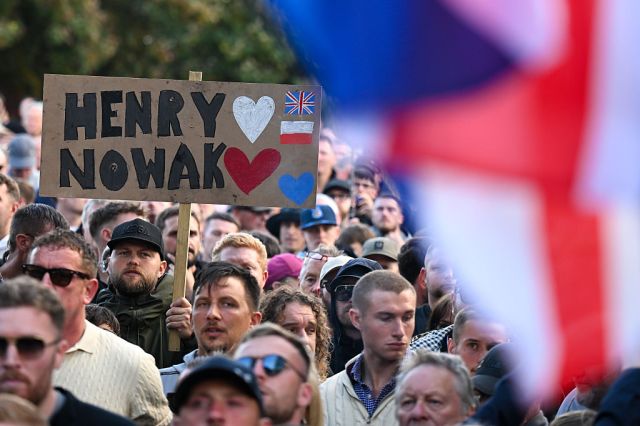
‘If politicians say Polish people are taking our jobs and eating swans then we’re going to be in trouble again.’ (Finnbarr Webster/Getty)





Rafał came to England for an easy life. He was in his late twenties, his parents had just died, and he had little to keep him in Poland. So when his sister suggested he join her, he upped sticks from Kielce, an elegant old town not far from Kraków. His first port of call was Great Yarmouth. It was 2007, three years since the European Union had expanded to the east, granting the right to live and work in the UK to millions more people.
For the first few months, Rafał worked at a strawberry farm on eastern England’s great, flat plain. I assume this was tough labour, out in the sun and the wind and the rain, bent over in a field doing the work the English did not want to do at wages they would not accept. But Rafał, a compact 46-year-old with greying hair, is flippant. He did not find it difficult. It was an easy life. And besides, he was making money. Soon, he had new clothes, a new suit. “I had too much money,” he grins, holding his hands apart to indicate a thick wad of cash. In Poland, an hour’s work would get him two litres of fuel, but here he could buy eight or nine. Rafał had arrived in an East Anglian El Dorado.
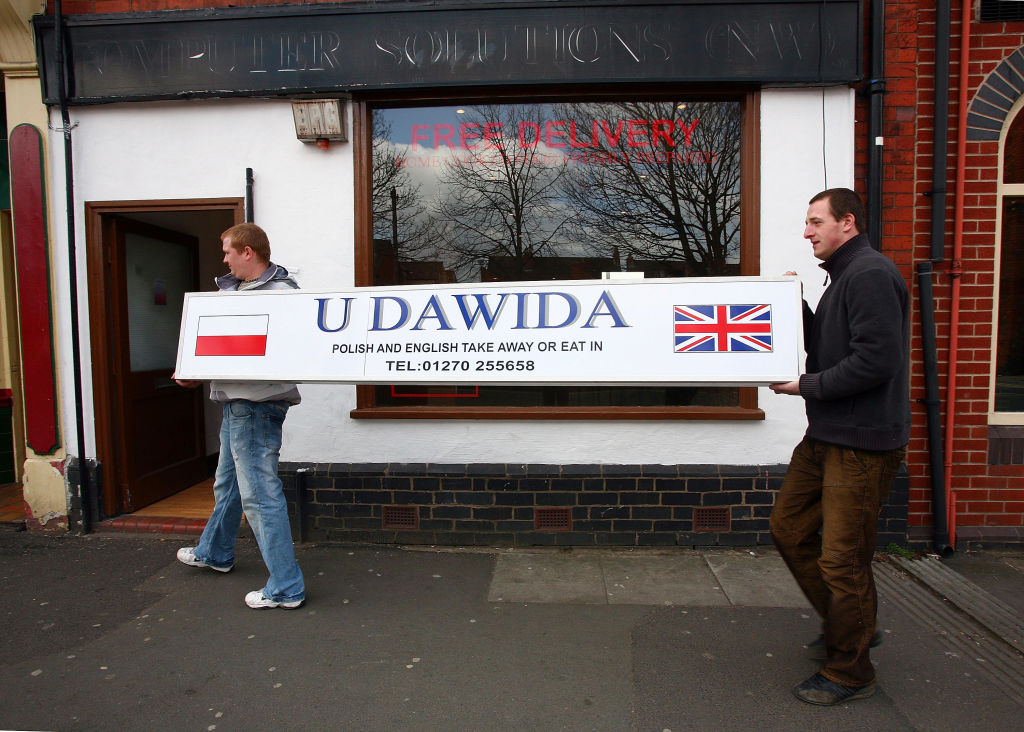
We are speaking on the pavement outside a Polish supermarket in one of Peterborough’s less salubrious districts, its streets tucked behind the train station. Almost 20 years ago, this was, the Daily Mail proclaimed, “the town the Poles took over”. “This has happened so quickly,” a pub landlord told the paper. “Two and a half years ago this was a lovely place to live. People would talk to each other in the street, shout good morning or visit each other for tea. Now the old people are scared to walk out at night.” It is clear, looking around, that the demographics of this corner of Peterborough have changed — and are changing again. I walk past an Eastern European shop advertising goods from Romania, Ukraine, and Lithuania, but it is closed and clearly has been for some time. Another European shop now advertises fresh dosas. Palestine flags flop from nearby windows. New cycles of migration are being fitted over the old, compounding like the layers of a Roman road.
Observing the shift, Rafał’s attitude has begun to mirror that of the pub landlord two decades before. “Sometimes black people ask me for spare change,” he says. “I say ‘go and work’.” His girlfriend is often scared to walk to the shops on her own at night. But he is not bothered. He is not a conflict guy. Recently, though, Rafał has seen something more concerning via Polish language media. An 18-year-old British-Polish man, Henry Nowak, bleeding to death on a Southampton street, as he begs impassive officers for help. According to the latest census, 4% of Southampton is Polish. When protesters rallied following the conviction of Nowak’s killer, they were joined by members of the Polish community.
Video footage of the demonstration shot by AY Audits, an anti-migrant influencer, shows a group of ruddy Polish men in sports gear facing off against a line of police. One clutches a tin of beer in his hand. The Poles chant in their own language before the Englishmen around them begin shouting “wanker”, and then the two sets of voices merge. “The Poles are some people,” added a viewer on X later. “Give them a few cans of Tyskie and they’d go to war with us.”
Poles began moving to Britain in any real numbers during the Second World War. The arrivals were largely male and often keen to turn around and fight their occupiers. By 1951, Britain was hosting more than 160,000 Polish refugees; most wished they could return home.
Those that came from 2004 onwards were different. Like Rafał, they had been drawn by the promise of higher wages and the chance to escape a brutal post-communist transition. And while other European nations put restrictions in place to limit migration from Eastern Europe, No. 10 did not. In the decade to 2014, the number of Poles in Britain rose from 69,000 to around 853,000.
Ten years after Brexit, the Poles demonstrating in Southampton reveal how far Britain’s migration politics have shifted. Quizzed in 2015, Nigel Farage said that he preferred immigrants from India than Poland. It was wrong to have a system that discriminated in favour of Europeans, and against those from the subcontinent, he told LBC the year before. Appearing on BBC 3, a youthful Tommy Robinson claimed that all migration from Poland should be blocked. Buttonholed this year by a Polish YouTuber, he insisted the opposite. “I love the Polish immigrants,” he said. “I’m for them.”
Perhaps there was always an element of cynicism. It is harder for your opponents to accuse you of racism if you argue that white immigrants are a greater problem than non-whites. But anti-Polish, anti-Eastern European sentiment went far broader. Polish migrants, the press alleged, were pillaging swans and fish from the rivers. The “Polish baby boom” would, we were told, lead to schools and the NHS being overwhelmed.
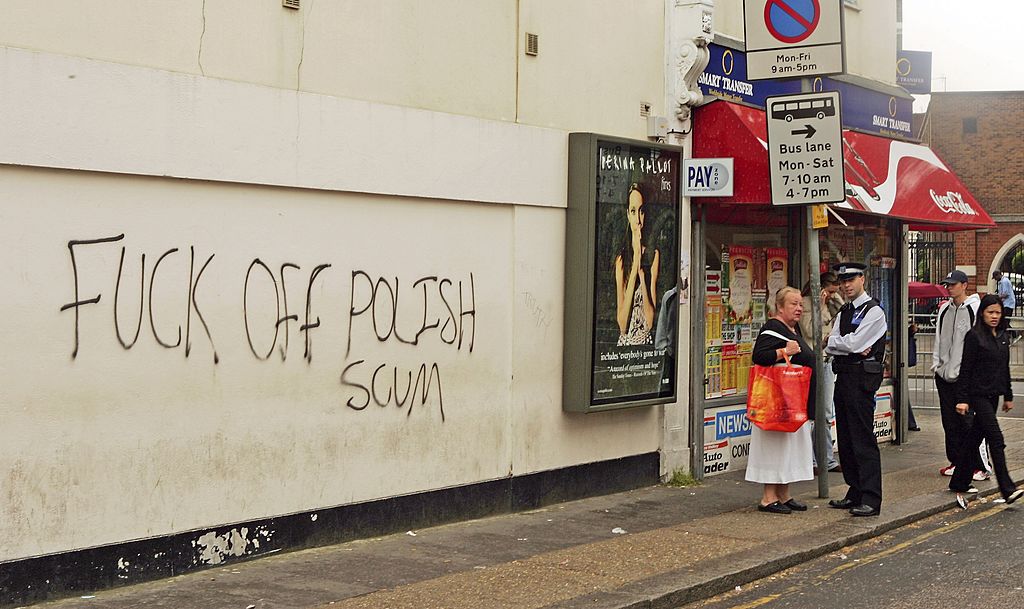
In 2015, Polish workers went on strike and gave blood to push back. George Byczynski, who organised the donation drive, told the press a compatriot in Kent had been subjected to an arson attack and graffiti telling him to “go home”. “There is an issue,” he said, “with the language politicians use and sometimes they do scapegoat Polish people.” After Brexit, though, bigotry truly exploded. “It was an extremely stressful time,” remembers Tomasz Wisniewski, a Worcester businessman and community activist. “I remember Polish shops being attacked, people on the street being attacked, children at school being attacked.” In one instance, a mother was beaten on her way home from picking up her kids. “I still have the pictures on my phone,” Wisniewski tells me. “You can see blood on their faces. I will never forget it.”
For Wisniewski, the disregard for people who had spent years working in Britain was reminiscent of the way in which the Government had appeased Stalin by failing to invite Polish troops to a victory parade held after the Second World War. Many Poles, he says, made this comparison to him in 2016. He believes he only avoided discrimination himself because he always makes sure to wear a suit. As he puts it: “I noted that people respect other people in suits in the UK.”
As Rafał’s Peterborough implies, the demographic mix of migrants to Britain has shifted once more. Free movement for Europeans ended; entry barriers for workers and students around the world were lowered. As a result, around 4.2 million people entered the country legally between 2021 and 2024. At the same time, tens of thousands began arriving yearly by small boat.
The idea that the British state is practising anti-white discrimination has meanwhile become central to Right-wing politics. Writing earlier this month on Substack, Nigel Farage argued that there is “nothing fair” about the way “White people” (his capital “W”) have been treated by successive governments. (Had he taken power in 2015, it might be noted, he would presumably have contributed to such discrimination by favouring Indian over Polish migrants.)
Acknowledging that the white British share of the population is due, in time, to become a minority, Farage appears to be positioning Reform UK as the white identity party for a balkanised nation. “Without a voice to speak up for [White Brits],” he concluded, “the future will be manifestly unjust.” The sight of Southampton’s Poles confronting the police alongside furious, anti-migrant Britons might therefore be read as a sign of their assimilation.
“So you had a Portuguese wave, you had a Lithuanian wave, you had a Polish wave and then you had Bulgarian wave and Romanian wave,” says Iga Paczkowska. “So now we are good foreigners. The other foreigners are bad, but we are good foreigners. ‘We don’t like foreigners, but we like Polish.’ This is something I heard so much, so many times.”
We are sitting in her office in the centre of Boston, once the locus of Polish migration to the UK. When the 2011 census was taken, this rural, Lincolnshire town had the highest population of Eastern Europeans anywhere in the country. Workers had made a beeline for the place, taking jobs in agriculture and food production and transforming the area. In response, Boston registered the highest Brexit vote in Britain. Three quarters of residents voted to Leave.
Paczkowska had thought it was impossible that Remain would not win. “For us, it was so ridiculous that it was unbelievable,” she says. Earlier in 2016, she had set up a business, Lincs-EU, that would help Polish migrants fill out paperwork and settle into Britain. A decade on, she is still busy, but far less than she would have been had we remained. Boston, which even for a provincial English town seems to have a high rate of shuttered shops, has declined since, she thinks. “It changed, here you are. But definitely not for the better.”
Like other British-Poles I speak to, Paczkowska is cynical about the attempt by some on the Right to defend Henry Nowak. Farage should be told about his preference for Indians over Poles, she says. “Let’s remind him that he doesn’t want to live next to Eastern Europeans.”
The apparent co-option of Poles into a coalition against anti-white discrimination does not reassure her either. “I think that Farage is a great politician,” she says. “But this is the person who, in my opinion, is as stable as a gummy bear. Whatever way the wind is blowing he’s going to go. He’s just using Henry’s death for his agenda. He sees the opportunities to campaign and that’s what he does.”
Though she opposes Farage, Paczkowska is not uncritical of Britain’s immigration regime. A jump in Romanian migrants to Boston after Brexit has caused new social fissures, she says. “They are more loud, more noticeable. They are shouting, they are dancing. They are playing music on the street, they are playing bowl on the street, they are playing soccer.”
Other British-Poles are paid up supporters of Reform UK, such as Adam Mitula, who served as the party’s interim campaign manager for the Gorton and Denton by-election until he was suspended over racist comments on social media. “Henry Nowak is half Polish. His dad is Polish. He could have been my son,” he wrote on Facebook after the trial of the teenager’s killer concluded. “I don’t want illegal immigrants in Europe,” Mitula added. “I don’t care. I don’t want foreign criminals in Europe. I don’t care.”
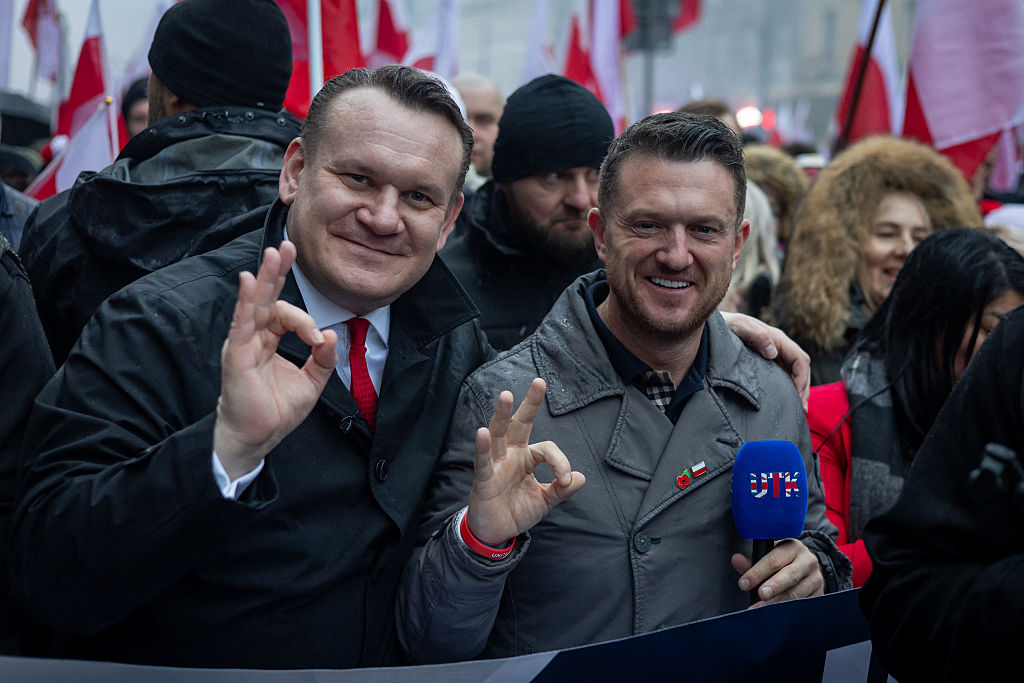
Given that Poland has repeatedly elected governments opposed to mass migration and asylum, this is perhaps unsurprising. For many on the Right, the central European nation is an inspiration. Robinson, now all in favour of Polish migrants, has attended a Warsaw nationalist march. He counts Dominik Tarczyński — famous for his boast that Poland would not admit one illegal Muslim migrant — as a friend; the Law and Justice MEP would have spoken at the latest Unite The Kingdom protest had Sir Keir Starmer not banned him from Britain.
In many ways, we are a long way from 2016. Over the last decade, Poles have climbed the economic ladder. They are far less likely to work on a factory floor, far more likely to speak English, and many, like Nowak, are slipping into the native population, identifiable only by an unfamiliar surname. As Britain’s migration debate becomes more sharply racialised and as white identity politics rises, they may yet be assimilated further.
When I ask Wisniewski if he now feels secure in Britain, he tells me it is still unclear. “What will happen in the future, it depends on the political mood,” he says. “If politicians say Polish people are taking our jobs and eating swans then we’re going to be in trouble again.”
