




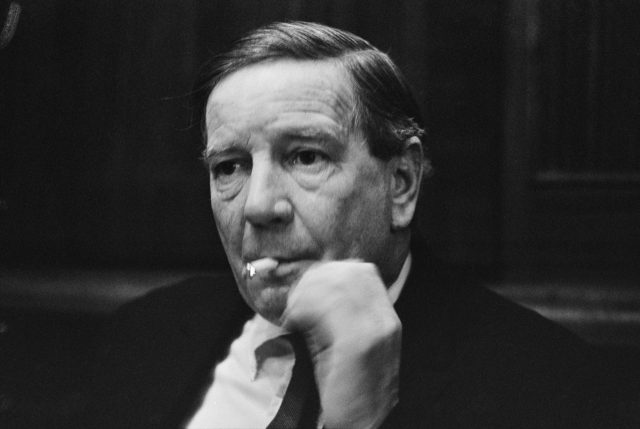





Who would have thought that Friedrich Nietzsche’s concept of the Übermensch would find one of its most remarkable manifestations not among the “blond beasts” of Adolf Hitler’s Aryan fantasies, but in a handful of effete yet determined young British men, all of whom were educated at the University of Cambridge in the late Twenties and early Thirties. What marked them out, and still marks them out, is their repudiation of the pieties of their time and place in favour of a harsh and uncompromising creed, spawned in the East, the aim of which was to destroy the society of the West into which they were born.
The Cambridge Five, as they are known — Kim Philby, Anthony Blunt, Guy Burgess, Donald Maclean and John Cairncross — continue to fascinate and baffle us, though the world in which they lived, and which they betrayed, has utterly vanished. Mind you, it is notable in this context that in Enemies Within (2018), Richard Davenport-Hines sees a continuing, direct link between the treachery of the Five and British politics right down to our own day. He writes:
“The undermining of authority, the rejection of expertise, the suspicion of educational advantages, and the use of the words ‘elite’ and ‘Establishment’ as derogatory epithets transformed the social and political temper of Britain. The long-term results of the Burgess and Maclean defection reached their apotheosis when joined with other forces in the referendum vote for Brexit on 23 June 2016.”
These men were born into privilege, to a greater or lesser degree; they had money, education, social status; they drank, they caroused, and in a puritan age they had sex galore; and if to disapproving eyes they might have seemed frivolous, they had in secret a core of steely resolution, thanks to an unfaltering allegiance to their Marxist-Leninist convictions. They were, to their own eyes, the loftiest among men.
And theirs was a man’s world. As Davenport-Hines writes, “Masculine loyalties rather than class affinities are the key that unlocks the closed secrets of communist espionage in Britain. The jokes between men — the unifying management of male personnel of all classes by the device of humour — was indispensable to engendering such loyalty. Laughing at the same jokes is one of the tightest forms of conformity.” It is also a way of excluding women from the serious business in which men must engage. This is no small point. The contempt shown by Philby and his fellow-conspirators towards the institutions that employed and indeed prized them has a dismayingly male cast to it. Needless to say, to a man, they treated women abominably.
The most famous of the Five, and probably the one who caused the most wide-ranging harm to the security of the West, was Harold Adrian Russell Philby, nicknamed, with unwitting prescience, Kim, after the eponymous boy-spy in Rudyard Kipling’s novel. His father was St John Philby, an Arabist and a cad, who started out as a socialist but later on had some questionable dealings with the Nazis, including Adolf Eichmann. Kim Philby began his career in journalism, but went on to join British intelligence, where he flourished as a spymaster, while at the same time passing reams of secret material to the Soviet Union, which he continued to do, with extraordinary success, from the Thirties until his defection to Russia in 1963. Antonia Senior, author of the recently published Stalin’s Apostles, a magnificent and surely definitive history of the dark doings of the Cambridge Five, observes that “Two of Philby’s greatest talents were lying and camouflage”.
But then, the ability to tell plausible lies, to lie in plain sight, so to say, is a prerequisite for all undercover agents. What marks Philby, and to an even greater extent Anthony Blunt, as special cases, is how coolly they kept their heads while others around them were losing theirs. Philby brazened it out to the very end, while Blunt, the effete son of a Church of England clergyman, was the rock to which the others would cling, seeking shelter in times of storm and crisis.
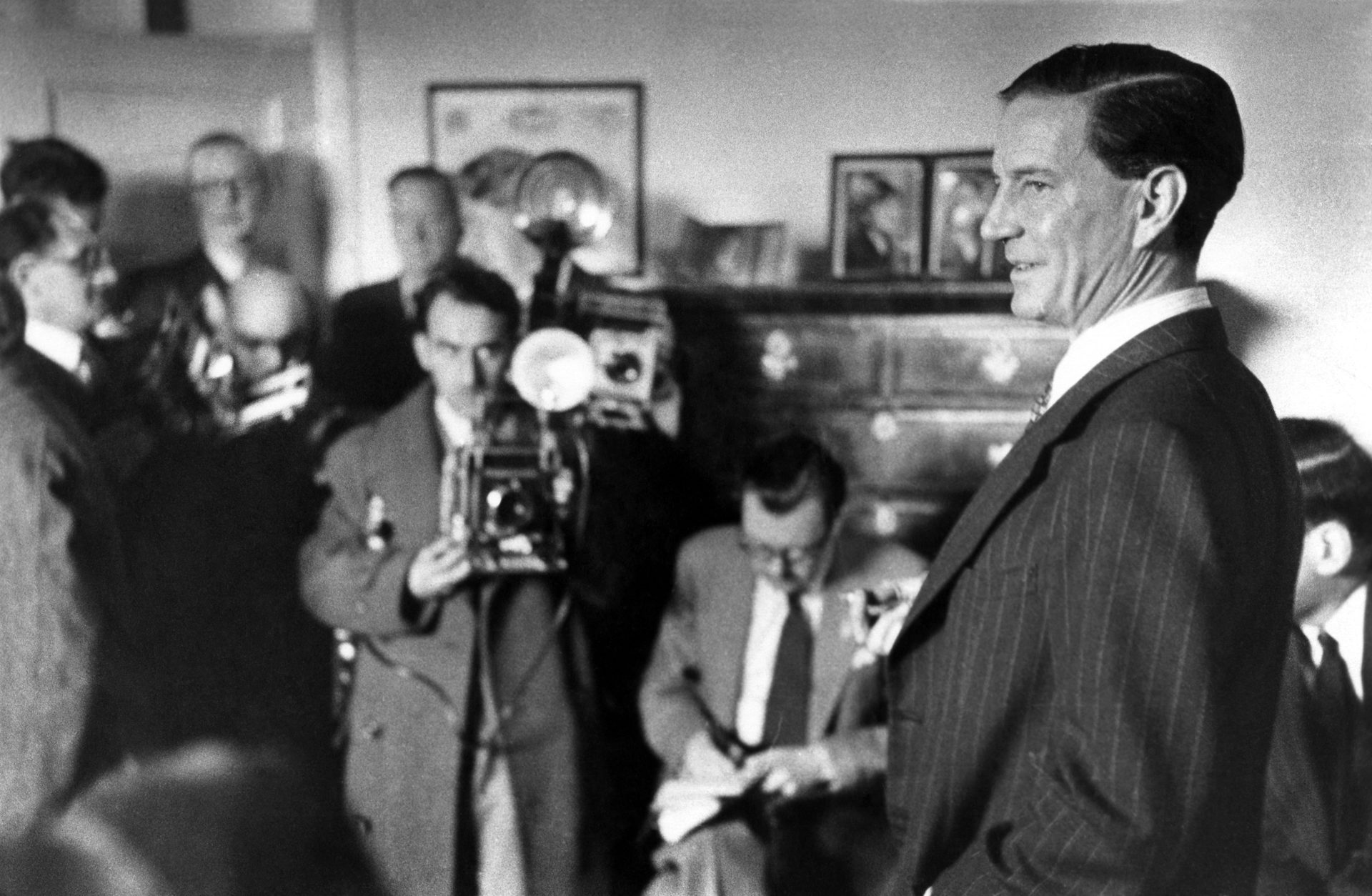
The pressure under which the spies lived and operated would have called not only for superhuman fortitude, but also for unfailing sangfroid and an effortless insouciance. In the wake of the defection of Burgess and Maclean, and the lingering suspicions swirling about the heads of those who had been intimate with them, Philby called a press conference at his flat in 1955, not only for print journalists but Pathé News cameramen as well. Prime Minister Harold Macmillan had told Parliament that Philby was not a spy, and as one watches Kim’s performance in that old newsreel, one cannot but be impressed by the amused impishness with which he carries off the charade.
And yet: look more closely, and there is detectable in the traitor’s eye a lurking glint of the terror of being found out.
They all had a wobble, sooner or later. In Master of Lies, his new book on Blunt, Piers Blofeld recounts an anecdote that already appeared in Miranda Carter’s masterly biography, Anthony Blunt: His Lives (2001). Coming away from a party one night in the mid-Fifties, the novelist Rosamond Lehmann shared a taxi with Blunt, who suddenly lost control and burst into tears. This is Blofeld:
“‘I am very, very sorry, Rosamond,’ he said to her. ‘Can you ever forgive me?’ When she asked why, Blunt just shook his head, as if it was all too much for him. She found the whole thing very staged and insincere — as well as plain baffling: forgive him for what?”
What is most striking in this incident, and it is not in Miranda Carter’s version of it, is the suggestion that Lehman found Blunt’s fit of weeping “very staged and insincere”. It is as if the old deceiver, even in extremis, could not but put on an act.
Both Blofeld and Senior have mined into a cache of MI5 files released in 2025, and some of the material they have turned up only adds to the shock of what was already a shameful history of deceit and betrayal. It positively chills the blood to read, in Blofeld, that under the Nazi-Soviet pact, “Blunt had been directing the Luftwaffe to British targets during the Blitz and was responsible for the deaths of thousands of British, American and Commonwealth soldiers as well as the suffering of countless millions more in Eastern Europe”.
Towards the end of the war, Blunt was still passing intelligence to the Nazis, because Stalin’s plan was to advance as far westwards into Europe and seize as much territory as possible before the fighting stopped. “Every day that prolonged the war in the West brought the Russians closer to Berlin from the East,” writes Blofeld.
Horrifying too in Antonia Senior’s book is the story she recounts of the betrayal by Philby of a mission in 1951 to infiltrate the Soviet Union by agents of Western intelligence. A squad of Ukrainian partisans was parachuted into what the author calls the “restless Soviet fringes” between communist Poland and the Soviet Union. Philby was able to monitor the operation from beginning to end, an end which, thanks to him, was bloody in the extreme.
He scotched a similar anti-communist exercise in Albania, which Senior describes in fascinating if heartbreaking detail. A band of partisans, composed of émigrés, rendezvoused by night in a mountainous area in the Albanian interior with what they assumed was a party of like-minded Cold Warriors. The scene smacks of le Carré or Len Deighton:
“Both sides called out the pass phrase: ‘Death to the Bloody Communism’. Tomori [one of the reception party] identified the leader of the other group. ‘A well-dressed young man stood out, wearing an English-style coat draped over his shoulders. He carried a cane, a watch, and a shiny ring, and was armed with a revolver and the latest Italian automatic weapon, specifically crafted for agents of his kind.”
As one might expect, it was a trap; while the émigrés were backed by British and American intelligence agencies, Tomori and his men were committed communists. “There were gunshots and confusion in the darkness,” Senior writes. “One escaped, three were taken, and the local intermediary was shot in the head.” Years later, Philby, who had helped set the trap for the émigrés, wrote dismissively of them in his autobiography, “we Anglo-Saxons never forgot that these agents were just down from the trees”.
Among the Cambridge Five, the one who wrought the most serious damage, and who was himself perhaps the most seriously damaged by his clandestine work, was Donald Maclean. He also seems to have been the most deeply committed to the Marxist cause. When, after his exposure, Blunt was asked why he had done what he did, he shrugged and said, “Cowboys and Indians”. For Maclean, however, there was nothing playful about his intentions, or his actions. It was he, along with his fellow agents Klaus Fuchs and Allan Nunn May, who speeded up Russia’s development of the atomic bomb by at least a few vital, Cold War years.
Maclean was the son of a Liberal MP whose constituency was on the Scottish borders. At Cambridge, young Maclean read Modern Languages, and dabbled in Left-wing politics. In his final year, 1934, he was recruited for the Russians by the shadowy but ever resourceful Arnold Deutsch, a Soviet agent who had already brought Philby into the Cambridge circle. Deutsch was undoubtedly good at spotting potential spies, but if his judgement of Philby is anything to go by — “It is difficult for him to tell lies” — he was a dud when it came to character.
Once recruited, Maclean was instructed to get himself taken on by the Diplomatic Service, which he did with ease. At the final interview for the job, he earnestly repudiated his student Left-wing tendencies, which prompted the members of the board to exchange benevolent smiles. The league of gentlemen had welcomed another “one of us” into its ranks.
Maclean worked first in the Foreign Office in London, and then at the British Embassy in Paris. However, it was in Washington, where he served from 1944 to 1948, that he provided the richest material to his masters in Moscow. Thanks to him, the Russians were kept thoroughly up to date on every step of the West’s development of nuclear weapons.
The Cambridge spy ring was soaked in alcohol, which seems to have been the only way the five could keep at bay the unremitting fear of being unmasked. Maclean was a violent drunkard; in one gin-fuelled rampage he almost strangled his wife.
The biggest boozer of them all, though, was Guy Burgess. Scion of a wealthy family of Huguenot origins, Guy was as black as a sheep could get. A promiscuous homosexual, he would make a pass at any passing male, however perilous the circumstances. After Eton, where he shone, he went on to Trinity College Cambridge, and there he met Anthony Blunt; the two were possibly lovers, and certainly remained close right up to the day of Burgess’s flight to Moscow, in 1951. Philby had recognised Burgess’s potential, and recommended him to Arnold Deutsch, who recruited him and gave him the surely unintentionally apt codename, “Mädchen”.
After Cambridge, Burgess worked for the BBC’s Talks Department, where he brought in such twinkling lights as the poet John Betjeman, the arch-gossip Harold Nicolson, his old flame Blunt, and Kim Philby’s father. So all was cosy as usual, over at Auntie’s. It was partly his experience in broadcasting that led to Burgess’s recruitment into MI6, where he was able to harvest bales of fodder on Establishment thinking and planning, and rolled them on to Moscow.
By the mid-Forties, Burgess was embedded, if that is the word, at the British embassy in Washington, where the top-secret pickings were far richer than at the BBC or even in MI6. It is at this point that the mind becomes thoroughly boggled. As the Cold War warmed up, there were at the heart of the American intelligence establishment three clever, extremely determined and utterly ruthless Englishmen, all of whom were spying, busily and productively, for the Soviet Union.
However, the ring was starting to unravel. The Americans had set up a counterintelligence programme, codenamed Venona, with the aim of identifying a Russian spy known to his handlers as “Homer”. Much of the accumulating evidence pointed to Maclean as the culprit. Meanwhile Burgess was disgracing himself by getting repeatedly and noisily drunk in Washington’s bars, hotels and political salons, careering from one watering hole to the next in his open-topped Cadillac — in a single day he managed to collect three speeding tickets — and in general scandalising the nation’s notably strait-laced capital.
In May 1951, he returned to England, where he and Blunt began making arrangements to get Maclean safely off to Moscow, before the Americans had gathered enough incriminating material to unmask him as Homer. The abiding puzzle is that Burgess was supposed to accompany Maclean only part of the way — the route was through France and Switzerland to Prague and then on to Moscow — yet in the end they both ended up in the Russian capital. It is possible that Burgess thought he could deliver Maclean into the hands of his communist hosts and then return home as if nothing had happened; the notion is almost endearing.
And what of the Fourth Man, as he was called, before Blunt was outed as the Fifth? John Cairncross was in fact the odd man out. He was Scottish, for a start, and, as the son of the manager of an ironmongery, decidedly non-U. Not that the others were quite as posh as they would have liked to be; in Enemies Within, Davenport-Hines neatly defines them as of the “mezzanine class”, neither aristo nor middling, but something in between.
Cairncross did not even get to that floor. Though he was a dedicated and highly dangerous agent, he somehow never fails to raise a smile. He is like the inveterate straggler in a hen party, slightly forlorn, slightly dowdy, and more than slightly resentful. According to Stella Rimington, former head of MI5, he was the only one of the Cambridge Five who was motivated by money. He was finally exposed as a spy in 1981, but the authorities did not bother to prosecute him, seeming to prefer that he would just go away. They probably thought of him as did Philby’s sister, when she wrote in a letter to him in Moscow, “We’ve had just about as much as we can take for the moment.”
Why did they do it? Nothing, not even Cairncross’s avarice, seems to account for the vigour, ingenuity and singlemindedness with which they pursued their aims — that is, if they even knew what those aims were. It is unlikely that they read Marx at all deeply, nor did any of “Stalin’s Apostles” have any illusions about the Soviet paradise awaiting them should they be forced to cut and run. All three defectors, whatever good face they might put on it, detested life in Russia; while Blunt, urged by one of his handlers to make the great leap over the wall to Moscow, enquired bitterly if, once settled there, he would be guaranteed access to the Louvre.
Many books have been written on the Cambridge Five, and much speculation has been made about their characters and their motives. We began by invoking Nietzsche’s figure of the iron-willed Over-man, spurner of mundane, middle-class values, and certainly the Five considered themselves to be, as the title of one of Nietzsche’s books has it, “beyond good and evil”. However, even Nietzsche, had he stopped to consider, would have realised that beyond good and evil, as beyond Heaven and Hell, there is only Limbo — which is exactly where the Cambridge Five ended up.
So we ask again, why did they do it? Perhaps the matter is far simpler than the Nietzschean model would suggest; indeed, perhaps it is more accurately expressed by Aristotle, the philosopher of the mundane, when he observes that the man with a secret is the man possessed of power. And as we know, nothing, not even Georgian champagne, intoxicates more thoroughly than a draught of that heady brew.