




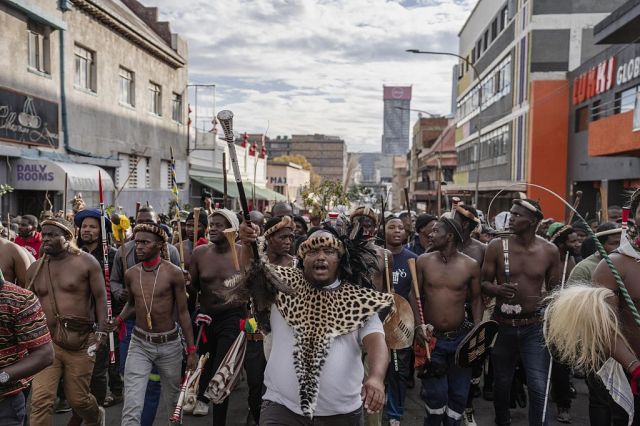
Demonstrators have worn traditional Zulu attire. (Ihsaan Haffejee/Anadolu via Getty Images)





As Britain reacted to an eruption of anti-migrant violence in Belfast earlier this month, seeing images of burnt-out terraced housing and hearing accounts of African nurses apprehended at checkpoints, a parallel story was unfolding 6,000 miles away, albeit on a much larger scale. In the Sherwood suburb of Durban, South Africa, some five-dozen immigrants from Malawi were taking refuge in a field beside a mosque, having been chased from their homes by protesters demanding they leave the country.
That field now contains around 10,000 terrified migrants from various African countries, living in makeshift tents and hoping to find a safe route out of South Africa. After false rumours claimed that they were being given accommodation rather than deported, the camp last week came under attack from rioters, who had to be dispersed with rubber bullets.
Similar scenes have been unfolding across South Africa, where a grassroots campaign to evict and intimidate illegal immigrants has gathered steam since early May. Displaced foreigners — some of whom say they are in the country legally — have taken to huddling in large groups outside police stations and churches, or hiding in the bush and on remote mountainsides. Homes have been torched and businesses looted. Vigilantes have gone from door to door demanding papers. The protests are loosely fronted by groups such as March and March, led by the former radio presenter Jacinta Ngobese-Zuma, and Operation Dudula, which has previously tried to obstruct illegal immigrants from accessing healthcare and schooling. The Zulu activist Nkosikhona Ndabandaba, who has more than 1.5 million Facebook followers, has donned traditional tribal garb to lead large crowds through the street.
The riots have so far left at least two dead — though the Malawian government claims the real number is five — while prompting other African countries, including Nigeria and Ghana, to evacuate hundreds of their citizens. In terms of death and destruction, the current unrest has yet to match some earlier waves of anti-immigrant violence, which have erupted periodically since 2008. Ominously, though, the vigilantes have declared a 30 June deadline for illegal migrants to leave South Africa. What they will do after that date is unclear.
In the past, Britain could look at such events with detached incomprehension, but it no longer has that luxury, given the incipient unravelling of its own multicultural regime. The riots in Belfast, where a Sudanese asylum seeker stands accused of a brutal knife attack, came on the heels of a furious response to the police’s handling of Henry Nowak’s murder by a young Sikh man, and against a backdrop of violent intimidation of British Muslims. Notwithstanding Andy Burnham’s opportunity to change the country’s mood following his victory in Makerfield — that mood became notably worse, after all, with the beginning of Keir Starmer’s ill-fated leadership in the summer of 2024 — there is a grim sense that it is only a matter of time until the next inciting incident turns the ratchet of civil strife a notch further.
Three years ago, when I argued in UnHerd that Britain was beginning to resemble South Africa in its institutional dysfunction and loss of social trust, I made an exception for ethnic tensions. “One only has to look at the frequent anti-immigrant pogroms in South African townships to see that, for all the anxieties over integration, British society remains a relative picture of harmony,” I wrote. Depressingly, the distinction no longer seems as obvious as it did.
Commentary and debate surrounding the unrest in South Africa — which are generally described as “xenophobic” or “Afrophobic”, in light of the protestors and their targets both coming from black communities — has been uncannily similar to the recent discourse in Britain. In a speech on 7 June, president Cyril Ramaphosa attempted to walk the same tightrope as mainstream Labour and Conservative politicians in Britain, signalling attentiveness to popular grievances over immigration and crime, while portraying the aggressive expression of those grievances as alien to the nation’s values. Ramaphosa spoke of the “legitimate concerns” of South Africans being hijacked by “forces” seeking to “further their own personal, political, or criminal agendas”; he denounced “social media campaigns that spread misinformation, fake news and lies”; he emphasised the country’s legal obligations to refugees, and stated that immigration “is the reason for our diversity and contributes to our vibrancy”. At the same time, he announced measures to crack down on illegal migration and the illegal employment of migrant workers.
Ramaphosa has to attempt this balance because in South Africa, as in Britain, populist movements have sought to harness anti-immigration sentiments as a way of peeling off support from his African National Congress (ANC) party. With municipal elections taking place later this year, uMkhonto we Sizwe, the breakaway party led by former ANC president Jacob Zuma, and Action SA, a Johannesburg-based party that supports mass deportations, have both expressed sympathy for the protestors. Their relationship between these parties and the groups orchestrating the protests is opaque, but a source familiar with the political landscape in South Africa tells me that they are widely believed to be “connected somehow”. On the ground, meanwhile, interviews with anti-immigrant protesters in South Africa produce similar responses as those with disgruntled Brits on the high streets of market towns. They talk about pressure on public services and housing, a lack of jobs, and crime.
Obviously the differences between Britain and South Africa remain vast, and immigration is no exception. Most South Africans live with a degree of poverty still unknown to Britain, and the conditions in which they must accommodate newcomers — who come from still poorer countries — are therefore totally different. Migrants survive as entrepreneurs running small businesses in townships, often quite successfully, or meet a prolific demand for cheap labour in hospitality, domestic work, and agriculture. One farmer tells me that he fears losing his entire workforce due to the current protests. Anti-immigrant pogroms take place in the context of a society that is violent in general. Contacting a local politician in the Western Cape for his views on the recent unrest, I received an apologetic voice note explaining that he was busy because “one of our councillors has just been shot”.
And yet, the scale of migration into South Africa has been far smaller than in Britain and other Western European countries. Whereas the latter have foreign-born populations comprising about 20% of the total, in South Africa the estimates are typically 4-5%, though the true scale of illegal immigration is difficult to assess.
These discrepancies make the similarities between the two countries all the more striking, and potentially instructive. Most obviously, the failure of the state to control or even to know who is crossing its borders has proven, in both cases, a uniquely potent source of anger and injustice. In South Africa, as with Britain’s Channel crossings, the governing classes have judged the management of an unwieldy border to be impractical as well as undesirable on ideological grounds, with the principles of Ubuntu, or solidarity and fraternity, playing a similar role in the South African context as the ethos of universal human rights in the British one. Just as protestors in Johannesburg and Durban demand adherence to proper legal processes and documentation, invoking the state’s duty to the safety of its citizens, so the British public consistently express far greater anxieties over the asylum system than over legal immigration.
But the problem of disorder goes beyond the border. In South Africa, fears over migration are amplified by endemic corruption — beginning with the routine bribery of officials for visas — which makes the country a magnet for unsavoury characters and fosters a general sense of vulnerability to opportunistic outsiders. The same is increasingly true of Britain, even if straightforward corruption is less of an issue here than incompetence. Immigration and multiculturalism have become associated with a multitude of institutional failures, from two-tier justice and bogus asylum claims to universities operating as visa factories and the conquest of high streets by financially suspect vape shops and Turkish barbers. Such trends are bound to make people sensitive to evidence of migrant criminality, though it seems that this is not simply a problem of perception: even the Guardian has suggested that asylum seekers are likely commit crimes at a higher rate.
Moreover, despite their economic differences, both South Africa and Britain have used foreign labour to compensate for their failure to educate and train their own citizens adequately, and both have maintained porous borders at a time of economic stagnation and high unemployment. The upshot is large numbers of newcomers arriving in societies whose outlook is coloured by economic insecurity, and by the stress of competing for scarce resources and opportunities.
To be sure, the situation in South Africa is worse. Education outcomes are poor even by African standards, and more than a third of young people are NEETs — not in education, employment or training. Rigid labour market laws have made it more attractive to hire illegal workers, who, besides being often better educated and having a work ethic born of desperation, cannot summon the authorities to investigate their employer. South Africans are therefore much more likely than British people to say that immigrants are taking jobs that they could and should be doing. But the situation in Britain is not good, either: 13.5% of 16-25-year-olds — more than a million people — are NEETs, and almost the entire increase in employment among young people since 2020 is accounted for by foreign nationals. Recent polling suggests that, as well as a majority of Brits being concerned about the impact on housing, a significant plurality sees immigration as having a negative economic impact, and thinks the numbers coming to work are too high.
Perhaps the most revealing parallel, though, concerns the loss of faith in established political parties. The ANC earned immense loyalty for leading South Africa’s black majority to freedom, but not infinite loyalty. The party’s loss of its absolute majority in 2024 came after a 30-year reign when it indulged in corruption and personal enrichment while failing to lift anything like a critical mass of South Africans out of poverty. Like most political movements, the ANC also has ideological commitments which clash with the views and interests of its voter base. The party’s commitment to Ubuntu, manifest in its reluctance to tighten its borders with other African states, stems from the historic connection of the anti-apartheid struggle with an ethos of pan-African solidarity. On taking power in 1994, the ANC welcomed refugees to South Africa. Over time, immigration has therefore presented populist parties with a wedge to drive between the ANC and some of its traditional supporters.
This story bears a more than passing resemblance to the decline of Britain’s two main parties, and especially to the post-Blair Labour Party’s estrangement from its traditional working-class base. We’ve become so accustomed to Labour as a party of progressive graduates, public-sector workers and minorities that we sometimes forget its purpose through most of its existence was to lead Britain’s workers in their struggle against the power of capital. The Party’s attitudes to mass-migration and multiculturalism show its evolution from a working-class liberation movement to a liberal cosmopolitan one, pushing a bloc of formerly loyal voters to the Right. In terms of voting patterns and geography, the party of the old working class is now Reform UK.
The untethering of political culture from its traditional party institutions, both Labour and Conservative, has helped to lead Britain to its current precipice, where further violent unrest seems increasingly plausible. As the authority of those institutions has waned, it has created space not so much for a politics driven by populists, but an anarchic and volatile form of mob rule, in which would-be figureheads seek to outbid one another for the attention of utterly disillusioned and frustrated audiences. The main mechanism, in Britain as in South Africa and indeed elsewhere, is of course social media. Yes, it is foolish to pretend that anger over immigration and related issues is simply an artefact of online misinformation and incitement; but it is equally foolish to ignore the role of social media in bringing that anger to a pitch where violence is tacitly accepted as inevitable, or even secretly welcomed.
In this context, recent events in South Africa are most salient not as a parallel, but as a warning. If political violence and vigilantism cross the threshold of normality, British society will be irrevocably changed.
Wessie du Toit writes about culture, design and ideas. His Substack is The Pathos of Things.
 wessiedutoit