




JD Vance stands with Shehbaz Sharif, the prime minister of Pakistan. (Fabrice Coffrini/Getty)





JD Vance looks tired, but he’s feeling upbeat. I’m sitting with the vice president in his office aboard Air Force Two, somewhere over Western Europe, heading home after marathon peace talks with the Iranians in Switzerland. He’s exchanged his suit and tie for a sweater and jeans. His wife, Usha, lies on the nearby bed, heavily pregnant, now reading, now tuning into the conversation, now dozing off.
His cheerfulness owes to what he sees as a concrete win in the Swiss negotiations. “One of the things we wanted to come out with,” he tells me, was a “channel on the Iranian side” for reducing conflict. “Which we did. They were like, ‘OK, fine, we’ll send somebody from the IRGC to go hang out in Doha with somebody from CENTCOM,’ and that’s how we’re going to settle a lot of these disputes.”
Such a channel, if it works, could also serve as Vance’s electoral lifeline. Politically, Trump’s Iran war has presented the vice president with the biggest conundrum of his career. He is seen, rightly, as the team captain of the “restrainer” faction within the Trump administration — reluctant to intervene abroad and seeking a rebalancing of US power towards the homeland. Suddenly, he had to defend an outright hot war with Iran.
By disposition, the vice president has to constantly tell a cohesive story about why he’s taking a given position at a given moment: a story that somehow re-integrates everything else he’s professed up to that point. Thus, for example, unlike most Republican office-holders and -seekers, who simply made peace with Trumpism once it became inevitable, Vance had to retell his own story in a way that rendered his conversion intellectually coherent.
That conversion meant championing a more humble foreign policy, a reluctance to enter conflicts in secondary regions if it meant distracting from domestic renewal. How would he integrate this war into that story? Diplomacy, in a word. Vance resolved to own the talks that commenced soon after the first bombs dropped. Last weekend, that effort took him to a luxury resort tucked into the verdant slopes on the shores of Lake Lucerne in Switzerland, where he and his Iranian counterparts met for talks mediated by Pakistan and Qatar.
Agreement in principle around a new security channel between the US and Iranian militaries was perhaps the biggest breakthrough of the Lake Lucerne peace summit. Such a mechanism may sound technical, but its existence could remake the face of the Middle East. The fact that it’s on the table is also a testament to what seemed unthinkable a few weeks ago: a comeback for Vance and the restrainers.
It all turns on a galaxy-sized if, of course. As Vance himself tells me, whether Iran’s “rhetorical flexibility is going to be met with action, that’s the big question hanging over all of this”. And that’s not to mention the Israelis and their media and political allies in the United States, who are working double-time to scupper the emerging arrangement — and framing Vance as a tool of the Islamic Republic for pursuing it.
The summit itself was revealing mainly for the conversation on the edges. Members of the media and diplomats from the four countries — Iran, Pakistan, Qatar, and the United States — spent hours milling about the resort’s lobby, where immense windows framed a view of the lake glinting far below. I’d been granted a US-flag credential, but I also speak Persian, permitting me to steal snatches of Iranian officials’ chatter. Mostly, they were concerned with lunch options, the Iran-Belgium World Cup match coming up that night, and other such banalities.
However, I did overhear one Iranian diplomat say, “The whole world is tired of this — inshallah, we’ll get something done here.” That hinted at a genuine hunger for a deal that the mullahs’ cold public statements rarely betray. A state-TV reporter, meanwhile, said, “The resistance-front media” — outlets associated with the Lebanese Hezbollah — “are watching us closely.” Don’t you dare sell out the Party of God, in other words. That, too, was interesting: a reminder that Tehran, like Washington, is sometimes the one being wagged by its clients, rather than the other way around.
The Iranian side’s discomfiture was a constant factor. Are we really doing this, wheeling and dealing with the Great Satan, assassins of the martyred imam? It was a sign that something quietly momentous was unfolding in the Alps: the quasi-normalisation of relations between the United States and the Islamic Republic — a process paradoxically made possible only after a full-on kinetic confrontation.
This was evident, above all, in the human interactions and small courtesies that resulted from delegates being stuck together for the better part of 48 hours: a joke about a malfunctioning elevator; the shared struggle to keep a manic press corps at bay. At times, the possibility of quasi-normalisation became too much to bear for the Iranians, leading to protocol snafus.
At noon on Sunday, the media were ushered into a ballroom for the opening of a quadrilateral meeting, featuring the top leaders from all four states. A handshake between Vance and Iran’s top negotiators, Parliament Speaker Mohammad Bagher Ghalibaf and Foreign Minister Abbas Araghchi, was expected.
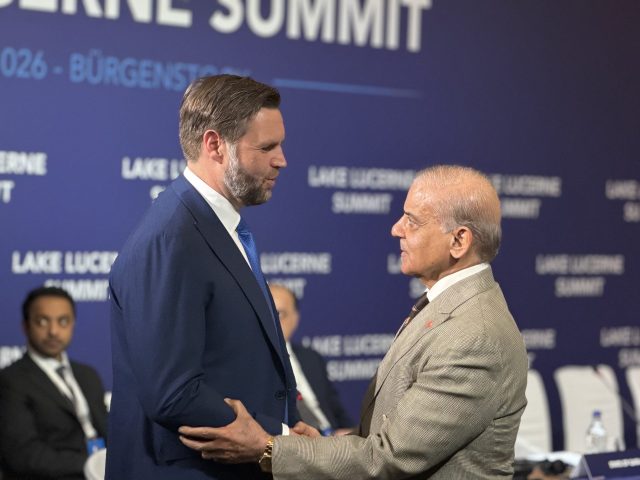
Vance, Pakistani premier Shehbaz Sharif, and Qatar’s Sheikh Mohammed filed in. So did their respective teams, including Jared Kushner and Steve Witkoff, President Trump’s personal envoys. Hugs were exchanged (Sharif, especially, seems to have a physical love language), and everyone took their spots. Everyone, that is, except the Iranians. As the awkward minutes wore on, Vance looked nervous. Eventually, Araghchi showed up — looking even more nervous and determined to avoid Vance’s glance, let alone the vice president’s hand — before stepping out just as swiftly as he’d come in; Ghalibaf was nowhere to be seen.
Vance and the others delivered encomia to Trump, a peacemaker possessed of a “visionary and very dynamic leadership”, as Sharif put it, the oil practically seeping across the floor. Then the staffers shoved the assembled hacks out of the room. Only afterwards were we allowed to glimpse Ghalibaf as he and Araghchi speed-walked to the ballroom. The Ghalibaf-Vance greeting, whatever form it took, would remain hidden from the public’s gaze.
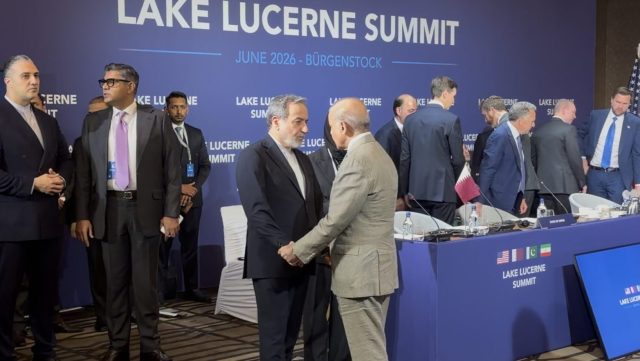
Back stateside, hawkish pundits were quick to frame this as an Iranian snub — a “humiliation” for Vance. Yet the four parties had already met in various formats earlier that day, including direct US-Iranian talks. Only afterward came the missing-handshake drama.
My own impression was of Iranian agitation, not hauteur: they were prepared to shake Vance’s hand on camera before the full implications suddenly hit them, not least among their domestic audience. The Iranians, after all, have their own anti-diplomacy Laura Loomers and Mark Levins, and theirs can do much worse than angry X posts and cable-news rants.
Even so, the two sides seem to have found a way to talk to each other through the occasionally strange optics. They’ve had practice. “The first time we ever sat down with them,” Vance recalls, “was in Istanbul, and it almost felt like a performance — they had to get certain things out, they had to attack us for certain things, and it was sort of difficult going. But then it got to a good place where we were able to actually have a conversation. There was a little bit of that element this time, too: ‘We didn’t ask for this, but the Iranian nation is great, et cetera, et cetera. But we’re happy to talk about peace.’”
Thus, when Trump threatened that the Iranian side wouldn’t have a country to return to if they didn’t behave themselves, Tehran’s negotiators grumbled, and rumours of a walkout circulated on Iranian media and at the hotel. But the talks, in fact, continued throughout.
A more difficult challenge for Vance is the substance of the deal being hammered out. A talking point taken up (for different purposes) by hawks and doves is that the new deal — summarised ahead of the Lucerne talks in a memorandum of understanding — is no better or even worse than President Barack Obama’s arrangement. That deal, known as the Joint Comprehensive Plan of Action [JCPOA], constrained Iranian nuclear capacity in exchange for limited sanctions relief. And, the argument runs, it didn’t require an invasion that led to the shuttering of the Strait of Hormuz and further American concessions to open it back up.
“There are many things I don’t like about the comparison to the JCPOA,” Vance counters, “but one of them is that the MOU is a much more generic document than the JCPOA.” He goes on: “It really is a foundational document: let’s open the Strait, let’s stop shooting at each other, and let’s see if we can make a nuclear deal. And from their perspective, it’s, ‘Let’s lift the blockade, let’s stop shooting at each other, and let’s see if there’s a sanctions deal.’ That’s fundamentally where it’s coming from.”
The vice president adds that the Iranians are offering “things radically different from the JCPOA”: a much more rigorous inspection regime and the “elimination” of the Islamic Republic’s existing stockpile of enriched uranium. “The flip side,” he tells me “is that they really want a fundamentally transformed relationship with the United States and the world — [and] I don’t know where we’re going to be able to land in the middle.”
A transformed US-Iran relationship and, therefore, a new Middle East — therein lie the promise and peril of the current diplomacy: for the region and for Vance’s political prospects alike.
Start with the regional prospects. The Trumpians — not just Vance, but also the likes of Kushner and Witkoff, who treat the Middle East as a real-estate problem — envision a more integrated region in which everyone talks to everyone else, even enemies. And the everyone very much includes Tehran. Enmities will no doubt persist, and violence may still erupt, but the flare-ups can be contained. Just this aspect, Vance argues, makes the deal more attractive to the Persian Gulf monarchies, which generally detested the earlier JCPOA.
The Arabs, Vance tells me, appreciate the new deal “because of the conversations they’re having with the Iranians. . . The Emiratis — by far the most hawkish, by far the most pro-Israel country in the [Gulf Cooperation Council] — they’re having conversations with the Iranians that have never happened before, including with the IRGC, about various types of economic incentives — ‘Here’s what we’d need to see to make your country investable’ — and the Iranians come back and say, ‘Okay, yeah, we’re willing to do all those things.’ ”
Which brings us to the political upside. The vice president’s dislike of Operation Epic Fury is the worst-kept secret in Washington. But if he succeeds diplomatically — and no one is more acutely aware than he of the weight of that conditional — he can fold the Iranian subplot into a longer narrative arc in which all things work together for the good: yes, there was another war, an unpopular, ill-defined one — but behold the new Middle East that emerged from it.
Standing athwart this vision are two powerful counterforces. One is Israel under Prime Minister Benjamin Netanyahu, whose dreams of a big regime-change war and “total victory” are now just that — dreams. The new memorandum, even more so than the JCPOA, accepts Iran in its current form as a permanent fixture in the region. What Bibi is fighting for now isn’t the nuclear terms or even the fate of the Gulf — it’s whether he can still move against Hezbollah in next-door Lebanon. Jerusalem wants to bifurcate the Lebanese front from the Iranian one. The memorandum ties them together, as Tehran demands.
At a brief news conference concluding the summit, I asked Vance how he would characterise progress on the Lebanon question. He described it as “very good” and touted the “deconfliction” mechanism outlined at Lucerne. Then he added something more: “Israel, and every other nation in the region, has the right of self-defence. But we want to make sure everyone has that right of self-defence in [a] background where we’re talking about how to de-escalate.”
Untrained ears could easily miss the two remarkable shifts embedded in those seemingly unremarkable lines. The first: Washington, not just Tehran, is now pushing for de-escalation across all fronts. The second: this was the first time — certainly in my nearly 20 years covering the region — that an American leader spoke of the right of self-defence of Middle Eastern nations other than Israel. It is an astonishing index of how far the Jewish state’s standing has shifted, on both sides of the aisle.
Still, envisioning something is one thing, getting Israeli leaders to go along is quite another, as US presidents have learned to their chagrin going back decades. How will Washington operate a deconfliction mechanism developed in talks to which the Jewish state wasn’t a party?
Aboard Air Force Two, Vance could only point to the limited progress so far. “I think we’re now [at] 48 hours where the ceasefire in Lebanon has effectively held. And even five days ago, the Qataris, the Pakistanis were calling me, like, ‘Here’s this, here’s this, here’s this.’ And I look at the side-by-side of where we were four or five days ago compared to three weeks ago, and it’s like — yeah, it’s annoying, we’re going to keep working on it, but it’s a lot better than it was a few weeks ago. It’s just a continuous process.”
The other obstacle is posed by Iran’s hard-liners, with their tendency to overplay a good hand. Vance is keenly aware that this is a regime whose supporters still daily cry “Death to America”. But he’s also managed to get its more reasonable elements to do business. The ideological foundations of the Tehran regime are real enough. But so was the quasi-normalisation that took place atop those Alpine heights.
Vance is cautiously optimistic. “They’re certainly talking differently than they have in the past,” he tells me. “There’s a whole host of reasons why that’s true. But whether the action will follow, whether the final deal actually meets some of what they’re promising in general terms — that’s what we have to figure out.” For now, he’s partially managed to pull the story back to his preferred plot line. More twists and turns no doubt lie around the bend.
Sohrab Ahmari is the US editor of UnHerd. His next book, on The Triumph of Normal, is forthcoming from HarperCollins.
 SohrabAhmari