




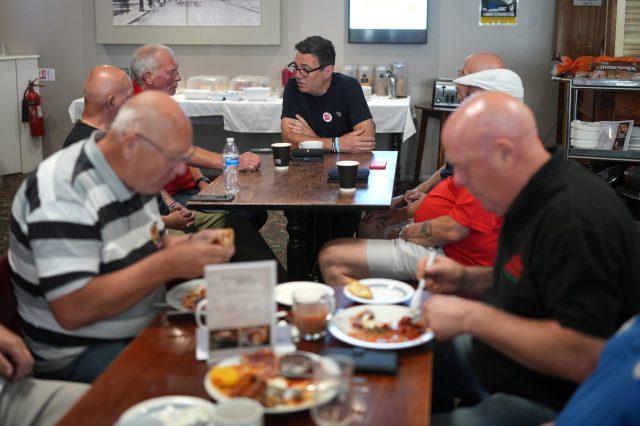
Food for thought. (Christopher Furlong/Getty)





Like many post-industrial constituencies in Northern England — areas with predominantly white, working-class, Brexit-voting populations — received wisdom had Makerfield hurtling towards the Right. Britain, it has been repeated by any number of well-paid and well-placed commentators, is a nation increasingly divided into progressive urban enclaves, supported by the bloc votes of ethnic minorities, pitted against more conservative and mainly white ex-industrial “heartlands”. On this reading, Makerfield, a collection of suburbs and former pit villages near Wigan, and where Reform dominated in the recent local elections, should have been easy pickings for Farage’s party.
What, then, explains Andy Burnham’s triumph? The most obvious factor is Burnham’s local popularity and easy going, affable manner. Had he been blocked from standing, as he was in Gorton and Denton, and replaced with another wooden Labour technocrat, the result would have been very different. Equally, Reform’s candidate, the local plumber and former army reservist Kenyon, was hobbled by his woeful performance on Question Time and a digital paper trail in which he came across as boorish and misogynistic. There’s a lesson here about the limits of the political everyman: it only works when it comes with a dash of professionalism.
Yet there’s clearly more going on here than personalities alone. As polling from the constituency has shown, the coalition that Burnham managed to form combined both urban progressives, of the sort that Labour has been losing nationally to the Greens, alongside soft-Conservative and Reform types. These are people who have turned away from Labour in recent years because of its rejection of progressive social and economic policies, as well as its new identity as the party of the “lanyard class”.
Many have since switched to Reform, or stopped voting altogether. Yet as the sociologist Sacha Hillhorst has shown, Reform’s vote in the last general election was basically unstable. In 2024, the party’s base comprised both nostalgic ex-Labour voters and former Tories bruised by the party’s years in government, retired miners and flash property developers, all “brought into a shared political project by varying degrees of opposition to immigration, a sense of decline, and a desire for political renewal”.
Despite the seeming glee with which the press and politicians have written off these voters, and many others in post-industrial areas, as either inherently or incipiently reactionary, Burnham’s victory shows otherwise. Of course, the desire for renewal can take many political forms — some reactionary, many not. All, however, have come to revolve around the symbolic void of Englishness, the gaping wound at the centre of our national self-conception. Both Reform and Restore have staked their claim on an exclusionary form of English nationalism, based in the former case on a racialised idea of “honest, hard-working people” against both the establishment and those who leech from the system. For the latter, it is built on an ethnocentric idea of whiteness.
For Makerfield’s new MP, identity has been key: not least in his Northernness. Blunt and plain-speaking, pitched in opposition to both an out-of-touch Westminster elite personified in Keir Starmer, and a particularly Southern brand of conservativism, Burnham, in his semi-ironic guise as “King of the North”, has managed to carve out symbolic space for a renewed vision of social democracy. His ability to talk to working-class people without condescension is a valuable asset, as is the fact that he is genuinely rooted in the community he now represents.
It’s clear that many voters in Makerfield bought into this, voting for a chance to remove the much despised Keir Starmer as prime minister, and for a platform which called for taking back control of key utilities. The country, its working-class and Northern redoubts foremost among them, are crying out for change, and a new vision for what the country can be. Burnham now has the mandate to deliver it.
The new MP seems to recognise this, promising a “new path” for both Makerfield and Britain as a whole. There is, however, a danger in this strategy. In claiming to speak for “the North” against an aloof establishment based in and serving the needs of the South East, there is a risk of him appearing to speak only for voters north of the Trent. Will this alienate Labour voters in London, let alone somewhere like Cornwall, clearly not Northern but marginalised nonetheless. There’s also the question of what kind of Northerness it is that Burnham embodies: can someone from the Northwest claim to speak on behalf of those from, say, Sunderland or Middlesbrough? Given Burnham’s talk about wanting to bring the nation together, he must tread gently here.
Another potential pitfall lies in his call, made during victory speech on Friday morning, to end “HMO Britain”. The deeply unpopular spate of outsourced houses that have sprung up, often in poorer, Northern parts of the country, have in recent years become something of a byword for economic decline and state failure. The fact that many of them are used to house refugees and asylum seekers provides fertile ground for a Right intent on tethering economic dysfunction to the question of immigration. Whatever vision of Northernness, or indeed Englishness, that Burnham manages to articulate will have to sever this link.
Doing so will be tough. As he has attempted this during the campaign he has been dragged to the Right on social policy, for instance in voicing support for Shabana Mahmood’s asylum reforms. This has put him on a collision course with more progressive elements of his base, a section which under Starmer has gravitated towards the Greens.
He is on safer ground with the political economy. His vision, dubbed “Manchesterism”, is yet to be fully articulated, and there is some internal competition on its true meaning. But, in its more radical form, as defined by Mathew Lawrence of the think tank Common Wealth, it involves the reversal of the privatisations of the Eighties; new publicly owned transport networks; and more social housing and the development of what Lawrence calls the “productive state”. All of this essentially amounts to a kind of “pro-business socialism”. As Burnham told his supporters, this by-election must be “known as a byword for the change that came to British politics”, which can usher in an “economy that works for everybody”.
Whether Burnham can achieve this remains to be seen. He is, after all, currently only an MP. There’s a long way to go until he reaches No. 10. And, much like Reform, Burnham’s coalition is an unsteady one. British politics has perhaps never been as fissiparous as it is today. Parties rise and fall; new blocs cohere and disintegrate. For Burnham to solidify his support and take it into the next general election, whenever that will be, will take a huge amount of political skill.
In doing so, there will be pressure for him to tone down his Northernness, to blunt the sharper edges of his populist appeal and appeal to “Middle England”. He should resist this. What’s clear from his success is that many voters have taken to his very rooted politics — a politics of place in the most literal sense — with genuine enthusiasm. There is real power in the ability to speak for the particular, for the local, but only if it is tethered to a vision which can reach beyond that too. Burnham can, and must, speak from the North; but in doing so he must transform the whole country. Voters, wherever they are, are desperate for a change; Burnham will have to deliver it. If he can’t, the path for a new Right government seems likely, whatever his outsider credentials.