




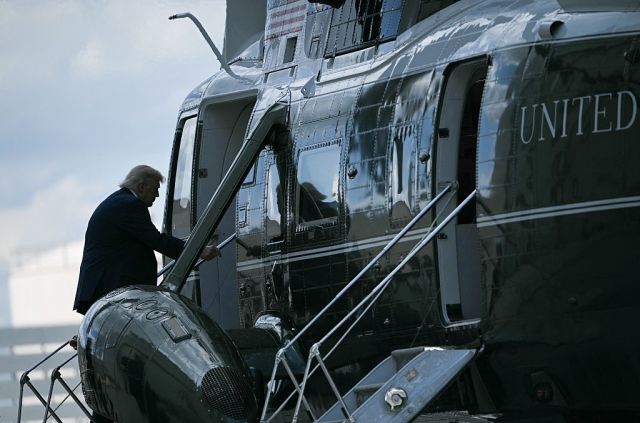
The US is no longer willing to sacrifice soldiers. (Brendan SMIALOWSKI / AFP via Getty Images)





Both those who criticise and those who loyally support Trump’s “deal” — it is hardly a sufficiently explicit agreement, indeed it remains vague on the key points — are carefully avoiding any mention of the critical factor that caused the abandonment of what could have been the last US-Iran war.
When the latest but probably not last Iran war started on 28 February 2026, the first victims, for once, were not innocent bystanders but rather Iran’s rulers and executioners, the supreme dictator Ali Khamenei; the Chief of the General Staff and head of Iran’s armed forces, General Abdolrahim Mousavi; the Minister of Defense, Aziz Nasirzadeh; the head of military research & development, Hossein Jabal Amelian; his predecessor Brigadier General Reza Mozaffari Nia, Esmail Khatib, the Minister of Intelligence; his deputy for Israel affairs, Yahya Hosseini Panjaki; some other officials, and also the private citizen Mojtaba Khamenei, son of Ali Khamenei but utterly unqualified for the emphatically non-hereditary supreme leader position. Mojtaba Khamenei has not been seen nor heard since the bombing, and is certainly mutilated if still alive.
Iran’s furious response to this mass decapitation was the launch of ballistic missiles — not just against Israel and US bases in the region but also against mere bystanders. Of the 1,471 launched missiles from the start on 28 February until 20 April, some 650 were aimed at Israel, 563 landed in the territory of the United Arab Emirates that has long helped Iran’s wrecked economy, 265 landed in Kuwait, where some US aircraft are based but which has always aided Iran, 215 attacked Qatar, which shares its vast natural gas field with Iran, a country that Qatar has never harmed, 194 struck Bahrain, the main regional base of the US Navy, and 135 were aimed at Saudi Arabia, in spite of its complete neutrality.
Iran’s very primitive missiles have been much less lethal than the German V2s of 1944 — some 3,225 of which killed more than 7,000 people in England and Belgium — but with their huge mass of metal they inflicted much property damage even if their warheads did not explode. The older and more abundant Kheibar Shekan weighs 17 metric tons with its 750kg warhead, the newer and larger Khorramshahr weighs close to 20 tons and delivers multiple warheads weighing up to 1,500kg.
What Iran achieved with its 650 missiles aimed at Israel was to damage many buildings and kill 27 civilians and one off-duty IDF soldier, though some 3,000 more were injured across the country, some of them seriously.
While Iran attacked civilians with its very inaccurate missiles, both the US and Israel relied on extreme precision to destroy underground missile assembly plants, detected missile launchers, rocket fuel depots and mixing plants. This entire subterranean industry was the result of many years of very high spending, largely funded by the diversion of the funds urgently needed to provide water supplies for Iran’s second city Mashad, historic Yazd and other cities but for Tehran above all, which may even have to be evacuated, according to Iran’s only elected leader, president Masoud Pezeshkian.
The dam-building and water supply budgets were not enough, so the nation-wide electrical generation funds were also diverted to the Revolutionary Guards’ missile industries, and also the funding needed to pipe the country’s unlimited natural gas supplies to every city. As a result, last winter and into March when the war started, horribly polluting mazout, residual oil, had to be burned to keep Tehran’s people from freezing, because neither electrical nor gas heating was sufficient in the winter months, even with global warming.
The regime was thus on the edge of systemic failure on the eve of the war, but has now been saved by the way the war was fought — and not fought. The mass decapitation of 28 February allowed surviving Revolutionary Guards officers to take over in Tehran, very much as the SS did in Berlin after Hitler’s death on 30 April 1945, eagerly killing anyone who wanted to surrender until Russian troops arrived two days later.
But this time no troops were approaching Tehran, truly mission impossible because of geography alone if nothing else. Nobody in his right mind could contemplate an advance over 800 miles of desert and mountains on the only road from the Bandar Abbas on the Gulf coast to Tehran, with its 13 million people. If only a tenth still support the regime — that many are salaried in the army, police, part-time militia, Revolutionary Guards and the Bonyad foundations that own much of the economy — it would be enough to start a long season of urban warfare.
No such invasion plan had even been suggested by anyone, so there was no justification for the pre-emptive “boots on the ground” hysteria loudly manifest from isolationist backwaters and White House Vice Presidential staffers alike. As it turned out, however, the hysteria generated by wholly imaginary invasion plans had very real consequences, which in fact determined the outcome of the war till this day.
To understand how fears over a non-event brought about a veritable defeat, one must return to the other military action that occurred just before the start of the bombing, on 28 February. This already seems a long time ago, because everybody in the White House would have laughed at the suggestion that President Trump would ever come to terms with the Revolutionary Guards. Some 3,000 paratroopers of the rapid-response force of the 82 airborne division were sent to the Gulf, to join the 5,000 Marines of the 11th and 31st Marine expeditionary units already there.
They were more than enough to counter the entirely predictable — and predicted — Revolutionary Guard response to the bombing, which was to try to stop the flow of tankers and bulk carriers delivering crude oil, liquified natural gas and fertiliser down the narrow seaways in the mostly shallow Persian Gulf from Iraq, Kuwait, Qatar and — partly — from Saudi Arabia, which can send half its oil by pipeline to the Red Sea, and the United Arab Emirates, which has a pipeline to the Indian ocean for half its oil.
The Revolutionary Guards and Iran’s navy could not attack the tankers and bulk carriers with their warships, armed motorboats or submarines, all of which were efficiently sunk soon after the bombing started. But they could endanger navigation by dropping sea mines from any traditional dhow or fishing vessel, and even by attacking passing tankers with their anti-tank missiles. That would be enough to cause insurance companies to suspend their coverage, thereby stopping Persian Gulf supplies to the world economy.
That is where the airborne troops and Marines could be highly effective. With ample helicopter transport to take up positions for hours or days on uninhabited Persian Gulf islands and deserted coastal tracts to secure nearby navigable channels, and with strong tactical air support only minutes away to minimise combat risks, they were fully capable of defeating any interfering enemy forces.
By sending them into action, the US could have denied any oil shipments from Iran’s oil terminal at Kharg Island and from lesser terminals at Qeshm and Jask on the Indian Ocean beyond the Gulf, thus cutting off most of Iran’s oil export revenues. At the same time, those ground and air forces could minimise any interference with the tankers and fertiliser bulk carriers transiting from Iraq, Kuwait, the Emirates, Qatar and Saudi Arabia into the Indian Ocean, minimising the war’s impact on global commodity markets.
Israel’s Prime Minister Netanyahu had asked only for assured resupplies of aerial munitions when it came to the pre-emptive bombing of Iran’s ballistic missiles, hoping to avoid the danger of an all-out attack that could overwhelm Israel’s defences. He was surprised and pleased by Trump’s decision to join in and take command of the offensive. He did not pause to consider the possibility that he was forming an alliance with a weaker power, which would let him down.
By then, 28 February 2026, a total of 1,150 Israeli soldiers and local security officers had been killed since the war started on October 7, 2023, the equivalent of 39,100 dead US soldiers given the 1:34 population ratio.
Netanyahu, who was widely unpopular even before the war, was politically unaffected by the loss of more than 1,000 soldiers, but 1,150 killed in action — let alone 39,100 — would have quickly ended the Trump presidency via a fast impeachment with enough Republican votes, among vast coast-to coast mass protests. In other words, Netanyahu’s exclusive reliance on his personal dialogues with Trump, which left Israel’s Foreign Ministry and Intelligence a mere bystander, blinded him to the great change that had transformed the United States into a post-heroic country, no more willing to engage in combat than our Nato allies. Nor is it a political or even a cultural transformation that might be undone by strong leadership, but rather the unavoidable consequence of the collapse in female fertility, now down to 1.6. It means that very few American families have two or more boys, such that one might fall in combat without the family’s extinction. Almost every US combatant is now a “Private Ryan”.
That is why a prudent opposition to more wars in pursuit of quixotic aims — such as the 2003 Iraq war that I testified against before the Senate Foreign Relations Committee, seeing no chance of bringing democracy to Baghdad, and the Afghan war to modernise unwilling populations — has been transformed into a “boots on the ground” psychosis. Also present within the White House, it equates small-scale and short-lived commando actions with another endless war, nullifying the tremendous strength of US air power, allowing the Revolutionary Guards to win with very few fighters and very few small boats.
So this war fought by an irresolute President has not only allowed America’s worst enemies to come out the winners in spite of their utterly disastrous national policies, primitive missile engineering and clumsy military operations, but has also degraded US military strength down to European levels, because troops that cannot be risked in combat even for great gains are of little military value.
Professor Edward Luttwak is a strategist and historian known for his works on grand strategy, geoeconomics, military history, and international relations.
 ELuttwak