




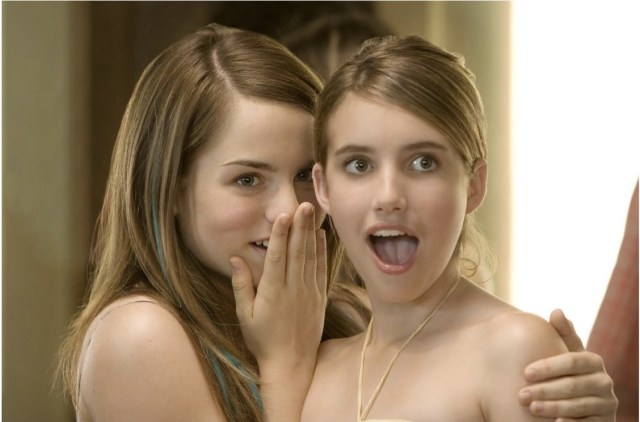
‘Gossips are not going to go away anytime soon.’ (Aquamarine/20th Century Studios)





Women love hearing about other women’s misfortunes, and this week we were given a treat. “This story starts in a bathroom in Venice,” wrote the former TV presenter and author Liz Fraser, recounting how a gossip website ruined her life.
Already exhausted by years of vicious online remarks about every aspect of her existence, Fraser described how she had retreated from the world, and was even avoiding socialising in case fellow school mums wrote about it afterwards. And now some unknown foe had spotted her having “a quiet coffee and gelato” with her daughter in the Italian city, and made an acerbic comment about it on the Tattle Life website. Soaking in the bath that night and feeling horribly hunted, she says she reached her “rock bottom”.
Celebrities and influencers have been complaining about Tattle Life’s existence for years, and Fraser’s dramatic new tale of persecution only adds more energy to the growing campaign against it. In February, a group of Labour MPs wrote to Ofcom implying that posts on the site were responsible for the suicide of a 16-year-old girl called Princess Bliss Dickson. Ofcom has since said it is “moving quickly” to examine if there are grounds to take action, while the Information Commission said it is also investigating.
On one hand, then, we have the framing of the famous and semi-famous women who say they have been deeply hurt by Tattle Life: a place of unalloyed evil, seething with inexplicable hatred and contempt. But there are other stories too, and to my mind they complicate matters. One such story is also narrated by Fraser, and it starts well before that fateful night in the bath.
It can be found over on her Instagram account, where she visually depicts a life that appears to be heading towards perfection in an ever-ascending arc. Row after row of artfully composed photographs display her gorgeous existence for the admiration of passers-by. There are morning espressos in Venice, where she seems to spend much of the year; shots of her beautiful children and handsome man; selfie after selfie of her own toned body and immensely photogenic face.
Here is Liz flushed after another marathon; here she is drinking champagne and toasting the camera; here she stands on a mountain peak. Here is a picture of her brunch in Salzburg; here she is in the bath again, muscled legs stretched out glistening before her. The accompanying captions try to convey humility and likeableness, and her wish to “make a small difference to some part of the universe”, but the pictures themselves scream success, money, desirability, winning at life.
Viewers are obviously supposed to covet what this woman has, for there would be little point in the laborious display otherwise. What they are not supposed to do, presumably, is imagine Fraser taking a photo of her own legs in the bath: tucking her chin, craning her neck awkwardly back and perching the phone on her chest as she tries to get the angle right, wiping the lens intermittently with a flannel to stop it getting fogged up. The anonymous posters on Tattle Life imagine all this sort of thing and more, providing a brutally deflating commentary to the curated exhibition that is often as funny as it is biting. Egging each other on, they virtually gather to dissect, mock, speculate, bitch, and generally have a lovely time at Fraser’s expense. And they are particularly scathing about the way she likes to photograph her own legs.
So rather than a simple story of inexplicable internet harassment, what we have is a cautionary tale, featuring a co-dependent relationship between two parties: on the one hand, the influencer whose aim is to evoke a feeling of envy in others, and on the other, groups of anonymous posters who readily oblige. Of course, most influencers will furiously deny the charge, partly because being a thoroughly nice person without any rapacious superego whatsoever is a standard part of the female influencer schtick. Or as one Tattle Life commentator summed up the contradiction, as it manifests in Fraser specifically: she want us to know she is both “#hot and #humble”.
Equally, the anonymous posters on gossip sites will presumably deny they are really envious of the women they criticise. It is easy to pretend these places are just an extension of having a good gossip with friends, but there’s an obvious difference which betrays the spiteful edge. Namely, your targets can read what you are saying; and indeed, many posters on Tattle Life seem positively to want them to. As Fraser says, she is often addressed directly by posters. There is no doubt things can get out of hand in such places, with reputations seriously trashed as a result. Anonymity means tempting disinhibition, and envy doesn’t tend to know when to stop.
In her article, Fraser says she used investigators to find out the identities of her anonymous trolls, and discovered they were “almost exclusively women, often middle class, educated and mostly in their forties and fifties”, some of whom work “in journalism or in business” and who “post photos of walks in the woods, holidays in pretty European villages, and … charity fun runs”. In other words, they sound very much like her. A long time before the internet, Aristotle perspicuously noted that “we envy those who are near us in time, place, age, or reputation”. Or as Hesiod put it, more pithily, “beggar is envious of beggar and singer of singer”.
Yet despite her undoubted suffering over the years at the typing fingers of rivalrous mean girls, I can’t get too worked up about Fraser’s plight in the Venetian bathtub. There is an easy enough way to stop anonymous saddos talking about you on the internet, and it involves not being a massive show-off about your life. In contrast, the story of Princess Bliss Dickson — the teenage child of influencer Sophie-May Dickson, who took her own life in February, allegedly after Tattle Life criticism — is genuinely dark and disturbing. It really does suggest we urgently need to change the norms governing female social media use — though in a way that has nothing much to do with gossip websites per se.
At the time of her death, Princess Bliss had her own TikTok account where she would pout and grind in a heartbreakingly self-conscious way for the camera, as girls these days often do. But unlike most teenagers, she had already been in the public eye for most of her life. Aged four, she was featured in a 2014 television documentary, getting a spray tan. The show was about mothers — including her own, Sophie-May Dickson — who would painfully tease hair weaves in their tiny daughters’ curls, dress them in elaborate frills and furbelows, and cover them in make-up and glitter. Some comic genius at Channel 5 called the show “Blinging Up Baby”. Gleeful pieces in the tabloids followed, and a year later the mother also appeared on This Morning to discuss the excessive “pampering” of her two girls. The die seemed to be cast. From then on, Princess Bliss and her sister would be turned into living dolls full-time — and when television ceased to be interested, Sophie-May’s social media accounts would take up the slack.
Reportedly living in supported accommodation at the time of her death, the girl is said to have read critical comments on Tattle Life, both about her mother and herself, before her overdose of prescription medicine. Campaigners are implying that these must have been instrumental in her act. In advance of the release of a coroner’s report, it is hard to see how this connection can be made for sure; not to mention that it flies in the face of all professional advice about avoiding speculation in such cases.
But what we can say, perhaps, is that the role of Tattle Life in the awful saga is somewhat double-edged. Certainly, it was a place where cruel things were being said about the mother at the time, with a few strays caught by her blameless daughters too; and I wonder if posters really think about what it is like for a loyal child of a target to read this stuff. But equally, a lot of outrage was being expressed on the girls’ behalf about the circus-like spectacle being made of their young lives. And in that sentiment, at least, the anonymous posters weren’t wrong. In fact, they were drawing attention to an issue of child safeguarding few others seemed to care about.
Taken together, the Fraser and the Dickson cases demonstrate the unstable role of female gossip in the moral economy, and especially when the internet gets involved. Sometimes — perhaps even usually — it’s just a cheap way of striking at another person who makes you feel inferior and crap about your life, with criticism and mockery employed as a kind of levelling psychic compensation. But sometimes gossip has a constructive role, a way of expressing collective moral disapproval: of chewing someone’s behaviour over from every angle, and saying out loud what they are doing wrong. Tattle Life exemplifies both tendencies vividly, and you can’t lose one without the other.
The campaigners who want to see these sites banned conjure up an improbable world, where you can still have influencers and celebrities posting endless vain selfies and humblebrags to their rapt followers, but suppress the scepticism, envy, and spite of those not similarly entranced. I don’t think that’s possible. Last time I checked, Liz Fraser was still merrily posting about her fire emoji life, and says she is now writing a book about “female-female rivalry”. Meanwhile, Sophie-May Dickson was putting up pictures of Princess Bliss’s funeral, and seems to have coordinated her outfit with the coffin (still image and video both available for clicks). With such people in the world, I predict the gossips are not going to go away anytime soon. And to be perfectly honest, I’m tempted to join them.
