




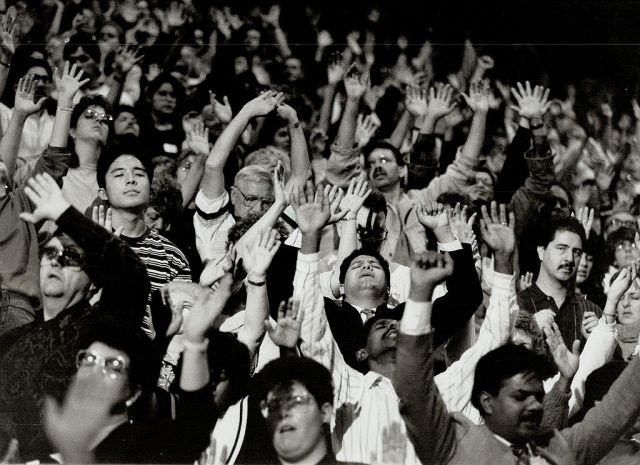
Followers of televangelist Benny Hinn believe in divine healing. Credit: Getty





The night before my father drove three hours to Southern Illinois to do battle with a demon bird, he handed me a three-ring binder. Inside was a thick stack of arcane documents he’d compiled over several months: photocopied maps, handwritten notes, and reprinted articles; opposition research, if you will, dedicated to a creature called the Piasa Bird.
That is the name for a multiheaded monster whose crude visage had been lavishly painted hundreds of years ago across the limestone bluffs above the Mississippi River in present-day Alton, Illinois, by the Illini — the Algonquian-speaking Native Americans after whom my home state was named. It was the late 1990s, and my dad, John Mark, and a small group of men in his prayer group planned to drive I-55 from Springfield, IL, to the old river town, march to the bluffs, pray intensely over the site, and begin a rite of spiritual warfare.
I had trouble hiding my incredulity. I was in college at the time, studying journalism, and had already begun the long, self-conscious process of distancing myself from the faith I’d been raised in. I told him he was embarrassing himself. Are you seriously going to drive three hours to fight a mythological demon bird?
The Piasa Bird is a quirky, little-known piece of Southern Illinois lore. The bluffs painting was first documented by French explorer Jacques Marquette and Louis Joliet during their famous Mississippi River expedition in 1673. (“They are as large as a calf, with head and horns like a goat, their eyes are red, beard like a tiger’s and a face like a man’s,” Marquette wrote in his diary.) And the bird returned to the page in 1836, when writer and Baptist minister John Russell published a newspaper story about it, a tall tale titled “The Bird That Devours Men.” In it, Russell describes a legend in which a brave Illini chief named Ouatoga helped his warriors kill the Piasa by using himself as bait. “Such is the Indian tradition. Of course, I cannot vouch for its truth,” Russell wrote.
Nearly 200 years later, my dad not only vouched for the story’s truth, but he’d tacked on a new supernatural element: he believed that the Piasa Bird was a demon, one that had cast a spell on the state of Illinois, binding it in a spiritual darkness that had yet to be broken. He pointed to a map, traced a finger along the bends of the Illinois River, and explained that our home state was shaped like a human heart and the rivers running through it were symbolic veins beating with the powerful blood of the Piasa. His goal: to bind the principality, thus freeing Illinois from Satanic power. He didn’t share my mortification about the preposterous quest to fight a demon. He traveled to Alton anyway. I never asked how it went.
I’ve been thinking about that night a lot since my mother, Janice, died last month — nearly a decade after my father passed. He died from a rare liver cancer in 2017, and my mom’s heart finally gave out in May after 20 years of assistance on a pacemaker. Between their deaths and the loss of my childhood home to bank foreclosure earlier this year, it feels like the final death of my past self and the strange and magical world of charismatic Christianity I was raised in.
What I realize now is that there was little difference between my father, who believed that devils and angels walked amongst us, and the Algonquian-speaking Native American tribes who, in Marquette and Joliet’s telling, averted their eyes in fear of the image of the Piasa Bird. For all their centuries and cultures apart, both the Illini and my parents shared an enchanted view of the world.
I had it once, too. It was a gift that I don’t want back. It also never let me go.
Christianity permeated everything in my early life. My mother, Janice, converted to Christianity in her mid-20s, not long after what my uncle described as a horrifically bad acid trip, in which she claimed to have seen the face of God, which wasn’t as uncommon as you’d think in the ’70s; the Jesus People movement of that time merged counter-cultural hippie aesthetics with fervent, Spirit-filled evangelical Christianity. My dad followed her, reluctantly at first, and gave up playing bass in a local cover band and recording jams in our marijuana-smoke-filled basement for Sunday morning hymns.
My family’s religion had a specific name, even if no one I knew used it: the neo-charismatic movement, or the Third Wave of the Holy Spirit. (We called it simply: “The Revival.”) Its most visible figure was John Wimber, the former Righteous Brothers keyboardist who founded the Vineyard Christian Fellowship and pioneered what he called “power evangelism” — the idea that conversion should be accompanied by signs and wonders, and that the miracles described in the New Testament had returned. Theologian C. Peter Wagner and his colleagues developed a related doctrine of “spiritual mapping” and “territorial spirits”: the idea that demonic powers were attached to specific geographic locations and could be displaced by prayer warriors visiting those sites. This is the theology my father was practicing on the bluffs above the Mississippi.
It is hard to overstate how large the Third Wave religious movement got. By the mid-’90s, the global Pentecostal and charismatic believer population was massive — estimated at over 200 million, spreading from Wimber’s Vineyard church in Orange County, California, to tens of millions of Americans gathered in evangelical churches, school gymnasiums, converted strip malls, and suburban basement prayer groups. Television did the rest: through Trinity Broadcasting Network and Pat Robertson’s Christian Broadcasting Network, televangelists like Jimmy Swaggart, Jim Bakker, Kenneth Copeland, and Benny Hinn brought faith healing, prophecy, and the spectacle of enchantment to millions of living rooms, including ours.
The quasi-megachurch we first attended, Calvary Temple in Springfield, was one of many congregations that got swept up by the Third Wave. It was once a more staid Southern Baptist church led by Pastor MC Johnson, a gravel-voiced veteran whose fire-and-brimstone sermons took on an extra element of menace due to a never-moving glass eye that replaced the one shot out during World War II. In the early 1980s, Calvary embraced the Third Wave’s theatrical turn. Soon, parishioners would interrupt services to speak in tongues, and others with the alleged Gift of Prophecy would interpret those tongues, speaking in the voice of God. Pastor Johnson preached constantly about the coming Rapture, once speculating that the Antichrist would be incredibly gay (“The Queen Bee of ‘Em All,” he claimed).
The End Times, we were told, were not just near; they were imminent. The Third Wave brought with it some frightening implications based on dispensationalism, the 19th-century scheme of John Nelson Darby that splits human history into seven divine “dispensations” culminating in the Rapture, the rise of the Antichrist, and Armageddon. Hal Lindsey’s The Late Great Planet Earth (1970) sold tens of millions of copies by popularizing this framework and predicting that Jesus would return sometime during the Reagan administration. I shudder when I recall being haunted by A Thief in the Night, a quartet of evangelical films released across the ’70s and ’80s, the precursor to the Left Behind novels of the ’90s. I was one of tens of millions of kids who saw them at church watch parties, disturbed to see characters unlucky enough to sleep through the Rapture and wake up in the Great Tribulation, where the United Nations was running guillotines for anyone who refused the Mark of the Beast. I didn’t need Freddy Krueger or Friday the 13th movies; that was fake. I had eschatology, and it was real; at times, it was difficult not to approach every service with a sense of both thrill and fear. Would someone at church prophesize that the Rapture would occur next week? Maybe.
Jesus, of course, didn’t get the memo and stayed in heaven, but my parents only grew more devout as the ’80s came to an end. It began with Sunday School, my mom donning choir robes, and my dad playing bass guitar for the church band, and escalated from there. By my teen years, I was forced to attend three-hour revival services in which hundreds of parishioners were lined up like they were waiting to ride Space Mountain at Disneyland and then were knocked down to the ground like bowling pins by an African missionary, claiming they were all “slain in the spirit.” A woman holding a picnic basket would stand at the ready to cover the slain women with red blankets for the sake of decency. There was wild dancing, unstructured singing and chanting, running and writhing in the aisles — a hyper-emotive style of worship similar to the kind that led to Ann Lee and the Shakers’ exile to colonial America a few centuries ago.
Both my parents believed in direct divine revelation from God and that the line between the spiritual and physical realms of existence was ever blurry. When I was in college, my mother told me Jesus once rode a chariot through her church’s sanctuary and somehow gifted parishioners with gold fillings in their teeth. She once attempted an exorcism at a Pizza Hut, trying to cast out a demon she believed had inhabited a homeless woman who, looking back, was probably in the grip of something more chemical than supernatural. My mom and dad both once joined a day-long prayer march around a local strip club called Deja Vu, inspired by the Israelites’ march around Jericho in the Old Testament. They came home certain that a holy cloud had descended from heaven upon it.
I cringed instinctively and constantly back then to these encounters, but now what lingers most in my mind about my parents’ faith isn’t that it was weird or outrageous — though it was at times — it was that it appeared holistic and genuine. The door of the spirit was open for them, and their door, in the most literal sense, was open to everyone, too. Over the years, they housed a mentally disabled man, a Thai immigrant, and a homeless man they’d pulled in off the street. These were not charity projects but houseguests, people absorbed into the ordinary rhythm of their lives. They raised my nephew Aidin for a decade, and my father spent his retirement years not traveling, as he had hoped, but nursing my mother through the aftermath of her stroke because that was simply what love required. These acts didn’t proceed from a theology of social justice or a framework of civic obligation. It proceeded, as far as I could tell, from the same source as everything else — the conviction that the world was alive, that other people were addressed by God and therefore deserving of the same attention, that the membrane between the spiritual and the human was thin enough that you had to act accordingly.
“Faith, hope, and love are the triune frequencies, which, once aligned to the Jesus Frequency, allow for a super strong laser-like frequency beam that allows even the dead to be resurrected.” My father wrote that and about 50,000 more words like it before he died. He spent the last decade of his life on a manuscript called The Good Vibrations Manual — 12 chapters synthesizing electromagnetic frequency theory, charismatic Christian theology, and personal revelation into a single explanatory system for the universe. He believed that prayer, worship, prophetic dreams, visions, and even the soul’s passage after death all moved as literal particle waves — supersonic frequencies that traveled through dimensional portholes between earth and the throne room of God, the spiritual realm described by Paul in II Corinthians 12 as “the third heaven.”
He had no formal training in physics, just 45 years of musicianship and what he described as a series of direct communications from God, the first of which arrived in 2002 with an instruction drawn from Jeremiah 29:13: You will seek Me and find Me when you seek Me with all your heart. He took the instruction literally and devoted the rest of his life to it.
The vanity license plate on the back of my parents’ 1982 Chevy Nova read “MORE LORD”— which was their philosophy, that there was always more of Jesus’s presence out there to bathe in; it was an unquenchable thirst.
I find it ironic that the paradigm I experienced in abundance in my youth — an enchanted cosmos, a world alive with spiritual presence and urgency at every moment — has become, of all things, cool: an object of widespread longing. Kind of.
There is a reason why I felt like an outsider in my tight-knit religious community until I left the church at age 30. As I aged, went away to college, and took steps into the wider culture, I discovered that in America, faith and belief were not only in steady retreat, they were disparaged. Hollywood mocked Christianity constantly; The Simpsons gave us decades of Ned Flanders. Jesus Camp was nominated for an Academy Award for its portrayal of a Pentecostal children’s camp as a kind of theocratic boot camp. (“Was your church like Jesus Camp?” I used to get asked constantly.) In the Obama years, the New Atheists emerged as a trendy intellectual force, led by figures known as the Four Horsemen: Christopher Hitchens, Richard Dawkins, Sam Harris, and Daniel Dennett. They attacked religion as not just irrelevant, but actively bad, with Dawkins claiming that faith was a “mental illness” and “a force for evil in the world.” The evangelical Christian world was their most obvious target; faith healing, creationism, and tongues-speaking served as the paradigm cases of religious irrationality. I understood the critique, even shared some of it — and yet something about the New Atheists’ triumphalism felt, even then, like its own kind of faith.
But now in the 2020s, the cultural vibes have shifted. Church attendance has stopped declining; the explosive growth of the religious “nones” has plateaued, and urban Gen-Zers are turning back to Catholicism to the point where young Chicagoans are flying novelty “Da Pope” flags in Wrigleyville, as if they are rooting for him to win the World Series of Religion. Meanwhile, a string of public intellectuals have converted or returned to Christianity in recent years, including former New Atheist Ayaan Hirsi Ali. Hollywood has even softened on evangelicalism slightly; I couldn’t believe my eyes a few months ago when The Testament of Ann Lee, a film about the founder of the aforementioned Shakers, treated the ecstatic sect of Christianity with deep respect.
The fact that there is some mainstream, even pop cultural, acceptance of the new religious wave is novel. But what is more striking is that this new wave of religiosity of the ’20s is pursuing, not steering away from, the woo-woo elements that once made religion such a ripe object of ridicule. The trend is being called “re-enchantment,” though it is still hard for anyone to put their finger on what that actually means or looks like in practice. What everyone seems to vaguely agree on is that it is a reversal of what Max Weber described a century ago as Entzauberung der Welt, roughly translated as “the unmagicking of the world.” The phrase meant the slow draining of mystery, meaning, and sacred presence from the post-Enlightenment West by a new kind of reformation of science, bureaucracy, and reason.
For re-enchanters, there’s an emphasis on an experiential form of spirituality, with mystery, miracles, cosmic encounters with a divine being they can’t fully understand. “The world is not what we think it is,” writes Rod Dreher in his 2024 treatise Living in Wonder: Finding Mystery and Meaning in a Secular Age. “It is so much weirder. It is so much darker. It is so, so much brighter and more beautiful. We do not create meaning; meaning is already there, waiting to be discovered.” Dreher isn’t alone. He, Paul Kingsnorth, Ross Douthat, and David Bentley Hart — christened the “Four Horsemen of New Theism” in inverted homage to the New Atheist quartet they have supposedly displaced — have made careers out of talking about Making God Great Again. They are influential in the new cottage industry of bestselling books, podcasts, and Substack newsletters calling for the re-enchantment of the world. One critic, surveying the re-enchantment scene, observed that “Substack is rife with it. Twitter reeks with it.”
The Christian God, of course, isn’t the only supernatural being making a 21st-century comeback; Satan’s back too. A decade ago, it was only TV preachers and Alex Jones shouting at the devil, but suddenly it is mainstream conservatives more broadly that are seriously invoking Beelzebub or the Antichrist: Tucker Carlson, Peter Thiel, and JD Vance, the latter of whom says he believes that UFOs are demons. The quest for re-enchantment isn’t even strictly a Biblical, or even religious project. On the Left, the devil and demons are often treated as friendlier folx, possibly woke allies to social justice-loving ultraliberals who have assembled, from scraps, a loose spirituality of astrology, witchcraft, tarot, and a kind of Green New Deal of neo-paganism. In Strange Rites: New Religions for a Godless World, Tara Isabella Burton explains the rise of “bespoke spirituality” in America, such as the communist witches, the transhumanism of Silicon Valley, the cult-lite overtones of self-care fitness programs like Soulcycle, and the highly online denizens of Manosphere who hopelessly lust after the rise of a new Rome.
What the emergence of these new mystics — of both the God and godless kind — and all of the media attention they’ve earned conceals is that a version of what they are looking for was never lost by everyone. For a significant slice of America, especially among the working-class, the age of enchantment never ended — it just existed at the margins. It survived in church basements, converted strip malls, revival services, and the homes of people like my parents, who did not experience angels and demons as metaphors for psychic life or symbols in a civilizational argument, but as facts. This is precisely the kind of enchantment that the new re-enchanters tend to avoid: not tasteful, not literary, not mediated through landscape writing, ancient liturgy, or a podcast about the crisis of meaning, but embarrassing, excessive, and alive.
The intellectual, elite New Right and the super libs driving much of the current conversation have cast a wary eye on charismatic Christianity and said nearly in unison: OK, but not that kind of enchantment.
I can relate.
After my childhood immersion in my parents’ faith, I spent my more skeptical 20s in a church in Missouri that was part of the “seeker church” boom of the ’80s and ’90s. That’s when megachurches popped up everywhere in the exurbs, and the Joel Osteens of the world preached a capitalism-friendly gospel that turned Jesus into your life coach and financial advisor. That wave, in which everyone seemed unsettled by the more exuberant brands of faith, was defined by a watering down of theology for the sake of filling pews. Congregations like the one I attended in college awkwardly shoved the enchanted world of Christianity to the side like Thomas Jefferson in his edited, miracle-free Jefferson Bible. They turned services into an ill-fitting mix of rock concert and self-help TED Talk-like sermons to lure “I’m spiritual, not religious” fence-sitters. It was pleasant, inviting, and ultimately hollow.
My departure, when it finally came, was in 2006, a year into an already half-hearted missionary stint in Venice, California. The details involved an episode of This American Life called “Heretics,” and the sudden conviction that Hell was not a supernatural prison waiting for the unsaved but simply this — the suffering we make for each other, here, now, always. If Hell wasn’t real, then neither was Heaven, and the whole spiritual rigging came down. Within weeks, I had abandoned the mission and moved to Chicago, leaving my faith to drown in the Pacific.
What I remember most about that period is not the relief — though there was certainly relief in losing the fear of eternal damnation — but the specific quality of the silence that followed. The world became, almost overnight, a place drained of color. Events happened. People lived and died. I believed, as Karl Marx described, that history unfolded by the grinding logic of materialism, effect, interest, power, accident, and entropy. The cosmic aliveness of my childhood — the sense that every moment was charged with spiritual significance, that God was attending to you with terrifying specificity — was gone.
Like many Americans, I was now faced with the impossible burden of piecing together my own meaning and purpose in an age of hyperindividualism. I told myself this was maturity. I built a career on it. As a journalist, I learned the professional dialect of disenchantment, ironic, analytical, allergic to earnestness in the way that people who were once very earnest tend to be.
But a decade after leaving, sitting in the audience at Chicago’s Steppenwolf Theatre watching The Christians, a play about a pastor’s disenchantment, I walked out onto Halsted Street, dazed. The play ends with a bright spotlight that narrows and focuses exclusively on the character Pastor Paul, who loses his congregation after rejecting the harsh doctrine of Heaven and Hell, as I had done. He’s right, of course, but the truth left him sitting alone in the dark with no one to turn to.
I don’t have an answer — I’ve simply stopped asking nagging questions about the nature of existence and suppressed whatever longing I still carry for something I can’t name. “There are long periods in the lives of all of us, when the truth as revealed by faith is hideous, emotionally disturbing, downright repulsive,” Flannery O’Connor once wrote. “Witness the dark night of the soul in individual saints….”
I am among those saints who decide in those harrowing moments to stop groping around endlessly in the dark night, and close our eyes, and pretend it is day.
What I suspect, but can’t prove, is that the contemporary quest for re-enchantment is largely driven by those who never had the kind of heightened struggle I had, and thus yearn for something like it. It is a natural generational reaction against the rationalist excesses of the algorithmic age and technological post-modernity — that totalizing, interlocking apparatus of industrial capitalism, rationalism, and globalized power that Kingsnorth, the re-enchanter, collapses into a single, almost mythic epithet: “the Machine.”
By rejecting the grand metanarratives, especially the Old Time Religion of Christianity, we have left individuals with little to do except to helplessly rage against The Machine. We are drowning in a sea of context-free information, an increasing amount of which is hallucinated by AI systems, which are, in their own way, a degraded parody of what God once promised: an omniscient listener, an answer to every question, a presence that never sleeps. We can’t depend on the old pillars of the state and social life, either, as Kingsnorth writes, “Western culture seems in many ways to be visibly collapsing before our eyes. Our nations, our family structures, our communities, our assumptions, our ecosystems: everything is under strain, under attack, or bursting at the seams.”
The disenchanted alternative has not obviously produced better people or a more livable world. Why not then grasp at an immutable object of the past, in a time of impermanence?
The problem is that weak ontology is built into re-enchantment. That is the term philosopher Stephen White describes as the self-aware practice of believing something you know you are choosing to believe without strong claims to absolute truth. The shared premise of much of the re-enchantment literature is rather simple: the modern world is spiritually thin, and something must be done. The cures vary widely: secular philosophers prescribe the wonder-of-everyday-as-practice; Christian theologians prescribe prayer and mystical experience; novelists and essayists prescribe a return to landscape, tradition, and ritual.
Few can agree on what kind of magic fills the void. Do we now fill it with belief and worship of God, Satan, or the Earth? Do we jump on the Pope Leo bandwagon? Shall we reintroduce the wolves and worship them? Too often, the re-enchanters run into the problem the disenchanted New Atheists never had: it is easier to say what you are against than what you are actually for.
Suppose enchantment is only an illusion, a trick of the light that any honest adult knows better than to believe in, which is more or less what weak ontology already concedes. Then willing yourself back into it is an absurd errand, because it asks you to suspend a disbelief that snaps back into place the instant you stop performing the suspension. There is something faintly ridiculous about deciding to enchant yourself, like trying to surprise yourself with a birthday party you planned. This is why the re-enchantment shelf keeps sliding, almost against its will, into the language of fantasy and simulation, of theme parks and Disney movies. You can visit the Holy Land Experience, the Orlando Bible theme park, but you can’t permanently move there.
And if enchantment is not an illusion, but instead is a real spiritual power of the kind my parents staked their lives on, then the project becomes stranger and more dangerous still. In the older sense of the word, the power to enchant does not belong to the person under the spell. If you are enchanted, you probably do not know it. You certainly do not manage it, curate it, schedule it for Saturday, or set aside 20 minutes for it after finishing a book about the crisis of meaning. Jesus won’t ride in on a chariot on your time.
I am not arguing that my family’s faith was better than anyone else’s. I am making the narrower and more devastating claim that the secular re-enchantment project is playing a game it can’t win because it secretly believes winning would be a loss too great to bear. To succeed, re-enchantment would require the surrender of the ironic distance that makes the project legible to you in the first place — the capacity to write about it, podcast about it, buy the books about it, to be the kind of person who can evaluate various re-enchantment strategies and select the most compelling one. Enchantment, properly understood, is not a strategy. It is the end of strategy.
That is what Jean Baudrillard, the late French postmodern theorist, argued in his last major book, The Intelligence of Evil. The modern world, he claimed, has entered a condition he called “Integral Reality,” a state in which “everything is realized and technically materialized without reference to any principle or final purpose whatever.” The real hasn’t vanished physically; it has vanished metaphysically. The principle that gave the world meaning is dead, and what remains is an unrestrained expansion, a saturated and totalized reality that has lost its shadow. The contemporary re-enchanters live in the aftermath, trying to reintroduce wolves to a Yellowstone that has been paved over.
Baudrillard was right about the paving-over, but he was wrong — or at least incomplete — about what it erased. What my childhood helps me to see is that Integral Reality liquidated not magic per se, but the conditions of credulity: the thick social webs, the inherited cosmologies, the shared and unquestioned worlds inside which magic could function — not as an anomaly but as the baseline. What my parents had, what they tried to give me, what I received and then rejected, and what I am still sorting through wasn’t a set of beliefs that happened to be wrong. It was a way of inhabiting the world, a posture of openness to the possibility that the world might be, in some sense that resists clean explication, for you. Not in the prosperity-gospel sense, or the sense that God is a vending machine waiting to be correctly petitioned with coins, but in the sense that the universe is not actually indifferent to you. That what happened to my father on a limestone bluff above the Mississippi River wasn’t nothing, even if it wasn’t what he thought it was.
My father did not go to Alton because he had curated a contemplative practice that cultivated his openness to the miraculous. He went because the world was already on fire, and he could see it, and he could not look away, and he was not ashamed. The house I grew up in belongs to the bank now, and his binder of research on the demon bird, I assume, went with it. He held it out to me once, and I handed it back. I have been thinking about that ever since.
