




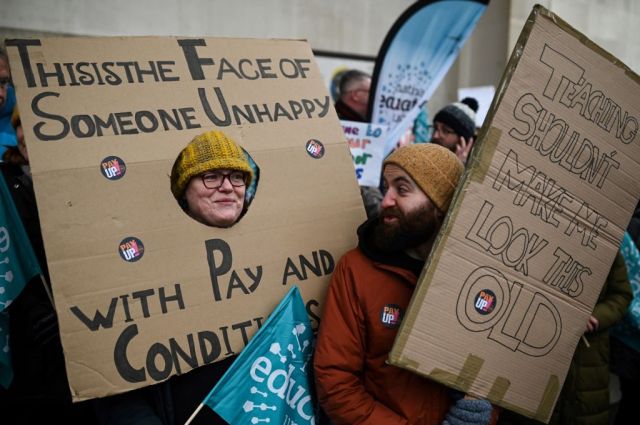
Workers of the world unite? (Oli Scarff/AFP/Getty)





On a plinth outside the Trades Union Congress headquarters in Bloomsbury stands a modernist sculpture by Bernard Meadows. Called “The Spirit of Brotherhood”, it was commissioned back in the Fifties, yet remains a gleaming bronze symbol of fraternal solidarity. Showing a heroic figure reaching down, arm outstretched, to lift a fallen comrade, the statue speaks powerfully to the supreme self-confidence of the labour movement in its postwar glow, gathering the nation’s trade unions and, together, campaigning for the dignity of work.
Today, alas, things feel very different. Where “the Left” once connoted strike-prone shop stewards and horny-handed socialist rabble-rousers, today the new bogeymen for the City, the business lobbies, and the political Right tend to be soft Left MPs, picked from the serried ranks of Russell Group Labour Students societies and the progressive middle classes. And if the TUC is currently looking to downsize from its Bloomsbury pile, hardly surprising when the labour movement is now so diminished, the unity so vividly inscribed in Meadows’ sculpture also feels very far away, and it’s unclear whether even Andy Burnham and his protruding Northern vowels can do much to bring it back.
The most obvious example of union fracturing is in its schools. The NEU, Britain’s largest teachers’ union, is currently in a bitter dispute with three of the country’s largest general unions: Unite, Unison and the GMB. In essence, the disagreement centres around who gets to organise teaching assistants. That, you might think, is a rather arcane, technical dispute. Yet it has ignited fury within the Labour-affiliated mega-union, and could, according to a source familiar with the matter, even result in the teachers’ suspension from the TUC.
How to explain these oddly high stakes? Because, I’d argue, they reflect broader divisions at the heart of the union fraternity — on how to combat new threats to the Left and Right, and how to deal with the realities and disappointments of the Labour government now in office.
The old Labour Party’s Clause Four once promised to “secure for the workers, by hand and by brain the full fruits of their industry”. That was because there was an acceptance that cognitive, intellectual labour was a core part of the production process, a commodity to be exploited by capital just like any other. Sections of the Left still maintain a similarly expansive definition of class identity. Mick Lynch, the former transport workers leader, recently claimed that “if you don’t own the means of production, you are working class. If you have to get up when the alarm clock goes off and do a job and you depend on your earnings rather than your assets then you are working class.”
But this Marxian approach, attempting to unite all wage-earners within a diverse proletarian cause, is broad enough to deprive the term of any useful meaning or specificity. A definition that includes doctors, academics, bank managers and creative consultants within the same category as minimum-waged warehouse workers strips the former of those nuanced and overlapping privileges, accrued through what the French sociologist Bourdieu called habitus: the social mores, soft skills, personal tastes, lifestyles, education and values of people who share the same background.
These differences aren’t merely superficial — least of all in Britain — but indeed result in wildly opposed political visions. Polling last week revealed that trade unionists were more likely to support Reform than the Labour Party. The Unite leader Sharon Graham, who has openly toyed with the idea of disaffiliating from Labour, said that the numbers were “damning but not surprising”, that “Labour has abandoned the working class”, and that, therefore, “the working class have abandoned Labour”.
But that isn’t quite right. Instead of a homogenous blob moving en masse away from their traditional partisan loyalties, we find that the working class is no longer an intelligible or coherent political bloc at all. The masses have been replaced by a networked mess of competing cultural-political factions, separated by educational, generational and linguistic chasms. Certainly, those headline polling figures conceal predictable fissures. Among trade unionists with a university education, for instance, Labour was still the more popular party, gathering 34% to Reform’s 19%. Among non-graduates, however, the percentages were roughly reversed, with Reform gaining 36% to Labour’s 22%. While the Greens performed well among younger trade unionists, winning among 18-24 year-olds, their support nosedives for older members.
Beyond the numbers, meanwhile, these tensions are clear enough on the doorstep somewhere like Makerfield. In this Reform-friendly, white working-class seat, whether Burnham can still make the old language of work, place and solidarity sound vaguely plausible is being billed as an existential test for broad-church Labourism. It is, one activist tells me, a chance for “proof of concept”: reuniting the Left’s core vote under the Labour banner while also peeling off a nice chunk of Reformers. If the labour movement’s inherited unity is now more bronze sculpture than living reality, Burnham allies pray that it can now be revived by his inchoate brand of Mancunian normie populism.
If it’s tempting, however, for the Left to appeal to the putative “common economic interests” of lecturers and Deliveroo drivers, the country’s actual conditions prompt the opposite conclusion. Whether they like it or not, for example, professional-managerial workers are the beneficiaries of low-skilled migration, providing them with a cheap services class and the pleasant air of cosmopolitan vibrancy so beloved of the urban creatives, hipsters and the boho intellegentsia. No less important, these same professionals are largely insulated from the worst effects of intensifying competition for housing and jobs. That may explain why pollsters record that the white collar so-called “ABC1s” are less likely to think immigration is too high than the manual workers in the “C2DE” cohort; the lowest decile of earners saw an over-supply of cheap migrant labour squeeze their wages even before the Boriswave.
On climate policy, meanwhile, adherence to net zero and all its commandments might be sacrosanct for some workers — a general mark of basic decency, say, for a sociology professor. But for those remaining in our dilapidated manufacturing sector, “net zero” is more likely to be associated with high energy costs and the decimation of heavy industry.
Unite and the GMB, both representing workers in the oil and gas fields, are regularly found arguing in favour of North Sea drilling, setting out the case against net zero, and questioning the “just transition” and “climate jobs” rhetoric of the mainstream centre-left. They support Heathrow expansion, heavy infrastructure spending and a robust, developmentalist industrial strategy. Both unions are also reticent about adopting aggressive anti-Reform attack lines; they’re fully aware that a significant part of their membership base fully supports a Right populist agenda.
In contrast, though, the NEU has willfully engaged Nigel Farage in public rows, describing Reform as “racist” and “far Right”. The Reform leader has reacted in kind, last year telling a meeting that he was “anticipating a teachers’ strike very quickly” if he wins a general election. Why? Because, he claimed, “they are poisoning our kids” with critical race theory. For his part, Zack Polanski has spoken at both the NEU’s annual conference, and at the University and College Union, the body representing lecturers.
In the end, that rather abstruse row over teaching assistants should be seen in this context. For the teachers, flirtation with the Greens and a kamikaze approach to relations with fellow trade unions represents an opportunity for a political breach — with a movement that it thinks has become too conservative, too set in its ways, too unwilling to confidently challenge Reform with a strangled cry of “No pasáran!”.
All this is new, even compared to the glory days of Meadows’ statue. Way back in 1900, the Labour Party was formed as the Labour Representation Committee, intended as the parliamentary wing of the trade union movement. Now, though, the old congregation is splintering into sects. And if it’s too early to know what all this means for the future of trade unionism in Britain — let alone for the party that receives around £10 million in union funds a year — the question now must surely be: what will Andy do?
Happily for Graham and the other union bosses, Burnham is surely better placed than most Labour politicians to paper over the movement’s fractures. With a bold economic offering, he may even persuade enough voters that Labour can go beyond the comfort zones of the progressive graduate class, rediscovering its radical roots. But a byelection victory, if it happens, will not by itself restore the lost unity of the Left, because the seams now running through the labour movement are not merely failures of what Westminster calls “comms”. They are rooted, rather, in our nation’s divergent experiences and incentives. As the old rallying cry went: “The workers united will never be defeated.” But the next defeat, especially it comes from an insurgent Faragism fuelled by working-class disaffection, could leave a decaying broad-church labourism with little more than rusty statues.
Jonny Ball is a Contributing Editor at UnHerd. He formerly wrote under the name Despotic Inroad.
 DespoticInroad