




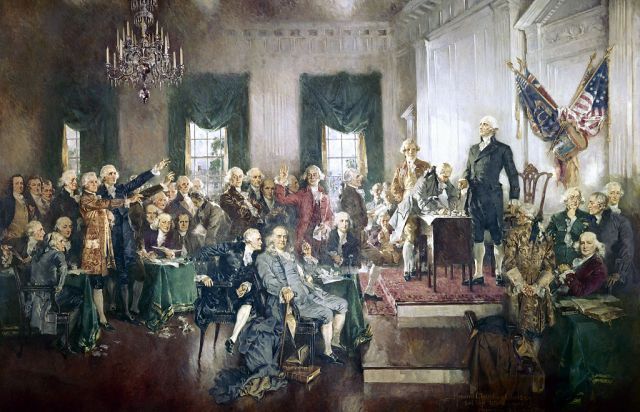
The Signing of the Constitution of the United States, with George Washington, Benjamin Franklin, and Thomas Jefferson at the Constitutional Convention of 1787; oil painting on canvas by Howard Chandler Christy, 1940. The painting is 20 by 30 feet and hangs in the United States Capitol building. (Photo by GraphicaArtis/Getty Images)






Next month, Americans mark the 250th anniversary of the Declaration of Independence from the British Empire. Although the present US Constitution was written in 1787, ratified in 1788, and first implemented in 1789, during the anniversary celebrations this summer we can expect to hear widespread encomia to the genius of the Constitution as well as of the eloquence of Thomas Jefferson’s preamble to the declaration.
Don’t believe it. While it was a milestone for its era, the US Constitution is deeply flawed. The most successful contemporary democracies have learned from America’s mistakes in designing their own, more recent national constitutions. Pious American patriots sometimes say that “the Founders built better than they knew.” In reality, the Founders botched the job.
Consider two current controversies, over President Trump’s demolition of the East Wing of the White House to build an official ballroom; and the Supreme Court’s involvement in partisan congressional redistricting in Virginia. In a country with a well-written constitution, neither would be a subject of controversy, because lines of authority would be well-delineated and unambiguous.
Can a president of the United States, a temporary occupant of the executive mansion, command upon a whim that much of it be demolished and rebuilt, on the basis of a design he alone has approved, with private, rather than public, funding? Surely, this is the kind of technical question that a well-written constitution would clarify. Congress authorized and funded the last extensive renovation of the White House under President Harry Truman, and under laws passed by Congress, major renovations are supposed to be reviewed and authorized in advance by the National Capital Planning Commission, or NCPC, and other agencies.
But Trump ordered the demolition of much of the White House before he sought approval from the NCPC, which he obtained only later, after a federal judge intervened to block construction and after he had stacked the commission with loyal appointees. The attempt of Trump’s Republican allies in Congress to belatedly fund the ongoing destruction has run afoul of parliamentary rules that govern what can be included in a funding bill under the procedure of budget reconciliation.
Either the Constitution allows a current president to unilaterally reshape the buildings and landscape of Washington, DC, on his own authority — or it doesn’t. If Trump does have the constitutional authority to destroy a third of the White House on his own initiative, can a future President Gavin Newsom or Kamala Harris demolish the Washington Monument and replace it?
Progressive Democrats as well as Right-wing Republicans make extreme claims about the location of authority under the Constitution — when it suits them. After Virginian voters, in a referendum on April 21, approved a plan by Virginia Democrats to gerrymander or rig congressional districts to lock in a Democratic majority in the state’s delegation to the US House of Representatives, the state’s high court struck down the measure as illegal because it didn’t follow proper procedures to amend the state constitution. The federal Supreme Court unanimously refused to review and possibly overturn the Virginia state supreme court’s decision.
Each of these cases illustrates a major design defect of the American federal constitution: the separation of powers, in the case of the White House ballroom; and America’s unique system of federalism, in the case of the Virginia gerrymandering case.
The Founders, bless their hearts, believed in the quaint 18th-century theory that safeguarding democracy and civil liberty required that executive, legislative, and judicial powers be allocated to different, independent, co-equal government branches. The theory was mistaken. We know it was mistaken because Britain and the other major English-speaking countries — Canada, Australia, and New Zealand — all have parliamentary systems, in which executive powers are wielded by the prime minister, a member of the legislature, with the British monarch serving as a ceremonial figurehead.
If the Founders had been right about the separation of powers, then Britain, Canada, Australia, and New Zealand should be undemocratic, illiberal regimes dominated by an all-powerful legislative dictatorship. Indeed, in defiance of the theory of the American founding, most other democracies in the world today have parliamentary or hybrid systems, rather than American-style presidential systems based on the separation of powers. The Founders, though undoubtedly great practical statesmen, were wrong on this fundamental point.
To make matters worse, as the political scientist Juan Linz argued, liberty and democracy tend to be in greater danger in presidential systems, rather than in parliamentary systems. The reason is that the separately elected president can claim equal authority with the legislature, and in a constitutional deadlock, he or she is more likely to command the loyalty of the armed forces and internal security services. Conversely, the only way that a legislature in a presidential system can remove an independently elected president is impeachment.
In a parliamentary system, prime ministers can fall from power when their parliamentary party or coalition loses the majority. And between elections, they can be dumped by their fellow legislators, with a vote of no confidence or similar measure, whereupon they once again become mere ordinary members of parliament, if they do not resign from politics. Just ask Keir Starmer. This model renders impeachments of prime ministers unnecessary.
The separation of powers in presidential systems, then, is more likely to cause breakdowns of democracy than to prevent them. On Jan. 6, 2021, after Trump falsely claimed that the election had been stolen by Joe Biden, MAGA supporters seeking to thwart the ratification of the Electoral College results ransacked the US Capitol and forced members of Congress to flee to safety. On Jan. 8, 2023, after another Right-wing populist, Jair Bolsonaro, lost the presidency of Brazil to Luiz Inacio Lula da Silva, supporters of Bolsonaro broke into and damaged the Brazilian presidential palace, the legislative chambers, and the high court, in the part of the capital of Brasilia known as — what else? — the Plaza of the Three Powers.
In contrast, when the party of another right-wing Populist, Viktor Orbán, was reduced to a minority in the Hungarian parliament on April 10 of this year, Orban graciously resigned as prime minister. In Hungary’s parliamentary system, he had no alternative. He could not claim to be the sole tribune of the Hungarian people, as he had never been directly elected, only chosen by his party when it held a legislative majority.
To be sure, there have been prime ministers who have become dictators in effect, like India’s Indira Gandhi, who ruled by authoritarian methods during the 21-month emergency of 1975-1977. But in 1977, Gandhi lost her own seat in parliament in an electoral backlash only to be re-elected and serve as prime minister again from 1980 to 1984.
In Turkey, Recep Tayyip Erdogan, prime minister from 2003 to 2014, was able to deepen his authoritarian rule only after he became president under a new Turkish constitution that converted Turkey’s parliamentary system to a presidential system. Thanks, American Founders!
American-style presidentialism, then, in other countries as well as the United States, encourages power grabs by chief executives, checked only by impeachments by the legislature and judicial rulings that a president might ignore (“John Marshall has made his decision,” as Andrew Jackson famously said when the high court displeased him, “now let him enforce it!”).
While the separation of powers is a constitutional crisis waiting to happen, the federal system inherited from America’s wise and enlightened Founders is simply a mess. Under the constitution of 1787, the authority of the states and their citizens is supposed to be protected from the federal government by two methods — a clear division of authority between state and federal governments, and the representation of the states as distinct corporate bodies, each with two Senators who initially were chosen by state legislatures. Since the founding, both of these parts of the American constitution have broken down.
Instead of a clear-cut allocation of different responsibilities to state and federal governments in a two-layer cake, we have something like a Streusel swirl, in which federal, state, and local authorities in particular areas are blended and intertwined. Much of the blending is the result of federal funding of state and local programs, including hybrid federal-state programs like Medicaid. The federal Department of Transportation, for example, pays in part for local bike trails and pedestrian walkways, in addition to federal interstate highways.
The reason is simple. When advocates for a policy can’t win at the level of the city council or state legislature, they often find allies in Congress to fund or mandate their favored program, federalism be damned. Interest groups on the Right as well the Left are willing to shop among levels of government until they find one that will do what they want. In the name of states’ rights, anti-abortion conservatives demanded that the Supreme Court return abortion policy to the states, and succeeded when the Court repealed Roe v. Wade in 2022. Meanwhile, pressured by deep-pocketed tech investors, the Trump administration has sought a federal ban on state regulation of AI. When it comes to federalism in the United States, the working theory of both parties and all factions is that whatever level of government they and their allies control has the authority to carry out the policy they want.
The second protection for the states built into the US Constitution — the election of two senators from every state — lost its purpose long ago. Originally, US senators were elected by state legislatures, on the theory that they represented states as political entities. But the 17th Amendment in 1913 wrecked the structure by requiring that US senators, like representatives, be elected directly by citizens.
But while congressional districts that send representatives to the House are revised after every census, reflecting population growth and sometimes partisan gerrymandering, the rule that each state has two senators, regardless of its population, is part of America’s defective constitution and can’t be altered. The result is that the Senate is the most grotesquely malapportioned legislative chamber in any country in the world. A voter in Wyoming, which has around 590,000 residents, has 66 times the political influence in the Senate as California, with its 39 million residents. The genius of the American constitution!
Would foreign leaders drafting a democratic constitution today in any country think, “Let’s copy the US Constitution and create a bicameral system in which the population ratios in one branch of the legislature can be as uneven as 66 to one”? Would a constitutional convention in a newly democratic Iran or China choose a presidential system in which an independently elected president, unchecked by the legislature, could plunge the country into a foreign war or tear down or build national monuments in the national capital with private money and without legislative authorization? No, they wouldn’t. Rational founders in the 21st century would conclude that democratic stability and continuity are likely to be more secure under a parliamentary regime than in an American-style presidential system.
Madison, Washington, Franklin, Hamilton, and the other members of the Constitutional convention of 1787 were patriotic, brave, well-informed, thoughtful, and public-spirited. These were unquestionably great men. Unfortunately, in looking for models for self-government on a national scale, they only had the examples of ancient, medieval, and modern city-states, leagues, and the proto-parliamentary British monarchy. With the few precedents at their disposal, and given the need to compromise to hold the shaky union together, the drafters of the US Constitution did the best they could at the time. But they screwed up. It’s time that Americans admit it.