




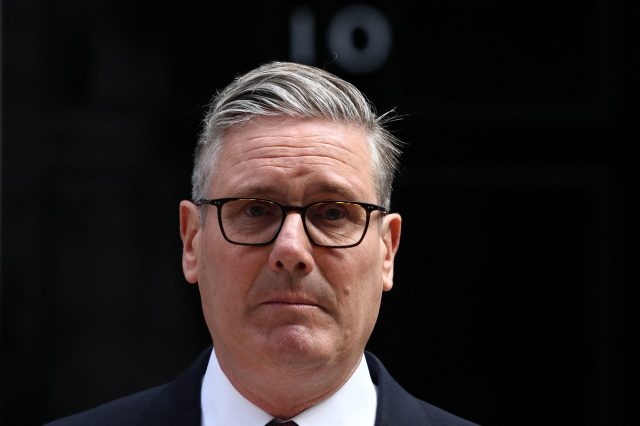
Two-tear Keir? (Henry Nicholls/AFP/Getty)





After an embattled two years, it’s Starmer’s turn: on Monday, following a weekend of escalating press speculation, he stood at the podium where he delivered a short statement that robotically listed his supposed achievements and then, with obvious emotion, announced his departure.
Perhaps the robotic tone was because he’s not actually all that proud of his record. Starmer’s denunciation of the previous regime as “morally bankrupt” is difficult to dispute, but can a man widely referred to as “two-tier Kier”, for his palpably asymmetric approach to public order, really boast of “decency”? Can a man whose legacy will be full-term abortion, censorship, digital surveillance, and the abolition of trial by jury really claim to have rescued Britain from the moral abyss? Can a man who gave us soaring youth unemployment, who shrugged at farm suicides, who thinks nothing of bankrupting schools for disabled children and religious minorities, really boast of returning to Britain a sense of pride?
Who cares? Not the Westminster court press, which reports on it all excitedly, as though this now wearily familiar Downing Street bloodshed is nothing more than a soap opera. And perhaps they’re right to ignore the substantive issues, and treat it as spectacle. This is, after all, arguably, a sober assessment of the relationship between any given prime minister and the machinery of governance.
Exactly 10 years ago, the country went to the polls to vote on whether or not we should remain in the EU. I voted Leave, as (narrowly) did the country. Overall, the desire was twofold: in the words of Vote Leave, to “Take Back Control”: that is, to restore democratically accountable national government, from its dissolution into the opaque Brussels machinery. And, relatedly, to end an inflow of immigration that, thanks to Brussels, we were powerless to control.
The deeper issue at the time, to my eye, was not just transnational treaties but state capacity. We couldn’t long maintain a reserve of competent civil servants, politicos, and mandarins, while also outsourcing to Brussels much of the policy you’d expect such experts to devise and implement. Just as muscles atrophy when you don’t use them, my fear was that eventually we’d lose our capacity to do joined-up policy, as an independent state. Civil servants would relax into the inertia of EU autopilot, and assume the totality of their job was implementing procedures and strictures devised elsewhere.
But the hour was already late. The regime’s inflexibility began causing real frustration with the global financial crash. A post-political regime that hummed along (it seemed) nicely in the boom years began to show its downside in the bust, in an insatiable appetite for human quantitative easing, delivered with a breezy lack of electoral accountability. Even so, after the crash, public faith in the settlement didn’t falter straight away. A hung Parliament in 2010 attested, even then, to the deep divide over how Britain’s future ought to unfold, but Cameron, as coalition leader, served a full term and was re-elected. Back then, more people than not at least somewhat trusted the British government.
So did I, by and large. In 2016, I thought matters might still be salvaged: that state capacity might be retrieved, and that it was worth trying. Over the past decade, though, I’ve come to wonder if I was wrong. This time a decade ago, the British people voted for change, and to take back control. But 52/48 is almost a hung Parliament, and the Remainer resistance was immense and well-connected. The ensuing trench warfare took years, claimed two prime ministers, and gravely damaged what trust the public still held in the idea that British governments answered to the British people. So did it work? Well, the monkey’s paw curled, and we have since enjoyed incessant change — of prime ministers. But we don’t seem to have taken back control of anything that actually matters.
This sense, that the democratic steering mechanisms on the machinery of state are purely decorative, was ultimately what prompted the Brexit vote. But even Brexit doesn’t seem to have produced the desired increase in responsiveness. All it has done, in fact, is increase the speed at which frustrated electorates cycle through prime ministers, hoping each time that this will be the one whose efforts connect with the machine, and who can show an ability to drive it.
Again and again, since Cameron, we’ve elected a new leader, who then governs for an eyeblink, and sees their approval rating plummet. Again and again, they come up against the same problem, that the Leave vote was supposed to remedy: the machinery of government won’t be steered. And no matter how many times we yank out the steering wheel and replace it with a different one, the machine just keeps trundling along.
This is surely why Starmer’s list of vaunted achievements is so paltry he had to read it out, at the resignation podium, in his bad-faith robot voice. The contrast was all the starker because so swiftly followed an emotional expression of gratitude to his family, that — unlike his rubbish “achievements” — he obviously did feel able to deliver with his whole chest. But for all the time I’ve spent ragging on Keith-GPT, he was ultimately a victim of the same problem as all the others.
By December 2024, barely six months and a single rioting season into his premiership, he was rubbing civil servants up the wrong way by complaining that nothing he wanted to do seemed achievable, because so much of the bureaucracy seemed comfortable in the “tepid bath of managed decline”. The mandarins were miffed. But Starmer wasn’t saying anything Dominic Cummings hadn’t already said during the Coalition years — and which hadn’t, in fact, long animated Cummings’s rationale for bringing Britain out of the EU. Cummings is still saying it, arguing recently that we’re stuck with stagnant growth, lagging technology, and dysfunctional public services, because the governing class is hell-bent on preventing change. Instead, their priority is preserving the interests of their own caste.
So if, after scant months in office, a proceduralists’ proceduralist like Starmer was sounding off about the Blob in terms scarcely distinguishable from Dominic Cummings, the reasonable conclusion is that there’s probably something to the critique. But Starmer didn’t grip any of these structural issues. Instead, under his premiership we have enjoyed two years of interconnected and ramifying cockups, as assorted forms of entrenched dysfunction interact in ever more complex and unhappy ways. This background of fractal ineptitude, vividly set off both by the regime’s perceived bias against white Britons, and at best ambivalent resolve on tackling mass migration, then provided a backdrop to assorted Labour factions who, sensing Starmer’s core ideological emptiness, have seized the opportunity to advance crank hobby-horses such as legalising suicide.
I see no evidence anywhere else in Labour (except from the Dark Lord himself, Tony Blair) of concrete thought on these structural issues. Who it’ll be is still undecided anyway: Starmer has evidently decided not to make it easy, and has announced a leadership contest. But it’ll be Burnham in the end, and my unhappy suspicion is that that come September, he will rock up at No. 10 with his boxes of Jamie Oliver cookbooks and suitcase of Professional Northerner regalia only to find that he, too, can’t get the machinery of government to respond.
Will he be courageous enough to get under the bonnet and change how the engine works? I don’t know. But a recent profile by a Manchester journalist, who has covered his mayoralty for years, depicted Burnham as a gifted unifier and genuinely popular, but weaker on joined-up governance. For example, a flagship homelessness scheme he launched in Manchester ended up, in practice, operating at cross purposes with other housing services. Meanwhile, the rest of the Labour bench are overwhelmingly more aligned with the architectures of business as usual — with the quangos, the mandarins, the judges, the human rights, the entitlements, and all the suffocating rest of it — to have any interest in letting him tinker. And Labour’s ungainly post-industrial coalition pulls in so many contradictory directions that the party remains, for now, woefully paralysed.
So unless Burnham is keeping his cards very close to his chest, once we’re through the latest round of court soap opera the almost inevitable prospect is more of the same. Another round of flashy, headline-grabbing schemes; another round of the permanent bureaucracy limply going through the motions, then resuming whatever it was doing before. More mass immigration, more Net Zero, more decline. More unrest. And, in due course, more Downing Street blood-letting.
But who knows, perhaps this is the least worst outcome. Last time we had a Labour government with a substantive plan for revolution, we ended up with Tony Blair’s constitutional vandalism. We are still living in his world today. That’s why voters are so frustrated, why the system won’t do anything else, and why every prime minister ends up hated. Ending the bloodshed requires not revolution, but counter-revolution.
This of course raises the grimmer and deeper question of whether Britain even retains the state capacity to make a success of such a counter-revolution, or could muster enough aligned operatives to replace those who would inevitably try and obstruct it. But evidently I haven’t learned anything from Brexit, after all, because I think it’s worth trying. If nothing else, just because it would make such a pleasant change to get through a full Parliamentary term, without having to hose another prime minister off the pavement.
