




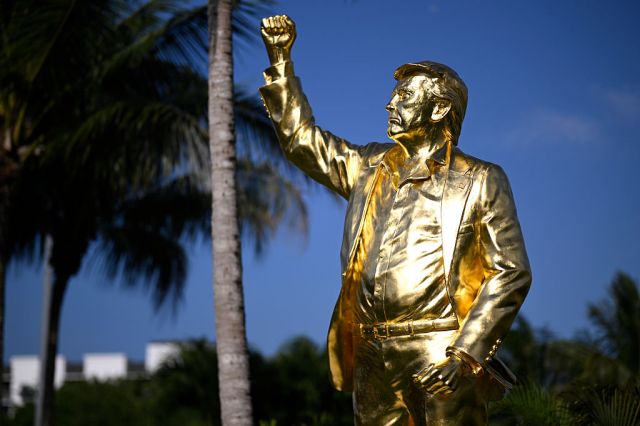
Golden TACO. (Orlando Ramirez/Getty)





The epic disaster that followed Donald Trump’s air assault on Iran was the expression of two extreme likelihoods. One concerned the assault itself, which almost everyone knew would empower the Iranians by handing them pretext for shutting the Strait of Hormuz — which is why prior administrations, however much they hated the mullahs, didn’t do it. The second concerned Trump, whose grandiosity and lack of judgment more or less preordained that he would eventually do something not just monumentally corrupt but practically and irreversibly disastrous.
But, using certain utopian mental adjustments, Trump’s elite supporters discounted or dismissed this latter likelihood. By utopian I don’t mean their understanding of Trump himself was idealistic or unrealistic. In fact, it was often the opposite. Many of Trump’s supporters openly conceded that his character was uniquely bad. Yes, they said, Trump’s an unsavoury guy by the ethical standards we uphold in regular life, but politics is not regular life, and, more important, the present moment isn’t regular politics. They believed, circa 2016 and again circa 2020 and 2024, that the hegemony enjoyed and enforced by authoritarian progressives both inside and outside government had grown so total and entrenched, and was so perverse in the beliefs it propounded and protected, that conservatives had to abandon politics as usual in favour of something more transgressive and outrageous.
This is where the utopianism comes in. But, before I go into the specific utopian characteristics of pro-Trump thinking, I want to back up and note the structural similarities between such thinking and more familiar forms of utopian political theory and practice that reach us from the political Left.
The progressive “hegemony” I referred to above has clear parallels with capitalist society as it appears in Left-wing theorising. This thinking grew from Marx’s own “critique of ideology”, the view that people, in effect, could not see and think and govern beyond the stage of economic history in which they found themselves. The critique of ideology came to eclipse economic analysis and dominate the most influential Marxist writing in mid-20th century Europe and America, as capitalism began to look more protean and resilient than Marx had predicted. Needing to account for this resilience, Marxists such as Frankfurt School luminaries Max Horkheimer, Theodor Adorno, and Herbert Marcuse began to dwell on the power of capitalism to reproduce itself at the level of ideology, the symbolic and spiritual realm of society and culture in which political imagination and moral belief are formed. In this theorising — which, thanks to some vigorous sloganeers, we now know as “Cultural Marxism” — everything from popular culture to advertising to psychotherapy works to palliate political discontent, to tease up and give benign release to revolutionary energies, to teach that capitalism is everything and the only thing people might hope for.
Thus did these social and cultural forces within capitalism evolve and spread into a hermetic system of political consciousness often called the “totality” or the “social totality” in Leftist theory. For these high theorists, theorising was pretty much all there was left. With the partial exception of Marcuse, they’d lost faith in revolution, partly because it seemed impossible, given the adaptive powers of the capitalist totality, and partly because they’d seen how real revolutions ended up. It was much easier for Marx, working not that long after Hegel and before any “Marxist” revolutions had happened, to write as if some force of History would guide the transition from revolutionary smashing and the dictatorship of the proletariat to an ideal society where the state itself has withered away. Writing in the Forties and Fifties, Adorno could have no such assurance.
The most prominent updating of this tradition of largely academic theorising about the “social totality” is Empire, the 1999 book by American professor Michael Hardt and Italian philosopher and ex-convict Antonio Negri. Empire was something of a surprise hit when it came out, despite its dense academic prose, because its update of the post-Marxist portrait of the social totality gave it a global scale, and everyone was on about “globalisation” at the time. According to Hardt and Negri, the increasingly globalised economy both relied on and supported its own totality, which they called “Empire” — a decentralised and “deterritorialised” system of trading markets, financial circuitry and undemocratic institutions working on behalf of capital, secured by networks of coercive geopolitical power emanating from the Pentagon. What made Empire nearly impossible to oppose is that it was both everywhere and nowhere in particular.
Empire and its illustrious predecessors, then, recast the political challenges facing radical politics so that they look more or less insurmountable. The social totality of mid-century capitalism, and then the globalised Empire of the end of the century, are so fully stitched together that both electoral opposition and more radical militancy are hopeless. Instead, these theorists tend to reimagine radical politics as happening on smaller scales, via the more abstract or personal channels of art, lifestyle, gender and sexuality. Perhaps the best example of this dynamic was the Occupy protests of 2011. They began as a swaggering movement against financialised capitalism in the seemingly propitious time after its near-suicide. But then they resolved into merely an outdoor chill session of affluent hipsters, while financialised capitalism righted itself and reassumed control.
American conservatives of the early 21st century found themselves in a parallel predicament to those thwarted Occupiers. By the 2010s, cultural progressivism had turned into a constant, slow-moving revolution in morals that felt, paradoxically, like a suffocating status quo, indeed its own sort of social totality. The nuclear family was breaking down, and elite commentators were defending its demise (while continuing to form nuclear families themselves). Popular culture was growing ever more garish in its sexuality. Racial discourse was a pageant of unhinged accusation, in which everything was “white supremacy”.
At some point, conservatives realised what they were facing wasn’t just a social totality, an organic interweaving of various moral tendencies of the age. What they were facing was a hegemon, an Empire — what people were starting to call “the Regime”. These tendencies were propagated by an interlocking network of powerful institutions — from the media to universities to advertising to NGOs — which were not just adopting novel and radical beliefs but enforcing them as orthodoxy.
Directly opposing the Regime became hard to imagine. Like Theodor Adorno, who channeled his gloomy Leftism into the private experience of difficult art, some embattled conservatives chose retreat rather than confrontation. Perhaps the best-known example of this thinking was Rod Dreher’s 2017 book The Benedict Option, which imagined a politics that ducks below the official level of advocacy and electioneering and turns to the nurturing of traditional family life, the homeschooling of children, and the building of small-scale Christian communities. The Dreher option rests on the reasonable idea that the intensity of partisan political fighting needed to effectively oppose the Regime would be bad for the soul, and the soul is the most important thing.
For people like Dreher, Trump made the prospect of taking on the Regime feel even more sordid and soul-endangering. But for other conservatives, it was precisely Trump’s crude vitality that made it possible to imagine finally doing this. “Yes, Trump is worse than imperfect,” Michael Anton wrote in his famous “Flight 93 Election” essay in the Claremont Review. “So what?” The threat and influence of the Regime were so dire that a Trump presidency was worth the risk. Anton takes his own sort of historical reassurance from the direness of the moment. He didn’t say that Trump was guided by a Hegelian force of reason in History, which would steer his actions toward desirable consequences. He said things were so bad that we couldn’t bother worrying about consequences. A radical break and some righteous smashing were good enough.
Charles Kesler’s Claremont Review essay from two years later, “Thinking About Trump”, echoes Anton’s realistic appraisal of Trump’s character but adds certain conceits that start to make the pro-Trump case look more directly teleological. The badness of Trump’s character, Kesler suggests, might be the very thing that leads not just to a righteous assault on the Regime: but to happy outcomes in general. He invokes Machiavelli, noting that sometimes a statesman “may be persuaded to serve the people for the sake of his own personal glory”. The badness of motives turns into a goodness of outcomes by an alchemy of political calculation.
But a more relevant force in the writing of Trump’s presidential destiny was the American Constitution. “As it happens,” Kesler wrote, “the U.S. Constitution famously set up a series of institutional checks and balances to encourage ambitious men to vie against other ambitious men to serve the public good.” The Constitution is as a machine that converts men’s selfish natures — “supplying, by opposite and rival interests, the defect of better motives”, as Federalist 51 put it — into effective governance.
Other Trump supporters have been eager to look beyond the machine-modernism of constitutionalists like Kesler and imagine that the forces shaping Trump’s presidential ends are simply divine. This was the surprising phenomenon in which devout Christians found that they had the same cultural and political enemies as Trump, and that Trump seemed to be conducting his war of insults on their behalf. These Christians quickly put a providential spin on his famously ungodly ways. Kesler himself describes this dynamic in sympathetic terms (while, in cagey Straussian fashion, withholding overt sanction of its supernatural substance).
In 2018, for example, evangelical leader Mike Evans spoke of Trump as “this flawed human being like you or I, this imperfect vessel”, and of God as “using him in an incredible, amazing way to fulfill His plans and purposes”. Since he first emerged as a Republican presidential contender and hate-object for America’s secular elites, this Christian love — circumspect, haloed in divine paradox — was the dominant way in which the un-Christian Trump was cast as an agent of higher fate.
And then he got shot. That is, in July 2024 Trump got nicked in the ear when he might have been hit squarely somewhere fatal, and those halos of Godly paradox were flung away like Frisbees. Trump was now simply the Ordained, divinely consecrated before our eyes by the blood of the outside edge of his own right ear. The not-notably-religious Steve Bannon said, “Trump wears the armor of God.” Tucker Carlson called the miss “divine intervention”. Of the moment when the bloodied Trump stood and shook his fist, Carlson said, “This was no longer a man… this was the leader of a nation.” Darren Beattie called Trump’s 2024 election “miraculous”, and saw it “leading to a new Golden Age”. This was not the usual thanking of God after a near disaster. It was also the summoning of a Trumpian future, a declaration that it was ordained and guided by Providence.
But I think this tic, the repeated reference to outside forces and higher destinies by Trump supporters, is something of a tell. In other words, these people wouldn’t even be thinking about the great fateful forces supplementing Trump’s character and directing Trumpian energies towards higher ends if that character were not so uniquely and dangerously defective. They devote a moment’s thought to Trump — the transgressive brilliance he directs against secular elites, the baroque collection of vices that make up his personality — and the agonised mix of attraction and misgiving generates an urgent, symptomatic, pressure-releasing remedy: Constitutional machinery! Higher destiny! Imperfect-vessel-of-divine-
Still, were it only the Trumpian motive that’s defective, per Federalist 51, I might be on Charles Kesler’s side. I might place my trust in our Constitution’s ability to check-and-balance the slightly corrupt and the overly vainglorious. But if it were just a matter of motives or morality, there’d be no need for the neurotic compensation, no need for the destiny-mongering. The real Trumpian defect that calls out for cosmic or constitutional supplement was always in judgement. His supporters neurotically conjure higher powers that might connect what he does to tolerable outcomes because, with him in the Oval Office, they have a constant, nagging reason to darkly wonder what’s going to happen. This is in part because he doesn’t exhibit much concern with such things himself.
From the beginning of his first presidential run, it was clear that Trump lived in his own world, made up his own rules. There was indeed a glaring moral dimension to this. He happily got away with being an all-around scumbag, someone who stiffed contractors and cheated on his wives and groped women. The Trumpist rebuttal to those who dwelt on these vices often sounded like posturing, the chest-thumping of people wanting to present themselves as mas macho than Trump’s wussified critics. Anton and others mocked “Never Trump” conservatives for their namby-pamby quailing about “norms”, but Trump’s indifference to norms was most worrying because it was part of his indifference to and incuriosity about anything that might condition his will and constrain his action. The most decorous of these conditions and constraints, and the easiest to point out in public discourse in an election year, were indeed the moral ones, the norms.
But the most important of them concerned the empirical realm, the world, the possible actions of other actors, about which Trump was just as cognitively closed off. Charles Kesler invoked Machiavelli’s concept of statesmanly virtù — which denotes a mix of wilful boldness in action and practical insight and foresight about the world of action — in making his case for the morally imperfect Trump. And Trump is obviously wilful, but he’s more impulsive than bold, while his practical insight and foresight are mainly limited to a certain narrow zone: people he might bully. He does hungrily seize the obvious advantage. In more ambiguous and demanding practical realms, however, his foresight reliably fails him, perhaps because it doesn’t occur to him to exercise foresight; he often seems surprised by the obvious consequences of his actions. This is the deep source of the recurring phenomenon now acronym’d as “TACO”: Trump Always Chickens Out.
His Iran debacle adheres to this broader dynamic all too well, with Trump forced into partial surrender and blustery face-saving after brushing aside caution about well-understood consequences of his actions and “boldly” going ahead anyway. Reporting by The New York Times on the lead-up to the war describes a high-level meeting in which Trump listened as Israeli Prime Minister Benjamin Netanyahu claimed the operation would cause the Iranian regime to fall. Regime change was indeed a necessary condition for success in any serious attack on Iran. It was the only way the US might cause an end to Iran’s nuclear programme without triggering the disaster that everyone has always known to expect: the closing of the Strait of Hormuz. Everyone understood this. It was also a pipe dream, which (almost) everyone understood as well. To their credit, Trump and his advisors also understood this. They said Netanyahu’s regime-change case was “farcical”. They said it was “bullshit”.
But they went ahead anyway. Why? According to the Times, “Everyone [in the meeting] deferred to the president’s instincts.” But Trump’s “instincts” are indistinguishable from his vain ambitions. His understanding of the world is totally occluded by his desire to be glorified as its most famous and respected guy. What could these intuitions possibly consist of? They would have to consist of something supernatural, something teleological, something about Higher Fate and Divine Purpose. That people in Trump’s inner circle bought into this vaguely mystical nonsense at such a crucial moment just shows they’d put no thought into where such nonsense came from in the first place. They convinced themselves a Trump presidency would be guided providentially, by forces that transcend Trump himself, because, well, it better be.