




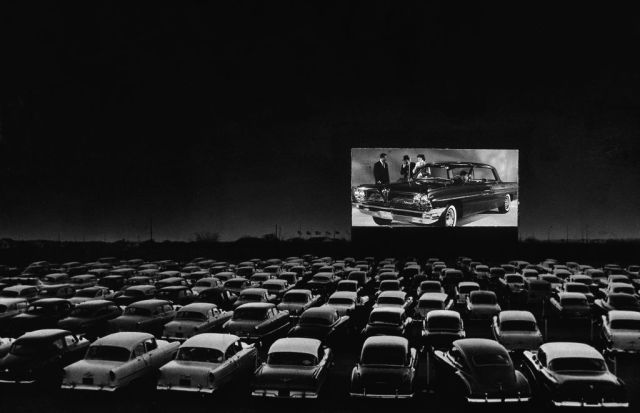
‘Movies have promised us modest fun all our lives.’ (New York Times Co./Hulton Archive/Getty)






Until recently, I had never seen Ewan McGregor’s movie adaptation of Philip Roth’s American Pastoral. I had hardly heard of it. And when I researched it, I found that it had been a serious flop in 2016, earning about a tenth of what it cost. But when my wife and I came across the picture, hiding in the stream, we loved it and were moved by it.
I don’t mean to call it a masterpiece. That can be too much of a burden. But it is so well done (it is the only film McGregor has directed, so far). What did we like? I think it was the unstressed sadness, and how that emotion grew out of its unusual study of a decent family in New Jersey coming apart. It’s about a couple (played by McGregor and Jennifer Connelly) who have a daughter (Dakota Fanning) who has a serious stammer. This is only smoothed away when, grown up, she becomes opposed to so much of Vietnam-era America and takes up a life of underground terrorism in which she bombs a small post office and kills a passer-by. It also destroys her father who had been a shining success in his young life, an athletic hero and a model for many onlookers.
The film sent me to Roth’s novel, published in 1997, to discover how much plot in the 423-page book the film had omitted (it was scripted by John Romano, a good writer on Hill Street Blues and the Coen Brothers’ movie, Intolerable Cruelty). I could see why these cuts had been made, and did not regret them because I felt McGregor had delivered what Roth intended. But the film had an urgency that improved on the Dickensian detail of Roth’s writing; this can be not so much rich and rewarding as claustrophobic. I don’t think it is the great book some commentators (like Harold Bloom) have claimed. Sometimes a movie can get to a point in a compelling way in one shot, instead of three pages. Of course, Roth was so esteemed that may have left editors afraid to touch him.
There has been a truism for decades that great novels make disappointing films while minor or even pulp fiction can be resplendent on the screen. So the films of Anna Karenina or The Great Gatsby are pathetic whereas very effective pictures were made from Double Indemnity (by James M. Cain), Kiss Me Deadly (Mickey Spillane) and The Graduate (Charles Webb). But this orthodoxy has been altered by television’s ability to do a novel, or a series of novels, in proper detail. Part of the impact of the original BBC The Forsyte Saga, in 1967, was that all (or nearly all) the narrative was covered, along with enviable period interiors and a cast of fine performances all done with care and respect. No one then anticipated what we now call long-form television with a literary reach. But it would grow into such epics as The Sopranos, Breaking Bad, Babylon Berlin and Ozark, which at over 40 hours on screen became novels on film — those old-fashioned novels that favour realistic social context, full descriptions of place, furnishing and atmosphere, and a delight in colourful small-part characters.
What I’m talking about is not just a texture of physical realism, but the chance of the story leaving characters more affected by doubt than saved by sudden brave adventure and melodramatic resolution. What I like about the film of American Pastoral is the way McGregor’s character breaks down, without collapsing, so that he anticipates his death before it arrives. It’s a movie that ends with a more poignant, though hushed, feeling for its America, its dream and its imagination, than we expected. It has uncertainties that are usually resolved or tidied up in our movies. That trait is a profound giveaway: American optimism is so desperately insecure. As if we all guess quietly that the recommended positive thinking is a scam.
Does that sound depressing? Movies have promised us modest fun all our lives. But are we really grown-up if we always accept that pressure in movies to have us feel good — again, or not for the first time (as if some grandeur has been lost or taken from us)? Isn’t that the inability to face life that cripples President Trump in his insistence on making America great again? What does that “again” refer to? To slavery, the exploitation of wilderness, to a crowd of unknown souls? When one might aspire instead to decent ordinariness, aware that most of us will die in some sense of failure, and in poverty and anonymity. How irrational to hope for anything much better — like wealth, fame, sexual glory, unhindered ego and an arch of our own — those abiding measures of cinematic fantasy.
What I like about the movie of American Pastoral is that lasting dismay, and a movie experience from which you walk back into the light, not humming the theme song, but so lost in thought you hardly want to talk to other people about what you felt. Because feeling life can be too complicated. So many bought the American ads — until recently.
The marriage of novels and films can work in strange ways. For example, Ernest Hemingway’s To Have and Have Not, published in 1937, is one of his best books — hard, clipped, unsentimental, but assured. But it never won much critical approval. There is a film of it, made by Howard Hawks in 1944, with Humphrey Bogart and introducing Lauren Bacall. It is a travesty of the book (no matter that William Faulkner was one of the screenwriters) but it is a glorious film: a screwball fantasy about courage, wit and sexiness (that uniquely American screen quality). It’s a good example of how Hollywood insouciance could massage a tough book into silky magic.
Hemingway fumed at the movie, but pocketed the deal. Movie has hung over authorship with its apparent promise of easy money. Time and again, Hollywood ruined his work — The Old Man and the Sea (with Spencer Tracy absurd as the Hispanic fisherman) has to be seen to be believed. But was it a dumb book in the first place?
We might all be better off if some fairly challenging novels had been filmed by someone as thoughtful as Ewan McGregor. So why is there no movie of Henderson the Rain King by Saul Bellow (I think Jack Nicholson wanted to do it), or Democracy by Joan Didion (her masterpiece but hardly known), or Kate Vaiden by Reynolds Price, or The Moviegoer by Walker Percy (where a character wonders if he has seen William Holden on the street that gets at the heart of film in a way that could never be filmed), or of James Salter’s A Sport and a Pastime, which in its terse, tender way outflanks most films’ wish to cover sex?
It’s possible for the seasoned observer to say: don’t worry, let literature look after itself. Fair point. It could be that novels will be here after we have stopped making movies. (That seems more likely now than 50 years ago.) Leave open the possibility that the novel’s openness to doubt, disenchanted reflection, and an understanding of failure may keep it alive. Film is in many ways a narrative form, and we still like to follow a story. But film can offer piercing feeling in a split second. And so our “American Imagination” might be more mature if it was open to a little more dismay as well as the thrill of immediate impact. Like Bacall asking Bogart if he knows how to whistle.
This is not only the American Imagination, though that is discussed much more often than the English Imagination — is that because Americans are so desperate to observe themselves in a fit of narcissism, and are in a habit of watching themselves as cinema? Does the happy ending lead to its own madness? I can think of no sadness to surpass Ford Madox Ford’s The Good Soldier (1915) which starts off by calling itself “the saddest story ever told”. This is an English novel, though most of it takes place on the Continent and one of its characters is American. It’s an uncanny book, one to return to every year or so. There was a television version made in Britain in 1981, and it’s faithful to the book’s lethal irony and poisoned allure. But there ought to be a new movie of the novel, one fit for our nausea now, that leaves us unclean or disturbed at having kept company with the characters.
You see, there is a chance in a book that we will be left in shocked awareness of what it is to be left alive.
***
A Sudden Flicker of Light by David Thomson is published by Allen Lane on 7 July 2026.