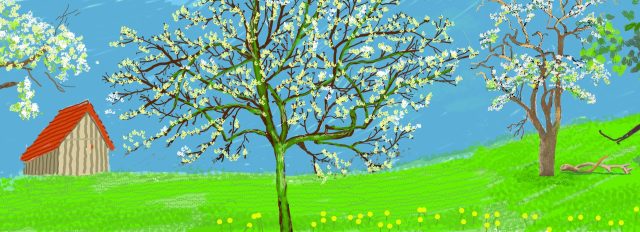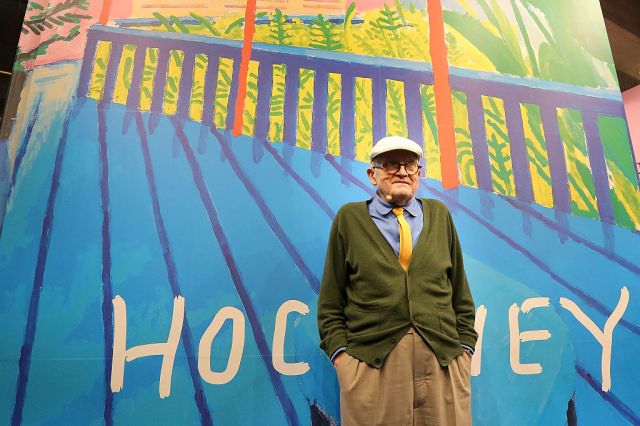
Hockney always trolled us with prettiness. (Hannelore Foerster/Getty)





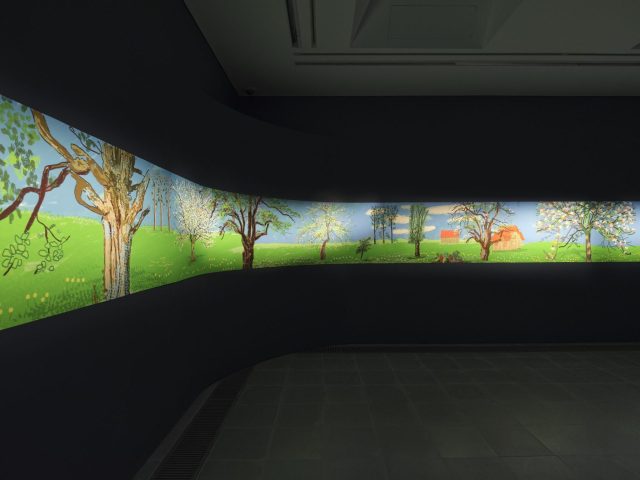
David Hockney has died, leaving London with the most visually seductive exhibition installation of the year as his obituary. A Year in Normandie is the most stunning I’ve seen since the National Gallery’s jewel-like Siena: The Rise of Painting. Entering the Serpentine’s North Gallery, you are plunged into darkness. A stripe of landscape painting in bright colours runs around the wall — so luminous in its colours, it looks on first glance like it’s been made out of neon and, on second glance, that it’s in 3D.
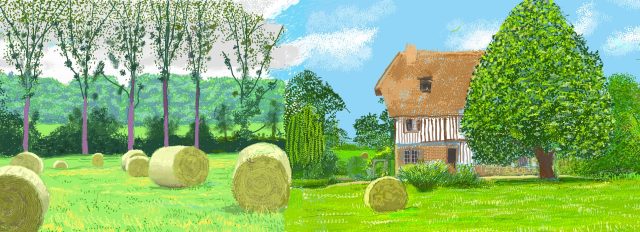
The work consists of 130 paintings of views near Hockney’s home in Normandy, executed on an iPad. They were made in 2020, amidst the pandemic lockdown. The successive scenes tell a story of the seasons, beginning with snow on the bare branches of trees in winter, through to the bright blossoms of Spring, saturated colours of Summer, glowering clouds and rain of Autumn and back to the first snow of Winter. Hockney’s iPad paintings which he has been making since 2010 have never looked so alluring. So, 10/10 for the exhibition design.
As for the art… Hmmm. It’s just the kind of stuff that the art critics like me are meant to dislike: a relentless panorama of prettiness. Pretty flowers, pretty trees, pretty paths, pretty skies, pretty half-timbered houses, runs my internal monologue. Pretty inane. It reminded me of what I used to draw when I was a teenager with my box of Caran d’Ache felt-tipped pens. I found myself wondering how many of the effects were accomplished with tabs you can just click on in the app he downloaded. Hockney said the display was inspired by the Bayeux Tapestry which he visited every fortnight in the first year he lived in Normandy. But hang on, the Bayeux Tapestry will be exhibited at the British Museum from September this year. Mightn’t he have decided to show his iPad drawings in this format because the idea is topical?
The critical voice inside my head continued: “He’s coasting on his celebrity status these days, isn’t he? This is typical ‘late work’ when the artist indulges himself…” Except… except… except I can’t stop looking at them. And the more I look at them, the more I like them. Even though I am trying not to! I can’t turn my head away.
I am hardly alone in this response, as I discovered when I canvassed the opinions of some of the punters looking at the show. Of course, some people simply love Hockney’s art. “It’s the usual David Hockney because he always brings joy,” one art lover told me unambiguously. “I’ve been here a couple of times. The first time I left happy, the second time I left very happy,” another beamed. There’s a second group who don’t rate it but respect Hockney’s devotion to pleasing the average gallery-goer: “It is not breaking any boundaries, but it is giving people what they want,” whispered a visitor to me. Lastly, there’s an ambivalent and confused third group. “I can’t quite decide if I l like it or not,” murmured one. “There are bits where I think I can’t bear this, but I can’t put my finger on why.” It was a sentiment with which I could heartily concur.
And as I retraced my steps around the exhibition several times, a thought slowly dawned on me. Could this be exactly the dilemma that Hockney seeks to evoke in my mind – and the minds of any other over-educated art critics and gallery-goers who might dare to visit his show? For this work goes against the conceptual grain of contemporary art deliberately, defiantly but also skilfully. It also dovetails with long-running themes in Hockney’s art: his return to early 20th-century “ism”s; his pop art sensibility; his interest in technology; and his commitment to beauty.
And then there is the defining aspect of his personality. Hockney loved to wind up the powers-that-be. If the art establishment of the moment decided that the important art was conceptual, “explores” trauma, “references” the identity of the artist, and so on — Hockney would say, uh-uh. I will make art that simply gives pleasure.
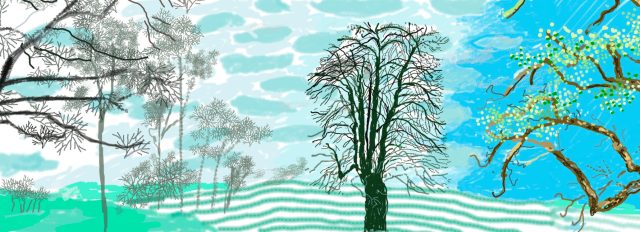
Hockney made his name with sleek and cool pop art images of people and swimming pools in LA in the sixties, but from the Eighties onwards, his art became increasingly inspired by modernist art movements. His large canvases of Californian landscapes were painted in a Cubist style, which also inspired his collages of polaroids. At the beginning of this century his work looked increasingly like Matisse’s. When he died, he was making iPad paintings outdoors in front of his subject, en plein air, to use the parlance of art history, just like the Impressionists. If it was raining, he would sit in a van with his tablet. He would use pure colours to build up and model his forms rather than adding a layer of shading over colours — again, just like the Impressionists did. In some scenes, a myriad of coloured dots recalls the pointilliste movement, while the spidery branches dotted with blossom are very Van Gogh. The colours are hyper-intense, too — a tree in shadow might be purple or crimson — in a manner redolent of the Fauves. I spotted one of those classic metal white-painted garden chairs, sitting in the sunlight; its scrolling ironwork and chipped paint is, deliciously, painted in bold brown, white and black just like Matisse might have done. The hay bales in changing light, Hockney himself declared, are inspired by Monet.
So who was Hockney trying to be? Fauvists André Derain or Raoul Dufy? Van Gogh? Pissarro? Matisse? There are traces of all of them in Hockney’s Year in Normandie, without anything which amounts to imitation. Rather Hockney comes across in these works as the French Post-Impressionist who never was — Monsieur David Huq-Nez, perhaps — working a century too late. Those artists were dedicated to painting beauty, which they might find in a view out of a window, in a back garden or down the road, and that was enough of a purpose for art. In 1908, Matisse wrote: “What I dream of is an art of balance, of purity and serenity… something like a good armchair in which to rest from physical fatigue.”
Today art is expected to supply psychological angst or radical concepts, but Hockney always defiantly maintained the right of art to just be great to look at: “I have always believed that art should be a deep pleasure… There is always, everywhere, an enormous amount of suffering, but I believe that my duty as an artist is to overcome and alleviate the sterility of despair.”
To this artistically retro project, he added a tech element. Hockney’s art was back to the future. His engagement with digital media began in 1985 when he was invited to draw on the Quantel Paintbox for the BBC programme Painting with Light. “I think I was the only one who grasped the possibilities of it as it developed,” he told Serpentine director Hans Ulrich Obrist in an interview. He was invited to the launch of Adobe Photoshop in Silicon Valley around 1989 and could see “the end of chemical photography.” Every image at the Serpentine is made in a new hi-tech medium, the iPad with the drawing/painting app, Brushes, customised for Hockney by a software company specialising in immersive computer-generated environments, Reflex Arc, whose past clients include BBC, Marvel and Manchester’s National Science & Media Museum. Reflex Arc designed special virtual brushes for Hockney, one of which was designed to put down bursts of dots in a pointilliste style. So, yes, to answer my earlier question in the gallery — he really did use a special tool from a drop-down menu.
And what of it? The technology adds its own artistic feel to the work. Look closely and you see how Hockney would build up the image with a simple repertory of fields of colour, dots and squiggles. Hockney’s always been a brilliant draughtsman, and he applies his marks and colours with such deftness that you can identify the weeping willows, oaks and apple orchard trees, along with most of the flowering plants. Although printed onto paper, Hockney’s palette has the electronic intensity of the screen. It’s all clearly structured as layers, which gives it the quality of cels in animation. There’s an anime quality to the world Hockney leads us into, as if he is making Post-Impressionist style cartoons — which leads us back to his Pop Art roots.
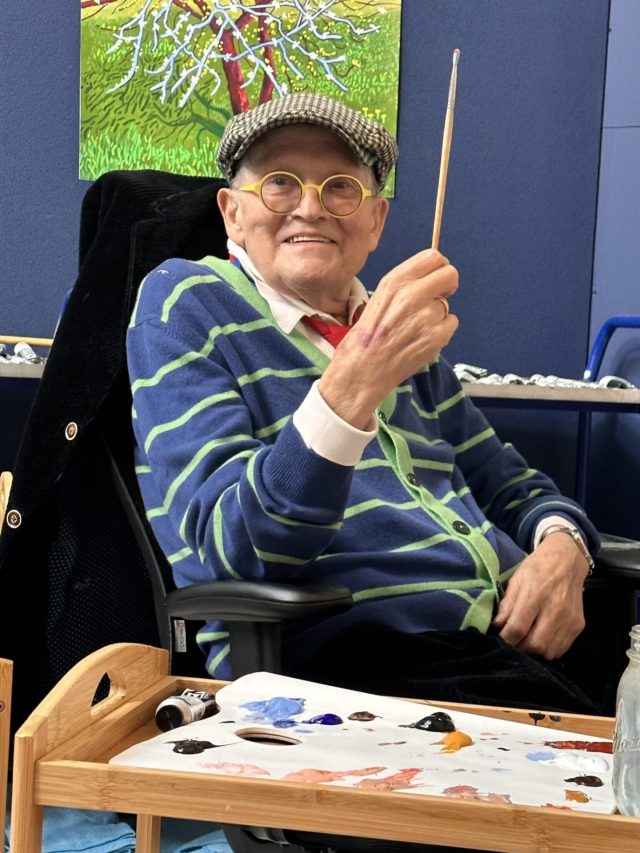
Finally we come to David Hockney the life-long anti-elite contrarian. As a Student at the Royal College of Art in London in the early Sixties, he refused to write the obligatory degree essay and demanded to be graded on his paintings and drawings alone. The RCA changed their rules and gave Hockney his degree. Hockney criticises perspective, that pillar of Western art, at every opportunity; the human eye, he likes to say, doesn’t see in perspective from one point of view at one frozen moment in time. He wrote a book, Secret Knowledge, arguing convincingly that artists were using camera-like tools long before the invention of photography itself. It became a BBC TV series in 2003. Beyond the confines of the art world, he honed a public persona as a cantankerous Yorkshireman. He came across in his interviews as what the Germans call a Besserwisser — someone who always knows better. He was a proud smoker and complained in most of his interviews about the ban in public places: “I think that writing ‘Smoking Kills’ on a packet of cigarettes is just part of the uglification of Europe,” he once said.
So, as tranquil and serene as Hockney’s scroll of Normandy landscapes are, they are also part of his life-long campaign against the establishment. He painted when art critics and curators said painting was dead. He made figurative paintings, when abstraction was all the rage. These days he’s painting on computers — anathema for those who think painting is all about the original hand of the artist. As we have seen, he paints beauty like it’s going out of fashion (which it did long ago). But, it’s not just any kind of beauty: it’s a particular populist, much-maligned, generic kind of beauty, the one you find on postcards and biscuit tins, of landscapes with cottages, blossoms and sunsets. Hockney always trolled us with prettiness.
David Hockney: A Year in Normandes and Some Other Thoughts About Painting is at the Serpentine Gallery until 23 August.