




‘The format is finely tuned for hyperstimulation’. (Sixth Tone)





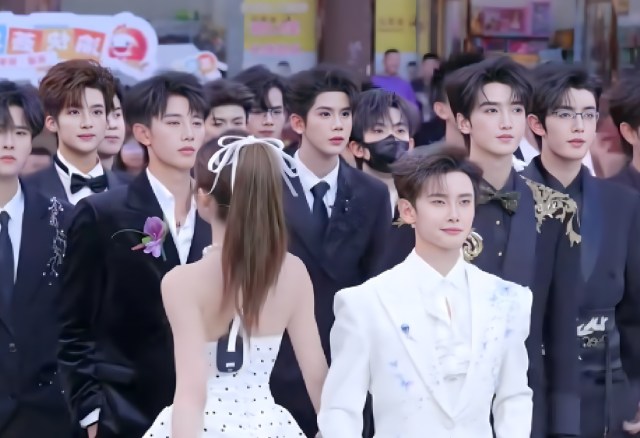
In a square in Chongqing, China, a phalanx of besuited men with floppy hair and thick, white foundation marches forwards and backwards. At the front is a couple dressed in dazzling white; the girlfriend faces away from the camera. The pair bark catchphrases to the unseen livestream audience, thanking the watchers of Douyin, Kuaishou and RedNote (Xiaohongshu) ― the Chinese equivalents of TikTok, which is banned in China ― for their generous donations. When a certain threshold of engagement is reached, the woman will turn around and show her face. All the while, a trance-like song plays: “When the bass gets bumpin’ up in the club / Pour another shot and show me some love.”
The star of these Chongqing streams is Long Haotian, an internet celebrity who competed for China in breakdancing at the Youth Olympics. His girlfriend-slash-streaming colleague is Yao Yao; she talks in a squeaky baby voice and emotes like an animated character on a video-game loading screen. The couple has enjoyed a strange TikTok virality in the West in recent weeks, spurring imitations and parodies and racking up millions of views. Many clips taken from their videos on Chinese sites receive tens of thousands of likes; one has half a million, and its comments overflow with baffled enchantment. “Understood nothing but could not stop watching,” says one. “This is so bizarre but I will watch them in full,” says another. “Why do I keep watching these,” asks a third. Over the course of these streams, precisely nothing of note happens. Regardless, China watches. The revenue of tuanbo, meaning “group or team livestreams”, is expected to leap from 15 billion yuan ($2.2 billion) last year to 40 billion yuan ($5.8 billion) this year. And now, we watch too.
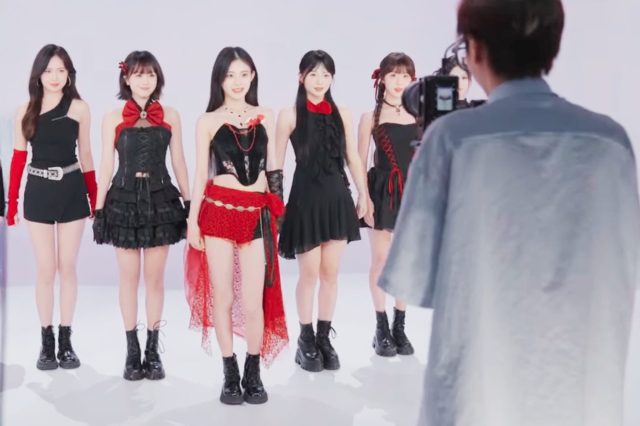
The Chongqing dancers aren’t a one-off: whenever tuanbo makes it over to Western TikTok, we are rapt. The format is finely tuned for hyperstimulation: bright colours, catchy music, constant interaction with a hidden viewership. Elsewhere, the livestreaming models are even more overt in their roles as meaningless revenue-generators. In one video, pavements are studded with ringlights, each illuminating a pretty Chinese woman who speaks into her phone, collecting donations from viewers or selling plastic products. In some streams, performers float surfboards on wave machines; viewers spike when they fall off. Some have line-ups of four or five girls in their teens or early twenties, each of whom can be made to perform the same dance again, and again, and again. Occasionally they pass out or cry from exhaustion, fake or otherwise; this in turn keeps viewers watching. Other videos stage high-stakes scenarios, such as nonsensical factory work under the scowling gaze of a hated boss. In many cases, the audience is mesmerised by the satisfying repetition. Often these “livestreams” are in fact recorded loops: viewers rarely notice, so unvarying is the format.
The appeal is rarely that these streamers are especially sexy, or outrageous, or original — it is that they are absurd and perform on demand. The emptier the logic of the streams, the more engagement they drum up. We are accustomed to Western influencers behaving like miniature celebrities — the principles of authenticity, glamour and charisma are piped in directly from Hollywood — whereas Chinese idol culture is about cohesion. Tuanbo performers make themselves generic and perform robotically, often literally moving like automatons. There is no interest in intimacy or sincerity. Like our baby-voiced Yao Yao, they are stock characters. On the Western internet, the individual is the star; on the Chinese internet, success means operating as a highly efficient whole. And so the two forms of content reflect the philosophies of their alien worlds.
Still, it takes a lot of effort to look that flat. China’s streaming stars are working their arses off to come across as catchphrase-bleating idiots while carrying out meticulous and highly choreographed set-pieces. The finished product more closely resembles a call centre or production line than a television show. In this, the streams mirror the country’s industrial and military prowess. There is often something borderline martial in the videos’ regimentation. No other country attracts foreign viewers with the spectacle of men marching in a city square.
Since the Nineties the West has watched, enthralled and aghast, as China has churned out vast factories, corralled hyperefficient workforces and thrown together cities seemingly overnight. Online, a similar thing is happening to pop culture. If the Californian dream of the internet was about liberating creativity, creating a boundless Eden of artists and independent agents, tuanbo offers an alternative future: content that resembles manufacturing. The livestream host is a worker in a vast attention economy, labouring under the same prerogative for efficiency that transformed the country’s factories into the workshop of the world. The principles of Chinese social media are ruthless visions of the future: hyperrationalism and scale, mass production. We are glued to them as horrified Victorians would be glued to the vision of industrial textile mills. They show us how quickly we become cogs.
I’d wager that Chinese streaming culture has more influence on the West than any CCP messaging. The CCP does not control these streams, of course, nor are they propaganda in any normal sense of the word. And yet, indirectly, they are engines for Chinese soft power: overt diplomacy efforts are always boring and suspect, whereas new media forms quickly become part of Western culture without anybody caring. These spectacularly weird livestreams haunt and hypnotise Western viewers just like American AI slop of talking fruits, or quasi-sexual ASMR. The difference is that China’s productions have emerged from a far less permissive social-media culture in which censorship is pervasive and brutal, and major tech firms are expected to align with state priorities.
Aside from merely degrading the quality of pop culture — a lost cause anyway in the age of TikTok — what makes tuanbo so unsettling is that it breaks down our understanding of the role of the internet as an ocean of creators, free individuals operating without limits, replacing it with a homogenised bloc of content producers and consumers who are, by definition, unsubversive. China’s novel model of scaling and optimising online videos may in the future outcompete the Western model of individual creativity. After all, this is the country that conquered industrialised manufacturing; culture, too, could one day be “made in China”. This, I’m sure, would suit Xi Jinping’s agenda just fine.
Maybe one day, when Xi’s forces inevitably invade Taiwan, the generation of young people who would have turned out on the streets in protest will instead be preoccupied with their phones, watching a squadron of beauty-filtered men in stacked shoes. “When the bass gets bumpin’ up in the club…”
