




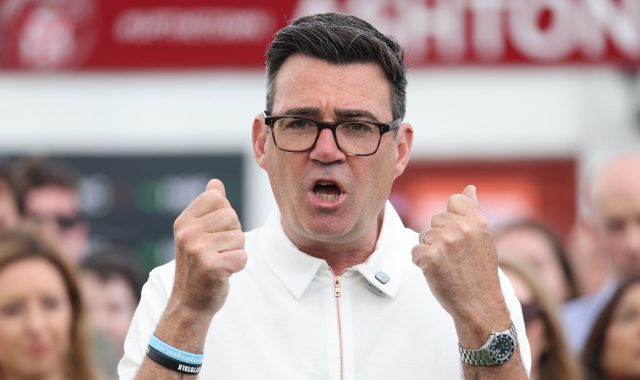
Will he be our liberator? (Ryan Jenkinson/Getty)





Mario Cuomo once said that politicians should campaign in poetry and govern in prose. That’s no longer true, at least in Britain — where politicians must reconcile the demands of the electorate with those of the bond market. Should he become prime minister, Andy Burnham, a keen lover of poetry, must address the country in the driest prose. Because if he makes the same mistake as Keir Starmer, and refuses to confront voters with the hard reality facing the country, then his term in office is unlikely to last much longer than his predecessor’s.
The hard reality is that Britain is in hock to the bond market. Its options are limited, and all the democratic will in the world can’t change that — at least, not in the short term. Galling as it is that fund managers have come to assume a weight similar to, if not greater than, that of democratically-elected governments, that is the consequence of choices made by those same governments over decades — choices that deferred the costs of those decisions to a future that is now, suddenly, upon us.
James Carville, the Democrat strategist, famously said that he’d like to be reincarnated as the bond market because then he could “intimidate everybody”. But it wasn’t always so. There was a time when gilts were the only show in town. Fund managers who needed a stable income from a credit-worthy source had no option but to buy government bonds, and little reason to search for alternatives.
However, three developments have since converged to create the situation in which we find ourselves today. First, financial globalisation opened the world to investors. This helped keep interest low in western countries as investors from emerging markets looked to park their money in “safe havens”. But it also opened the door to investors in those safe havens being able to look elsewhere if that status ever changed.
Second, defined-benefit pensions were increasingly replaced with defined-contribution pensions. In the short term this was another win for governments. With the population aging and retirements getting longer, defined-benefit schemes were going to demand ever bigger contributions if they were to remain sustainable. Switching the model saved employers money in the short term, boosting profits and thereby asset values, which was always a political winner. But it also meant the guaranteed supply of credit from pension managers needing long-term, stable returns diminished.
Third, slowing economic growth in rich countries drove debt higher, as governments postponed the tax rises or expenditure cuts which would bring budgets back into alignment. At the same time, rising economic growth and improving fiscal management in developing countries helped improve their credit-worthiness, creating new competition for creditors.
Today, as a result, hedge funds — increasingly foreign-owned ones — have replaced pension-funds as the main buyer of UK gilts. Footloose and fickle, they chase returns and dump bonds the moment they doubt a government’s fiscal prudence, as Britain discovered during Liz Truss’s premiership. And with plenty of options in a changing world, from higher-yielding but increasingly safe emerging-market debt to corporate bonds, investors can play hard to get.
Voters like poetry — grand visions and promises of pleasure without pain — but fund managers don’t. They want the driest prose: that the bonds they buy will hold their value, that their money will be returned at the promised date, that they can sell the bonds easily if they need cash, and that the interest rate at which they bought them will be honoured.
Keir Starmer and Rachel Reeves failed to bridge that gap. While the Chancellor often talked of hard choices, she seldom made them. On the expenditure side, Labour promised to restore public services but offered few compensating trade-offs. Instead, the Government maintained the triple-lock on pensions, reversed modest welfare reforms and froze most taxes, saying they would raise the growth rate of the economy to pay for it all.
Yet they offered no compelling narrative for how they would do this. The bold changes that might have had an impact, like deep planning reform, a major infrastructure programme or re-integrating with Europe, were all ruled out since various constituencies opposed them. Starmer seemed to think that simply by acting like an adult, unlike some of his recent Tory predecessors, investors would return to Britain and the economy would take off.
It didn’t, and there was little reason to believe it would do so in the foreseeable future. And the fatal consequence of relying upon growth as a get-out-of-jail card, but failing to deliver it, was that Reeves could only keep bond investors on board by constantly sweetening the terms of their loans. Although her fiscal management prevented a Liz Truss moment, it merely spread the pain out over time. Since Starmer and Reeves took control of Britain’s economic direction, UK gilt yields have risen by 0.7%, making it the most expensive government debt in the G7. Investors didn’t panic and rush for the exits, as happened in 2022. Instead, they demanded ever more inducements from their hosts if they were to stay at the party.
In short, Starmer and Reeves began their term of office facing a daunting challenge — deteriorating public services, burdensome debt, a housing crisis, stagnant productivity and a restive electorate demanding action on all fronts — but having chosen first to bind their hands. It was inevitable they would spend their term bobbing, weaving and ducking, desperately holding out for the bell but destined not to end the round. Despite his claim that he bequeaths an economy that “is stronger, growing faster than our peers”, in truth GDP growth is slowing and real wages are stagnating.
Burnham needs to digest that lesson fast, because there will be no time for him to learn on the job. Should he become prime minister, he would take office with the financial conditions facing the government even worse than they were when Starmer took office. As revealed starkly on the morning Burnham’s return to parliament was announced, the interest the government must pay on its debt now consumes nearly 10% of total expenditure, which is considerably more than it spends on defence (itself an area that Britain must spend more on, lest it alienate its many alliance partners). And with bond yields rising across developed markets, that is likely only to worsen.
Yet while the prose demanded by gilt buyers has become even colder and more austere, voters still want poetry. Burnham has offered plenty: re-nationalising utilities, increasing defence spending, cutting student loans, business tax cuts. If he doesn’t rapidly pivot to a prose which the bond markets like reading, he’ll enter the same doom-loop that saddled the Starmer-Reeves duopoly.
Some observers have concluded that this is inevitable, that Britain has become ungovernable and no prime minister can succeed, the proof being that the electorate now cycles through them with stunning rapidity — six so far in the last decade, soon to be seven. This line of thought holds that Britain, like many western countries, is gripped in a sort of Cleopatra complex: voters beat any messenger who delivers news of hard choices, leading politicians to make impossible pledges only to be kicked out the door when they fail to deliver. For all that he spoke of the change he brought to the UK in his short term of office, Starmer shied away from anything major, and it hasn’t escaped notice that even some of the “change delivered” for which he claimed credit in his resignation speech were measures that didn’t originate in Downing Street but were forced upon him by his MPs who resisted change.
Perhaps what Britain needs is better voters. But it seems just as likely that what it really needs is better leaders. The country’s beloved wartime narrative is that in 1940 the country had the option of an easy way out by appeasing Nazi Germany but chose instead to follow Winston Churchill into battle. Is it really impossible for leaders today to muster a will to fight? If Britain wants to end its servitude to the bond markets, it can. All it needs to do is reduce its need for them – by making itself an attractive creditor that can turn down offers that are insufficiently appealing. That will require both a bold plan to boost growth and a credible one to keep current expenditure under control. Labour nostalgists who hark back to the Seventies, when Tony Benn called for a Fortress Britain that would put bond investors back in their place, overlook that Britain is an entirely different place today: our bond-buyers aren’t all Britons who can be corralled behind a national project and our debt is rising and not falling as a share of GDP, giving those buyers ever more leverage.
Perhaps devolution will produce positive outcomes, and perhaps Burnham can tweak Rachel Reeves’s fiscal rules a bit — though only if he’s to produce more convincing ones — but so far he’s produced little of an economic vision. He’d better do so fast, because he doesn’t have the luxury of time. Attention has thus turned to who he selects as his Chancellor as an indication of his economic vision: will it be the left-leaning Ed Miliband ushering in change, the right-leaning Wes Streeting heralding Blairite continuity, or possibly someone else all together?
But that’s looking for clues in the wrong place. Whoever Burnham selects will have their hands bound by the bond market into which Britain has delivered itself. If they have bold ambitions, they’ll need to match it with serious intent to preserve the country’s solvency, lest the markets discipline them. Doing as Starmer did and farming economic strategy out to his Chancellor would be a dereliction of duty. Burnham’s first job is to produce an economic vision for the nation — and if need be, to seek a mandate for it. If there’s one glimmer of hope, it’s that he has begun assembling an economics team, which suggests both a willingness to listen and a seriousness of purpose. One example is Jim O’Neill, a former chief economist for Goldman Sachs, who wants to increase infrastructure spending while keeping to the fiscal rules; another is Mark McVitie, the former director of the Labour Growth Group who has called for a watering-down of clean energy policy and a rise in capital gains tax to fund a 2p cut in national insurance.
On Sunday, the former Prime Minister Rishi Sunak offered him sage advice: “he’ll never have more power than on his first day in the job. It is vital he has a clear and achievable plan for what he wants to do in those opening hours.” One acid test will be what he has to say on triple-lock on pensions, a policy which dooms every government to an eternally worsening fiscal position and will deepen the country’s debt bondage.
If Burnham vows to keep it, his rivals should begin their leadership campaigns now, because his tenure will be as ill-fated as Starmer’s. Burnham will have to govern in a prose we might not enjoy, but there can still be lessons for him in poetry. As he makes the journey from Manchester to London, Burnham might therefore do well to reflect on a similar train journey from northern England chronicled by his favourite poet, Philip Larkin, who observed a car of young newlyweds at the peak of their joy rolling into their destination “ready to be loosed with all the power / That being changed can give”. Much like them, Burnham’s ride will be joyous — but will end in London, as Larkin’s poem ominously does, in a downpour.
John Rapley is an author and academic who divides his time between London, Johannesburg and Ottawa. His books include Why Empires Fall: Rome, America and the Future of the West (with Peter Heather, Penguin, 2023) and Twilight of the Money Gods: Economics as a Religion (Simon & Schuster, 2017).
 jarapley