




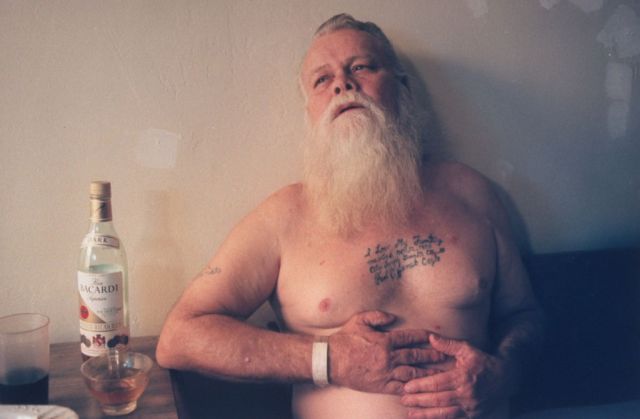
Every American deserves empathy. (Steve Liss/Getty)





The midterm primaries in Ohio are today — but some voters might wonder why they bother. After all, Democrats stand as much of a chance of winning here as the (famously hopeless) Cleveland Browns have of winning the Super Bowl. As things stand, Republicans hold all six of Ohio’s state-wide offices. Even in the state’s most competitive race, pitting former Democratic Senator Sherrod Brown against the incumbent Jon Husted, the Republican is almost certain to win. More than that, and despite wars, inflation, scandal, the vast majority of Ohio’s white working-class voters still approve of Donald Trump, with college-educated Buckeyes remarkably enthusiastic too.
Even armchair psephologists will know it wasn’t always like this. A swing state since before the Civil War, Ohio was once a presidential coin-flip, the national bellwether. As late as 2008, Barack Obama won Ohio by a comfy 4.5 points, with a strong union vote sweeping him along. Then came Trump, who over the last decade has transformed the Buckeye State into something approaching a personal fief, upending electoral wisdom and wonkish certainties as he went. “I wrote a book called The Bellwether about Ohio in advance of 2016,” laughs Kyle Kondik, a long-time electoral analyst, “and the thing was obsolete within a few months.”
That journey, that realignment, has by now been dissected to death. Yet it still feels wholly appropriate that Ohio, that archetypal MAGA conquest, should be voting the same week as the silver jubilee of Nickel and Dimed, published in May 2001. The author, muckraking journalist Barbara Ehrenreich, saw the Trumpian revolution years before Trump. “Someday,” she said of her working-class subjects, “they are bound to tire of getting so little in return and to demand to be paid what they’re worth.” A Leftie to her core, the author was hoping her reportage would inspire unions and healthcare-for-all. Instead we got Trumpism — and reading Ehrenreich tells us why.
At its root, Nickel and Dimed is a work of hard-hitting journalism. Going undercover, Ehrenreich threw herself into America’s underbelly, working as a waitress in Florida, a housekeeper in Maine, and a Walmart clerk in Minnesota. What she called “old-fashioned reporting” laid bare the exploited lives of those 30% of American workers who in 1998 earned less than $8 an hour (the equivalent of $16.35 today). Low pay was shadowed by other indignities. From janitors to cleaning ladies to ditchdiggers, the writer discovered, “these are the untouchables of a supposedly caste-free and democratic society”.
Through a first-person narrative, Ehrenreich makes these people whole. There’s Holly, the dogged Maine cleaner who scrubs tiles on one foot, and George, the friendly immigrant dishwasher fired for “stealing” saltines from the restaurant storeroom. Divided into three acts, the author narrates her journey across the vastness of America, always on the hunt for low-wage work and a budget-priced hovel. Yet through all this, and as Ehrenreich readily admits, no job, no matter how lowly, is truly “unskilled”. Quite the opposite: whether it’s slinging ham-and-eggs or scouring grout, success requires poise and grit.
The daughter of a Montana copper miner, Ehrenreich was reared in the postwar working class — a time when people like her enjoyed real security. In 1975, nearly a quarter of US jobs were in manufacturing, where wages averaged $6.24 an hour. When adjusted for inflation, that’s the equivalent of $80,000, and you didn’t even need a college degree. Post-industrial America changed that equation. Between 1979 and 2005, the wages of those with a bachelor’s or post-graduate degree jumped by nearly 25%; their household wealth leapt by $4 trillion. For their part, the pay of those with mere high-school degrees fell. By 2023, the median weekly wage for a working-class man was, adjusted for inflation, only a smidgen higher than in 1979.
This national story was Ohio’s too. Fifty years ago, the state was the world’s source for rubber, glass, steel. Goodyear, Owens-Corning, and Youngstown Sheet & Tube — these grand Ohio firms employed tens of thousands of people. Justin Gest, an expert on transatlantic working-class despair, tells me that steel in somewhere like Youngstown, a steel centre not far from the Pennsylvania border, was the 20th-century equivalent to Silicon Valley. A George Mason University professor and author of a book on the city, he describes how locals used to say that as long as graphite from the mills fell like black snow onto their windshields each morning, they knew times were good. “They would wipe it off with their fingers,” Gest recalls, “and look at each other and say, ‘this is gold dust’.”
In September 1977, the dust dried up. Youngstown Sheet & Tube shuttered. Automation, globalisation, and dated, uncompetitive factories meant that 5,000 workers became jobless overnight. Over the next few years, another 41,000 lost their jobs in Youngstown’s Mahoning Valley, alongside another 1.2 million manufacturing posts across the ex-industrial Midwest. From 2000-2011, a further 5.4 million American manufacturing jobs vanished too. Ehrenreich’s Nickel and Dimed chronicles the world of low-paying, low-status gigs that arose in the aftermath.
Perhaps that timing explains the book’s success. The author of 21 books and a regular contributor to all the “right” publications — The New York Times, Harper’s, The Nation — Ehrenreich was for decades a staple of liberal American life. Yet Nickel and Dimed was without doubt her critical and commercial hit, becoming a cultural sensation basically overnight. Educated literati gobbled up so many copies you’d think a tofu smashburger lay hidden in its pages. A Times bestseller for weeks, it became a staple of college courses right across the country.
Yet if we “anywheres” wallowed in the opportunities for performative empathy that Nickel and Dimed provided, former Ohio giants like Akron and Toledo — and Youngstown — remained what Gest calls “post-traumatic” communities. This isn’t merely a question of lost income. Rather, vanished respectability and self-value spawned a kind of spiritual vertigo. “They seemed unmoored, untethered from their families and communities,” says Andrew Cherlin, a Johns Hopkins sociologist, of America’s white working class. Without purposeful labour and social ties, divorce, alcoholism, and anomie enveloped whole towns. Sure enough, Youngstown became famous not for its black gold, but for drugs and divorce. By the Eighties, it had become the murder capital of the United States.
Nickel and Dimed appeared just as the second wave of deindustrialisation crested — leaving millions of Americans stranded in its wake. One of Ehrenreich’s most powerful interviews is with a woman called Colleen, who cleans the homes of rich folk in Cape Cod. “I don’t want what they have… But what I would like is to be able to take a day off now and then… and still be able to buy groceries.” Yet if stories like these inspired millions of Americans to wring their hands in tandem, Ehrenreich’s book did not, as its blurb proclaimed, “change the way America perceives its working poor”. Elections came and candidates went and nothing changed for the working class, except for the slow downward spiral. All the while, many liberals were content with putting “Hope” posters in their front-facing windows, safe in the knowledge that Obama’s post-racial utopia was just around the corner. As for economics, it turned out that neoliberalism had its upsides, especially for that class of nimble, educated workers that gravitated towards Ehrenreich’s book in the first place.
At the tail end of the Great Recession, 60% of college-educated Americans described their personal finances as “excellent” or “good”. Non-college whites, and non-college minorities for that matter, felt very differently. Things were especially tough in Ohio. If its footballing woes weren’t bad enough, Cleveland became known as the “ground zero” for the nation’s foreclosure crisis. Once the calamity ebbed, nearly half of the state’s remaining manufacturing jobs had disappeared. By 2013, Ohio’s median income was a fifth lower than what it had been in 2000.
Voting twice for Obama, Ohio’s working-class voters hardly expected miracles. Yet back in 2009, America’s first black president possessed both a mandate and massive congressional majorities. He could have used that authority to empower labour, not least by repealing the 1947 Taft-Hartley Act, which significantly restricted union activities. And if that was a bridge too far, a robust form of negative income tax could have offered Americans like Colleen a future. A less ambitious subsidised childcare programme would, at least, have made low-wage work pay. But if Obamacare was surely a good start, it finally proved rather weak sauce.
And as Ehrenreich warned us, “they are bound to tire of getting so little in return and to demand to be paid what they’re worth”. So when Donald Trump came to Ohio in 2015, pledging to bring back jobs — so fervently that even he urged the MAGA faithful not to “sell your house” before the good times returned — the state’s economic losers understandably responded. “They’ve tried absolutely everything,” is how Gest puts it. “And they continue to feel like globalisation’s losers. And you can’t really blame them.” Outraged that their lives and communities were upended, they voted for the one candidate who spoke most directly to their concerns. And more than once too: in the three presidential elections from 2016, Trump has won Ohio, that erstwhile bellwether, by an average of nine points.
That first triumph in the Rust Belt shocked America’s liberal professional class. And, in another moment of publishing kismet, it was at this point that Gest’s study of transatlantic working-class populism appeared. He recalls the earnest book tours during Trump’s first term. As he puts of white working-class America: “There was this sort of receptivity to better understanding their viewpoint, their perspectives and their life experiences.” Then came 2020, the Capitol riot, and 2024. In the aftermath, Gest observes a sea change in the liberal professional class. “There was a sense,” Gest suggests, “that no one was prepared to make the political compromises required to appeal to them.” Nearly half of liberal voters refuse to even share the same air as a Trump supporter. I’ve seen this transition myself. To quote one of my former grad-school colleagues: “Fuck you, if you voted for [Trump].”
Sure, Democratic elites say the right words. “The majority of Americans,” the party’s National Committee Chair lately conceded, “now believe the Republican Party best represents the interests of the working class and the poor, and the Democratic Party is the party of the wealthy and the elites.” But words, not action, tell the tale. And, in Congress, the number of working-class Democrats is almost nil. The party’s most high-profile “working-class” avatars, Pennsylvania Senator John Fetterman and Maine Senate candidate Graham Platner, are private-school preppies cosplaying in Carhartt and hoodies. Fetterman, a Harvard grad, famously used his mayorship of hardscrabble Braddock, Pennsylvania as a political launching pad. Other than turning an abandoned car dealership into his groovy loft, his adopted town is still on its back.
As for Ohio, the Democrats’ best hope — and a faint one at that — is Sherrod Brown. To be fair, the gravel-voiced former senator holds policy positions that jibe with working-class voters. An opponent of free trade, he delights what remains of organised labour. Yet Brown is also married to a Pulitzer Prize-winning journalist and recently relocated from blue-collar Cleveland to Bexley, a smart Columbus suburb. The party’s frontrunner for Secretary of State, meanwhile, is a self-funding cancer doctor. At least Amy Acton, the likely Democratic candidate for governor, is a working-class kid from Youngstown. It’s just a pity she led Ohio’s Covid response, gaining praise from The New York Times and earning a “Profile in Courage” prize from the Kennedys. Needless to say, many working-class Ohioans weren’t amused, with public pressure ultimately forcing Acton to resign her post as the state’s public health honcho.
Of course, the midterms are guaranteed for MAGA. Gas is up. Trump’s polls are down. And, more fundamentally, the President’s promises of a heartland revival have proved largely illusory. At the end of his first term, manufacturing jobs had slightly declined from 12.4 to 12.2 million. Even a pro-Trump analyst admits that any pre-Covid surge in industrial jobs happened outside the Rust Belt. A year into Trump’s second term, meanwhile, America is down 100,000 factory jobs. In short, the Democrats could easily score a Buckeye State upset come November. In the long-term, though, a party of, by, and for the professional middle class will lose working-class Ohio, the industrial Midwest, and, with it, America. Kyle Kondik is surely right when he says that “the old labour-Left tradition amongst white [working class] ethnics just died out, and Trump was the kill shot to it”.
To Ehrenreich’s credit, she grasped all this. Growing up working class, and then sweating and toiling with her Nickel and Dimed colleagues, she developed real sympathy for social untouchables. As she admitted of blue-collar support for MAGA: “My tradition — the tradition I come from of white working-class people — did not look well on billionaires or bosses or anybody in charge.” The difference between Ehrenreich and my tribe is that we have no problem with bosses and elites so long as it’s us commanding the heights.
Ehrenreich died in 2022, aged 81, her dream of a new America unrealised. All the same, she remains prophetic — just not in the way she hoped. She had longed for a politics that put the dignity of the working man and woman at the centre. What she got was Trump, using hollowed-out factories for photo-ops. Even so, her book remains a vivid chronicle of the nation’s largest voting demographic’s fall from economic stability, social respectability, and existential meaning. Until rich liberals take the time to understand that other America, let alone start fixing things, they’ll remain the Cleveland Browns of politics.
Jeff Bloodworth is a writer and professor of American political history at Gannon University
 jhueybloodworth