




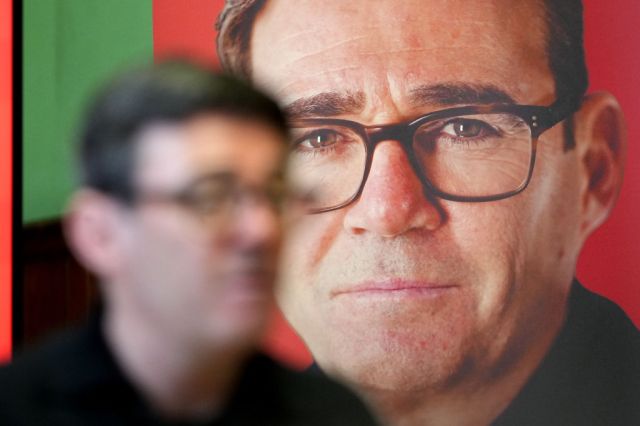
‘Burnham gave an answer whose slipperiness would put a greased eel to shame.’ (Christopher Furlong/Getty)





This time 10 years ago, I was heavily pregnant and waddling around small-town England with a bag of Leave campaign leaflets, in the weeks leading up to that seismic referendum. Leave won; there followed several years of trench warfare, before (or so we thought) it was resolved in Boris Johnson’s promise to “Get Brexit Done”.
Except, as it turned out, Brexit still isn’t done. Somewhere out there, I’m sure I can hear the faint bray of that irritating man with the hat. And if that isn’t joy enough, Brexit has lurched to still more turgid life as, variously, a woeful Hail Mary pass for Keir Starmer or a stick to beat Andy Burnham.
Makerfield, where Burnham hopes to win a by-election and then topple Starmer, voted 65% Leave. Burnham, for his part, said at the most recent Labour conference that he believed Britain should “eventually” rejoin. So, inevitably, his enemies both in Labour and in opposing parties have converged on Brexit as a potential Burnham weak point.
Nigel Farage is, of course, Mr Brexit himself. But Wes Streeting has also been conjuring Brexit’s unquiet ghosts, declaring to an audience on Saturday that “leaving the European Union was a catastrophic mistake”. In turn, when initially quizzed about Streeting’s grenade, Burnham gave an answer whose slipperiness would put a greased eel to shame. He told ITV News on Saturday that “In the long-term, there is a case for [rejoining the EU]” but that he is “not advocating that in this by-election”. In other words: this is what he believes, but right now he’d rather talk about something else.
I dare say he’d rather talk about literally anything else. But if Brexit is still the spectre at Labour’s feast, this is surely because it didn’t resolve any of the issues voters hoped it would address — including a large proportion of what used to be Labour’s working-class base. This is a cross-party failure: not even Boris Johnson’s promise to “Get Brexit Done” got Brexit done, if by Brexit you mean returning accountability to government and curbing mass immigration into Britain.
But perhaps on its own it was always too slight a vehicle for so momentous a quarrel. For the argument was ultimately not over policies that govern us, but about who governs and how. Should this happen via treaties, agreements, NGOs, and distant bureaucrats? Elected politicians? A secret third thing?
Almost a decade on, we’re still replaying the same arguments, about international agreements and national sovereignty, “Somewheres and Anywheres”, mass migration, out-of-touch elites, woke bureaucrats, reprehensible red-faced “gammons” and all the tiresome rest of it. The only historical analogy anyone seems able to conjure is the Second World War, as though British history began then. But, in truth, our paralysis makes more sense by analogy with Britain in the 17th century.
The baby who came leafleting with me in utero during the Brexit campaign is now, like Brexit, also almost a decade old. Unlike the “Farage Is Hitler” panickers, her knowledge of British history already reaches further back than the 20th century. But she doesn’t like the 17th, dismissing it as “confusing”. I don’t blame her: it was a bewildering mess. But the modern British state as such only came about through a gradual resolution of its upheavals.
The central question then, as now, was: how should the country be governed? Charles I, an ardent believer in the divine right of kings, so disliked having to share power with Parliament that he dissolved the Commons multiple times. His first Parliament sat for only two months, from June to August 1625, before he lost patience. (It went down in history as “the Useless Parliament”; we’ve had a few of those too.)
Most notably, Charles got so fed up that he called no Parliaments at all, for a 11-year stretch beginning in 1629 now known (by royalists) as the “Personal Rule” and (by haters) as “the Eleven Year Tyranny”. But he had to cave in 1640, when he realised he was too skint to be militarily effective. Parliament seized the opportunity to strip Charles of his autocratic powers. Tensions reached boiling point two years later, and the country dissolved into civil war, which only ended with Charles’ execution in 1649.
Even then England didn’t stabilise. There followed a period of experimental, idealistic “Commonwealth” republicanism, which went about as well as you can expect, and ended in military dictatorship, under Cromwell, from 1653 to 1659. After that, everyone was so sick of experiments that they went back to kings in 1660. But even this didn’t (as it were) “get Brexit done”. Instead there were ongoing political tussles for almost three more decades.
This all came to a head when James II lost his (a mental breakdown, this time, not decapitation) and fled the country. After this, William of Orange was installed as our defanged symbolic monarch, on the model we’ve had ever since.
Having invented constitutional monarchy, by the end of that century we’d added central banking and national debt. A few years later, hostilities with Scotland were permanently (well, sort of) ended by the Act of Union. In other words: most of the foundations of “modern Britain” were laid in the exhausted aftermath of that 60-year confusion.
And I wonder: maybe Brexit feels so endless because the issues at stake today are every bit as intricate, entrenched, structural and sometimes religious as those that make the 17th century confusing to a 10-year-old. We’re at loggerheads with Scotland again. Communications are once again disrupted, albeit this time not by radical pamphlet-printers. Religious agitators are also at large, albeit now mostly of a different stripe. And the basis of economy and power, too, is shifting: this time not from land ownership to trade, but from material trade to intangible, international finance and — latterly — the still more contentious question of AI.
Against this febrile backdrop, the central political question inverts the 17th century one. Back then, Parliament sought to broaden power away from an autocratic king. Now, the issue is the diffusion of power, through NGOs, regulators, rules, treaties, and other (often transnational) power-dispersing mechanisms; including, let’s not forget, the “bond vigilantes” that defenestrated Liz Truss, and are now threatening Labour’s putative king in the north. The deep question is once again: who rules? How might a more decisive regime be reconstituted from this swarm?
Against a pre-Brexit political consensus that treated some issues (including immigration) as pre-political, due to assorted transnational treaties and commitments, the winning slogan was “Take Back Control”. The voters were voting, in essence, in favour of votes that count. In this sense, it’s meaningless to argue about whether Brexit was about “the left-behind”, or about “democracy and national sovereignty”, or about “immigration”. They’re facets of the same question.
You can’t talk about being a nation, or a democracy, without defining whose interests you govern in — your nation, and your demos. This in turn requires you to define your borders, and who your economy serves. Instead, Johnson promised to “Get Brexit Done”, then turned the migration spigots on to avoid “wage inflation” after Covid.
Some might argue that given the way our economy is organised today, wage inflation would have been worse. But this is precisely the problem. The powers, principles, and pressures that structure actual decision-making in Britain are de jure liberal and democratic, but de facto something else entirely, that no one really has a name for yet. Brexit was one effect of this tension, but really it’s structural. So far, it’s proved intractable.
But perhaps it’s still early days. It took 60 years to resolve Britain’s early modern constitutional issues, from the “Useless Parliament” in 1625 to the “Glorious Revolution” in 1688. Against this, a decade of post-Brexit, post-modern paralysis is a flash in the pan.
And in any case, it’s arguably just that our hyperactive news cycle makes it feel like stasis. When you take a step back, things have already changed. Yes, the country has been stagnant since the crash. But we’re a long way from the political consensus that enabled it, in which maximum openness plus labour mobility and Big Finance would be the rising tide that lifted all boats.
And yes, a thicket of transnational rules and unelected busybodies still obstructs the much stricter migration controls two-thirds of the country would now prefer. But (perhaps connected to the appearance of a new sexual assault case in the news seemingly every week) the Overton window has moved dramatically. Elected MPs are now talking about “mass deportations”, something Farage called “a political impossibility” just two years ago. This would have been denounced during the Brexit campaign; during Peak Blair anyone using such language would have been sunk without trace. Now, even the same EU that issued dire warnings to the Tories about the so-called “Rwanda Plan” is in talks over third-country “return hubs”.
For his part, Burnham is furiously trying to dodge all these contentious bullets, beginning with Streeting’s Brexit missile. On Monday he said: “I respect Brexit.” But I’m not sure anyone believes him. Not after everyone else who said they would, and then didn’t. Meanwhile, wonks on the Right are publishing policy documents that list the structural obstacles to respecting what Brexit actually meant, in populist terms: more electoral control and fewer immigrants.
Reading these programmes, it’s clear that this comprises transforming basically every governance structure established since at least the turn of the millennium. The breadth of structural change such policies would require makes plain that the issues of migration and “who rules” are functionally identical, in micro- and macrocosm respectively. Changing the one means radically retooling the other. Will the current Right-wing contenders to do this succeed? Even if they don’t, I suspect eventually someone will. But I fear our upheavals are some way from over. By analogy with the 17th century, we’re not even halfway in.
I hope I’m wrong, though — or at least that I’m wrong about the direction of travel. For if this is happening, this time I think we’re running the story in reverse. That means we’re still in the decades of factionalism, meaning next would come Cromwellian dictatorship. Tracing my daughter’s history book backwards, what would follow then? Re-capitating the monarch? Perhaps I shouldn’t borrow trouble.
