




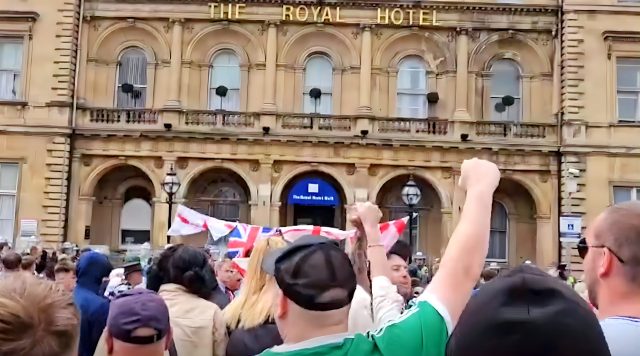
The Royal Hotel. (YouTube)





“It was just to say ‘fuck you’ to the government, really.” That’s how Josh Hobman describes the day Hull exploded. Over the next several hours, that hot August day in 2024, cars were damaged, fires started, missiles chucked at officers. Three shops on Jameson Street were looted, causing £400,000 of damage, and several people ultimately locked up. But more than the violence, and its sorry aftermath, what’s most striking about the disorder in Hull is where it all started: outside the Royal Hotel.
Growing up in the city, I remember my mother speaking about the Royal with a sense of pride. Not the pride, mind, of someone who could afford to stay there — but of someone who wanted her city to have places like it. You could walk in through the front doors and out through the back, right onto the platform at the train station. As for the building itself, it hosted weddings and conferences, and the occasional wake. The Royal, in short, was as much a part of Hull as its cream phone boxes: visible, familiar, unavoidable.
Yet by the time of Hull’s disorder — and as Hobman’s comment so vividly implies — the Royal had become something different, darker. In part, certainly, it was targeted because of who stayed there now: not tipsy aunts and mourners, but asylum seekers. Yet if the perhaps 200 people huddling inside the hotel were one of the targets, they were ultimately mere cyphers for a much broader malaise.
Speaking with several of those present that day, alongside others from across Hull, it’s clear that what largely underpinned the violence was not a coherent ideological project, still less organised extremism. Rather, it represented a belief that electoral promises were no longer translating into policy reality. That resulting anger was often messy, contradictory — and shameful. Some perpetrators were undoubtedly racist. But beyond the fires and the bricks lay something more structural: a sense that democratic accountability had thinned, and that decisions taken in Westminster were drifting beyond the reach of those dealing with the consequences.
Opened in 1849 as the Station Hotel, right beside Hull’s main rail terminus, the Royal stood at the literal gateway to the city. Given its current name in 1854, after a stay from Queen Victoria, it’s a regal endorsement that’s endured war, fire, rebuilding and reinvention. In its heyday, the hotel was a statement of Victorian confidence, with its imposing Italianate façade in warm stone, facing right onto Paragon Square. Things were just as impressive inside, all sweeping staircases and chandeliers. Not that everyone was charmed. Philip Larkin, who for years worked at Hull’s university library, and never one for romanticising his surroundings, found the Royal rather gloomy. Yet that note of austerity only reinforced its presence: a grand, slightly worn institution that anchored the city, whether you stayed there or not.
Perhaps that’s why, when asylum seekers were housed there under Home Office contracts in 2019, Hull was always going to react. What was initially described as contingency accommodation turned into something more permanent. There was no local vote, no real consultation, only a visible change imposed in the symbolic heart of the city. As for residents, many saw the transformation as further evidence that Hull’s future was being shaped elsewhere, by people who neither knew the town nor cared what happened next.
By the end of September 2025, official Home Office data showed that 777 asylum seekers were receiving state support in Kingston upon Hull. A city of 275,401, that’s about 28 per 10,000. Of these, 257 were in what was called hotel-based contingency housing — in other words places like the Royal. These figures may appear modest on paper. But to understand why they mattered, you must also grasp what Hull had already lost: and what came afterwards.
Almost everyone I spoke to in the city could trace their family stories back to the docks. Hull is a port city with a long memory. From the Fifties to the mid-Seventies, its fishing fleet ranged as far as the freezing North Atlantic, with trawlers away for weeks at a time. Some never returned — fishing was and is one of the most dangerous professions on Earth — but at the industry’s peak the dangers somehow felt worth it. Home to some 350 ships, Hull’s docks were crowded, its fortunes tied to waters thousands of miles away. That reach translated into something tangible at home: steady wages, full pubs, busy streets, and a sense that Hull mattered. Places like the Royal reflected that confidence.
Then it all unravelled — the Cod Wars, geopolitical shocks, rising costs and economic mismanagement are all to blame. By the early 2000s, Hull had one of the weakest local economies in the country, with large areas ranking among the most deprived in England. In 2001, around 38% of working-age adults had no formal qualifications, and earnings lagged well behind the British average. Yet this collapse was about more than unemployment; it eroded the pride that came from Hull’s place in a global industry. Boarded-up shops, low-paid work and a growing drugs trade reshaped the city’s texture. Regeneration did come, slowly and unevenly. But amid the retail developments and public investment, the push into renewables and, in 2017, the UK City of Culture, what was lost never truly returned.
Mass immigration arrived later. By the 2021 census, 13.1% of Hull’s population was born outside the UK, an increase of 4.6 percentage points since 2011. This demographic change soon became visible. New shops and services appeared, which some long-standing residents felt weren’t built with them in mind. Eastern European supermarkets; Asian takeaways; Turkish barbers — all these became more common, while many older fixtures of working-class life, from pubs to cafés, continued to vanish. Some of that loss merely reflected economic decline and changing habits. But set alongside immigration, the effect felt sharper.
Little wonder that Hull went heavily for Brexit, with many hoping their votes would help regain control over Britain’s borders. We know what happened next: the Boriswave, and more mistrust in the powers-that-be. That was especially true in a tight-knit, working-class city like Hull. Higher arrivals, legal and illegal alike, translated into pressure on housing and local services. Stories circulated of local families spending years on waiting lists, while newly arrived migrants were seen to be housed more quickly. Some, no doubt, were mere rumours. But it’s also true that council housing is governed by a points-based system putting need over nationality. In practice, that often reinforced a deep sense of unfairness among long-time residents.
Change, then, was not encountered in spreadsheets. It was encountered in kitchens, at school gates, in the way public spaces were used — and in how secure people felt in their own city. Several women tell me that young girls no longer feel safe walking past the Royal, day or night. “Nobody even wants to go anywhere near it,” is how one puts it, a woman in her forties with tied-back hair and a steady manner. Others speak of groups of men congregating outside, approaching young girls, and creating an atmosphere they describe as intimidating. Nothing, they say, was ever done about it.
Those fears did not appear in a vacuum. Hull had already been shadowed by longstanding claims grooming gangs operated in the city. Earlier this month, Humberside Police closed their investigation without charges, disappointing some alleged victims. Meanwhile, concerns about women’s safety in the city centre were embedded in the local conversation. Once again, many of these assertions were hard to verify. But they circulated persistently, reinforcing a sense of warnings ignored.
So when disorder came, it didn’t emerge from nothing. The Southport murders were merely the spark — even if online rumours and disinformation doubtless spread the flames. As riots erupted across England, a group of protesters gathered at Victoria Square, roughly 500 yards from the Royal. One of the organisers was John Francis, a broad-shouldered middle-aged man with a cockney accent who walks with the aid of a crutch. He says he moved to Hull in 1989, “and I’ve been here ever since”.
Francis is blunt, emotionally invested in his patch, and unafraid to say what he thinks. Through a Facebook group called Hull Patriotic Protesters, Francis had planned what he calls a “flash demo” focused on “winter fuel payments, illegal immigration, pensioners being shafted”. The group frames itself as patriotic, explicitly rejecting racism and extremism. Yet its rhetoric, particularly around illegal immigration, is often blunt and sometimes inflammatory. Francis, for his part, also acknowledged in a Sky News interview that he was once a member of the now-defunct English Defence League.
That history matters, placing Francis in a harder-edged tradition of street mobilisation. Yet nor does it fully explain the composition or mood of the crowd that August day. Watching violence unfold elsewhere, even Francis seems to have been cautious, claiming he tried to turn the march into a vigil, asking people to “bring flowers and teddy bears”.
Hobman, who saw a Facebook post advertising the protest, was among those who turned up. “People that love the country, basically,” he says, “we’re going to pay our respects.” He arranged childcare for his son and went into town. “Someone needs to do something.” At Victoria Square, a broad pedestrian space centred on a statue of the eponymous monarch, where protests are traditionally held, both John and Francis recall a heavy police presence and a small counter-protest. The interaction seemed to harden the mood. Then, as Hobman puts it, “everybody went there” — by which he means the Royal Hotel. By the time the crowd arrived, there were “about 3,000 people” outside.
What followed resembled scenes elsewhere: widespread disorder involving criminal damage and looting. Violence spread across much of Hull’s city centre and continued on into the evening. Hobman, who had been drinking, threw a beer can at a police shield. Three weeks later, he was arrested and sentenced to eight months in jail. “If I could turn back time,” he says, “I wouldn’t go.”
In the days that followed, the Prime Minister described the riots as “far-Right thuggery”. The phrase stuck, and to an extent for good reason. Some rioters in Hull and beyond directed hostility at “foreigners”, real or perceived, with reports of anti-immigrant and, at times, racist chanting. At one point in Hull, a breakaway group surrounded a car of Romanians, kicking and striking the vehicle and punching one of the occupants through a window.
But to describe the entire crowd as “far-Right” was rhetorically effective but analytically unhelpful, blurring the distinction between thugs and bystanders, racists and concerned citizens, extremists and criminal opportunists. When I ask Hobman what he understood by the phrase “far Right”, his answer is more nuanced than you might expect. “I don’t care if you’re black, blue, orange. I don’t want illegal immigrants here.” Francis, who says he left as events escalated and wasn’t involved in the disorder, draws a similar line, emphasising the importance of legality and integration. Both men, like everyone I speak to, invoke less the language of racial hierarchy than that of grievance — about borders, consent and perceived unfairness.
But when those two positions are treated as indistinguishable, political language loses precision. This dynamic isn’t new: recall, again, the way Brexiteers were too often equated with ignorance or worse. The political risk for Labour is now similar, even among those totally uninvolved in the violence. One woman I interview, who attended the initial protest, “absolutely hated” what happened outside the Royal. The vandalism, she says, was “stupid and self-defeating”. Yet she still thinks immigration policy has been handled recklessly — and there’s not much evidence the Government is doing much about it.
After all, though the current plan is to end hotel use by 2029, redistribution is hardly resolution, with migrants likely to end up scattered across HMOs or disused army barracks. That, of course, leaves the underlying questions of consent and mandate unanswered, to say nothing of the wider system that allowed migrants to enter Britain to start with.
Even so, and despite believing that promises made at the ballot box haven’t translated into policy, no one I speak to proposes dumping politics altogether. “They may not listen to me,” says one Hull mother with two young children, “but they’ll see my vote on the ballot.” Hobman is more blunt: “I will vote Reform.” Francis, who is standing as an independent in the May local elections, says that if he were not running himself, he too would back a Reform candidate.
Either way, this is hardly the language of anti-democratic withdrawal, reflecting instead a hard-headed electoral repositioning on the part of Hull and its people. The city’s recent political shifts reflect that turn. Luke Campbell, a local former Olympic boxer, won the mayoralty under the Reform banner last year, while the party is contesting all 19 seats in the upcoming local elections. With Nigel Farage recently visiting to drum up support, Reform will be hoping to convert that momentum into tangible gains.
None of this guarantees a lasting political realignment, but it does point to a growing willingness among voters to look past Labour. In this, Hull’s politics have long been more fluid than its industrial past might imply. While Labour dominated for decades, the city equally sustains a strong Liberal Democrat presence, one framed by a decent ground game and a focus on things like potholes. To that extent, Reform’s rise feels more radical, especially as it centres not on local gripes, but on immigration and indeed the direction of the country at large.
Nor is Hull exceptional. Across England and Wales, post-industrial communities are facing vast rapid demographic change without commensurate investment. And when locals are then told that concerns about pace or scale are morally suspect, the effect is combustible. All the same, Hull’s story also shows that migration is merely the razor edge of discontent. Even if Reform gains support on stopping the boats, say, it’ll ultimately be judged on something deeper: whether it can offer a credible economic settlement for Hull and places like it. Beyond border control, that’ll require sustained investment in jobs, skills and infrastructure; a housing system that feels fair; and a model of growth that restores a sense of stability. Without that, the underlying conditions that produced the riots will remain. As for the Royal, it may yet return to what it once was, a place for tipsy aunts and mourners. But Hull has a long memory.