









When ESPN launched, in 1979, sceptics questioned the wisdom of a 24-hour sports channel. “Nobody’s going to want to watch that many sports,” they repeatedly told its founder, Bill Rasmussen.
But Rasmussen, who had worked both in sports coverage and as a communications director for a hockey team, knew something about the audience that outsiders didn’t: true fans always want more.
There’s a similar calculation being made right now in Silicon Valley, where new entertainment brands are targeting an audience of tech obsessives who, like the sports fans, can’t get enough daily updates, insights and data from the most influential people in their industry. And last month, that growing power struggle to control the future of “new media” came to a head with OpenAI’s acquisition of TBPN and the launch of a16z-backed rival show, MTS.
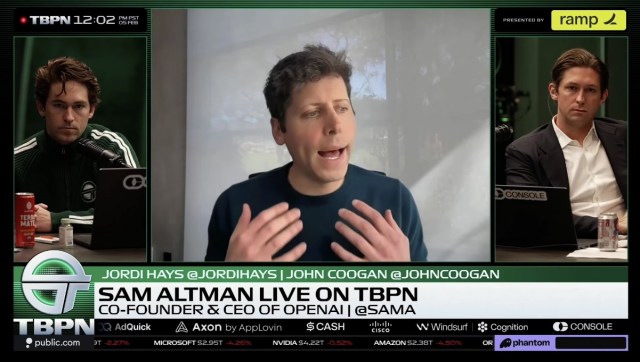
TBPN is a daily live show about the tech business, hosted by two tech entrepreneurs, Jordi Hays and John Coogan. Unlike many of their nerdy peers, they are relatively natural on camera: relaxed but not rambling. They are also hard to tell apart in their matching suits and floppy haircuts; like Ant & Dec with an upscale Hollywood gym membership.
Given that both have founded successful companies, which have matured and secured handsome acquisitions, they have significant cachet with business leaders; guests appreciate that the hosts have had skin in the game. And as a result, people like Mark Zuckerberg, Palantir boss Alex Karp, and the Collison brothers, who founded Stripe, are happy to come on. They know they won’t be subjected to an aggressive grilling.
The idea of fandom is key to the genre. It’s taken as a given that the viewer has a keen interest in the space, so the conversation can get pretty technical very quickly. In one recent episode, for example, the hosts were digging into semantic layers and scheme migrations with one guest, before batting around energy and geopolitical hypotheticals with fossil fuels advocate Alex Epstein the next.
Called the SportsCenter of Silicon Valley, it has also borrowed its look from the sports shows, with its split-screen discussions and canned sound effects. Even its full title, the Technology Business Programming Network, is a nod to ESPN.
And it has worked. Since its launch in late 2024, TBPN has become the biggest show in its niche — which you might call techno-capitalism. Yet it remains relatively small, pulling in an average of 70,000 viewers per episode. This is deliberate. According to Coogan, their high-value ideal audience numbers only around 200,000 founders, executives and adjacent people. Their goal, he says, “was to create a platform to reach the core audience… If we start bringing in new topics just to reach 10M views, it wouldn’t feel natural and we would lose the core audience we have worked to build.”
Certainly, it can be hard to get a general audience invested in the comings and goings of founders and funders, new AI model releases, and the B2B Saas of it all. So the TBPN approach is unapologetic. It’s not trying to sell tech to a new audience.
That focus clearly paid off, given OpenAI bought it in a surprise move last month for somewhere in the “low hundreds of millions”. The company suggested that the acquisition would help prepare the world for the changes wrought by AI. Fidji Simo, OpenAI’s CEO for AGI deployment, wrote that the business has “a responsibility to help create a space for a real, constructive conversation about the changes AI creates — with builders and people using the technology at the center”, and that TBPN had already created such a space.
The rationale doesn’t quite ring true. TBPN is not the place for long, philosophical discussions about superintelligence; if this is what the frontier lab wants it could have bought out Dwarkesh Patel’s podcast. Instead, it looks more like an attempt to acquire some likeability: befriending the jocks for a bit of second-hand popularity.
And that’s partly why the venture hit the right note. Where the 2010s tech sector took pains to show off its DEI credentials, today, there has been a notable vibe shift: tech bros are increasingly embracing their “bro-ness”. TBPN’s original name was even Technology Brothers. They’re taking a page out of another masculine-coded industry’s playbook.
But even more significant is that so much of what sports media invented suits the internet immensely well. Live event coverage and post-match chats can translate into the era of the multi-hour Twitch livestream. Turning commentators into personalities in their own right goes hand in hand with the increasing focus on turning journalists into influencers — and vice versa.
Tech is not the first sector where a sports DNA has proven revitalising for its coverage. Fast-talking stock markets commentator Jim Cramer, a son of Philadelphia’s all-consuming sports culture, first tried his hand at sports reporting before moving into finance, and eventually becoming famous as the host of the SportsCenter-esque Mad Money. More recently, startup media brands such as The Ringer, brainchild of ESPN alum, cover the business of Hollywood with a sports fan fervour, with casting announcements dissected like they’re player drafts and awards shows like tournaments.
Imitators have sprung up in the wake of TBPN’s success. There’s the European answer etn., which riffs on TBPN’s schtick right down the hosts appearing in promo imagery wearing matching suits. And now we have MTS.
The new show takes its name from “monitoring the situation”, an online meme used to describe the semi-serious way in which news junkies and day traders on X keep up with current affairs. This new entrant doesn’t seem to have quite found its footing yet, despite the opportune timing: many X users suspect that TBPN has been disappeared from their feeds, owing to Elon Musk’s longstanding feud with the show’s new boss, Sam Altman. MTS is a little bit more internet-poisoned than TBPN, bringing together the worlds of rambling politics livestreams with tech twitter discourse.
But crucially it sees TBPN’s bet on the persistent interest in tech news and raises it. Like its pioneering cable forebears, MTS is live, all the time. Or at least it aspires to be. These early weeks have been punctuated with off-air stretches. And when it’s online, even the channel’s most interesting segments struggle to justify being stretched out. The success or failure of the venture will hinge on whether it can demonstrate there is a truly bottomless appetite for tech news discussion, in the way there is for sports.
For the technology industry, the existence of and investment in these shows is a sign of self-consciousness among executives and companies. They know that they are the entertainment now, as the huge interest in blow-by-blow accounts of the Musk v. Altman underscores. They even have fanbases.
Those parasocial relationships will only become more intense this year as SpaceX, OpenAI, Anthropic and others eye joining the stock market. Soon, those viewers will also be shareholders. That dynamic of obsessive ownership already defines so much of our culture, from prediction markets gamblers sending journalists death threats to the easily-provoked wrath of K-pop stans.
These shows, though, highlight a weakness at the heart of big tech. They reveal it to be a sector that would prefer to build its own media ecosystem than engage with the existing one. Suspicion of journalists — and attempts to remake their profession from the outside — has never been more acute in the tech world. So it feels easier in that context for industry bosses to retreat to home turf. But too much navel-gazing and non-confrontational chatting will only entrench the industry’s insularity and keep it further detached from the public opinion about AI and other disruptive technologies. Having built themselves a fans-only enclosure, they might fail to notice when the crowd turns ugly.