




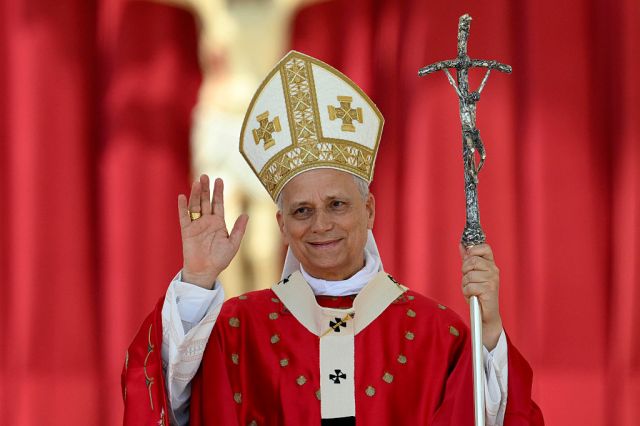
‘By any measure, Pope Leo is an unusual American.’ (Elisabetta Trevisan /Vatican Media/Vatican Pool/Getty)





The Basilica of St Augustine of Hippo, a stone’s throw from the Pantheon in Rome, is the grandiose mother church of the Augustinian Order. On its walls hang a Raphael, a Guercino, and one of the more controversial paintings of an endlessly controversial artist: Caravaggio. His Madonna of the Pilgrims caused a hullabaloo when it was unveiled in the early 1600s. It was everything prelates of the Counter-Reformation did not want to see in art: the mother of God is depicted barefoot, standing in the doorway of a rundown house looking down at two filthy, shabbily dressed pilgrims. One leg crossed over the other, so her skirt is pulled tight across a shapely thigh, the Virgin Mary is depicted as a sexy young Roman housewife. It didn’t help that the model Caravaggio used was probably a local courtesan known to have had affairs with a cardinal and a monsignor.
Still, the Augustinians never asked for the painting to be removed. They had survived a lot worse. Their order risked being suppressed in the 13th century. It was nearly wiped out by the Black Death. And it again risked extinction in the 18th century. Along the way, the Augustinians gave the world Martin Luther, which is scarcely a claim to distinction in the Catholic Church.
However eventful their past, the Augustinians today occupy a relatively uncontentious space in a Church which, like much of the rest of society, has become acrimoniously polarised in recent decades. They are neither as thoroughly liberal as the Jesuits nor as staunchly conservative as the quasi-monks of Opus Dei. If you were looking for a pope capable of bridging the divisions in the Catholic Church, which became painfully obvious during the stormy papacy of the populist-progressive Francis, you could do worse than elect an Augustinian friar. Which is exactly what the cardinals who gathered to elect Francis’s successor did a year ago when they opted for Cardinal Robert Prevost, the American head of the Vatican department that advises popes on the naming of bishops.
The reasoning, and manoeuvring, that led up to that decision is wrapped in a mist far denser than the white smoke that gushed from the Sistine Chapel’s rickety-looking chimney, announcing to the world that a new pope had been chosen. The cardinals swear an oath of secrecy and, although from time to time in the years that follow a papal election titbits of information leak out, the full story never emerges.
By electing the man who chose to be known as Leo XIV, the cardinal-electors (those below the age of 80 at the end of the previous papacy) tossed out of the Sistine Chapel’s windows a supposed taboo: that an American could never be, to use a charming Italian term, papabile (literally, “pope-able”).
The view widely held in the Vatican until last year was that it would be unthinkable for the Catholic Church to ally itself to the United States. You only had to imagine the effect a ‘‘gringo pope” would have in Latin America, where tens of millions of devout Catholics had suffered the consequences of CIA-engineered coups and other instruments of American foreign policy: an approach that was seldom less than condescending and all-too-often undemocratic and indifferent to human rights. And how would tens of millions of other pious Catholics in the poorest states of Africa and Asia react to seeing their Church governed by a citizen of a country in which wealth was celebrated, even worshipped? Among those convinced of the taboo was the then-Cardinal Prevost. “I’m an American, I can’t be elected,” he wrote to a fellow Augustinian just days before his election.
So why did those concerns suddenly count for so little? There are three discernible reasons. None are mutually exclusive and they all have a bearing on the current, tempestuous dispute between Leo XIV and Donald Trump.
The first has to do with Leo’s own character and biography. By any measure, he is an unusual American. He may root for the Chicago White Sox, but he has spent much of his life outside the United States, first as a missionary and later travelling as head of the Augustinian Order. He is fluent in Spanish and Italian, holds Peruvian citizenship and was the bishop of a Peruvian diocese. He has signally un-WASPish ancestry that even includes a touch of Creole. And his demeanour could scarcely be less like that of the brash, swaggering Americans who inhabit the collective imagination of the poor South.
A second factor, and one known to have weighed on the minds of the cardinals in Conclave, is the parlous state of the Vatican’s finances. One of the cardinals said as much before they were locked away for the vote. Asked if politics might play a role in their choice, Cardinal Tarcisio Isao Kikuchi, the Archbishop of Tokyo, replied: “I don’t think so. But perhaps money…”. The year before Pope Francis’s death, the Holy See ran a deficit of more than €80 million. Its pension fund has a shortfall of as much as €1 billion.
In a recent book on America’s relations with the Vatican, Papi, dollari e guerre, Massimo Franco, a columnist for the Italian daily Corriere della Sera, writes that there was so much talk of money in the discussions that preceded the Conclave that Cardinal Gerhard Müller had lost patience. “We’re meant to be electing the successor of Peter, not of Judas!”, he is said to have exclaimed. Traditionally, the biggest contributions to the Holy See came from Germany and the United States. But they fell off as the Catholic Church was immersed in scandals over the sexual abuse of minors by priests and the misuse of Vatican funds. An American pope would stand a better chance than most of loosening the purse-strings of his rich compatriots.
But the third, and simplest, way to explain the election of Leo is that the cardinals wanted a unifier and a period of tranquility after the turbulent papacy of Pope Francis and found in their mild-mannered American colleague a man only too happy to walk peacefully down the middle of the road. If that was the deciding factor, nothing much happened in the first 11 months of his papacy to suggest the cardinals got it wrong. It was a period of exceptional calm — free of scandal and controversy.
Leo delighted progressive Catholics by repeatedly quoting Francis and articulating many of the liberal views associated with him. But if the words were progressive, the symbolism was traditional. That was clear from the moment he walked out onto the balcony of St Peter’s wearing a red satin mozzetta, a shoulder cape that had long formed part of a pope’s garb, but which Francis dispensed with. He moved back into the grand papal apartments his predecessor had eschewed, and even gave permission for a mass to be said in Latin in St Peter’s. None of this earned him the approval of the most diehard conservatives like Steve Bannon. But symbolism counts for a lot in Catholicism and, at the very least, traditionalists could no longer feel, as many did under Francis, that they were being victimised.
On 7 April, though, the calm was shattered. Pope Leo clashed head-on with President Trump. A point that has been largely overlooked is that, if this was a fight, then it was Leo — not Trump — who threw the first punch. Asked about the President’s melodramatic threat to put an end to Iranian civilisation, Leo could have used any one of the many ways in which popes avoid calling out individual politicians. Instead, he described Trump’s warning as “truly unacceptable”. The President hit back, describing Leo as “WEAK” (his capitals) on crime and “terrible” at diplomacy. The man whom more than a billion Catholics believe is God’s representative on Earth needed to “get his act together”, the President wrote on Truth Social. For a while, it seemed as if the row was over after the Pope said he had no interest in debating with Trump. But then, this week, the President had another go at Leo, claiming “he thinks it’s just fine for Iran to have a nuclear weapon”. That stung the pontiff into another retort. “If anyone wants to criticise me for proclaiming the gospel, let them do so with the truth,” Leo said. “The Church has spoken out against all nuclear weapons for years.”
The clash — the way it started and the way it is continuing with Leo refusing to let Trump’s claims go unanswered — raises an intriguing thought. Insiders say that, in the discussions that precede a conclave, the cardinals first try to agree on the biggest challenge, or opportunity, facing the Catholic Church, and then move on to considering which of their number would be best suited to deal with it. That, it is said, is how a cardinal little known outside his native Poland came to be Pope John Paul II: his peers concluded that communism in Europe was structurally unsound and that a pontiff was needed who could help topple it.
The vast majority of cardinals — 108 of the 133 who filed into the Sistine Chapel on 7 May 2025 — owed their red caps to Francis and, with few exceptions, viewed the world in much the same way as the late pope. Might they have believed that the biggest single threat the Catholic Church faced was Donald Trump? The MAGA movement sees eye-to-eye with the Church on abortion. But Trump himself stands for much else that Catholics, and not just liberal Catholics, fear and disdain: the destruction of a rules-based world order, use of the death penalty at home and aggressive warmongering abroad, indifference to human rights, climate denial, harsh anti-immigration measures and — of particular concern to Leo — an apparent lack of concern for the dangers posed by the rapid development of artificial intelligence. What is more, Trump has come to be aligned with a section of the evangelical movement that is opposed, and in some cases actively hostile, to Catholicism.
Might the cardinals have sought in Francis’s successor something other than just an ability to reconcile the opposing wings of the Church? Might they have accepted an American not just because he might replenish the Vatican’s coffers, but because he could stand up to the US President, speaking to him in his own language and with a native understanding of the American political environment?
Soon after Leo was installed, a theory circulated in Rome that has since failed to gain much traction: that his election was orchestrated by the then-archbishop of New York, Timothy Dolan, a conservative openly favoured by Trump. Among those who still believe in it is the President himself. At the height of his row with the Pope, Trump said Leo would not have been chosen but for him. Perhaps he was right, just not in the way he meant.
John Hooper is The Economist’s correspondent for Italy and the Vatican. His latest book is The Italians.
 john_hooper