




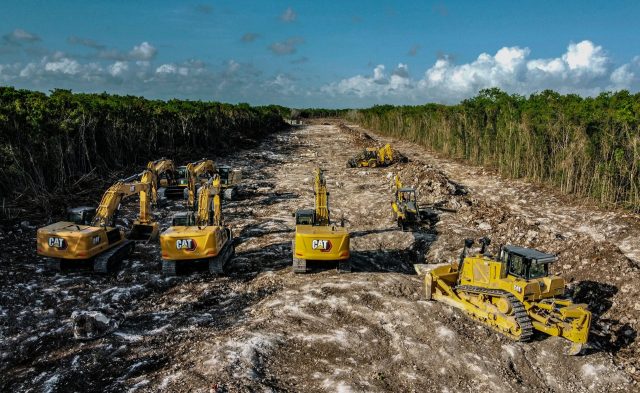
Construction of the Mayan Train between Tulum and Playa del Carmen, Quintana Roo State, Mexico, on April 14, 2022. (Carlo Echegoyen/ADP/Getty)





I’m deep in the Mexican jungle, and it’s 40°C. All around me, the earth is torn up, and red clay bleeds out near diggers and bulldozers. It should, in short, be hell on earth. But actually, life is pretty good. I’m gliding through the forests of Calakmul, in the southeastern Mexican state of Campeche, ensconced in an air-conditioned cabin. Beside me are not snakes and spiders, but happy day trippers, in smart shirts and Sunday dresses.
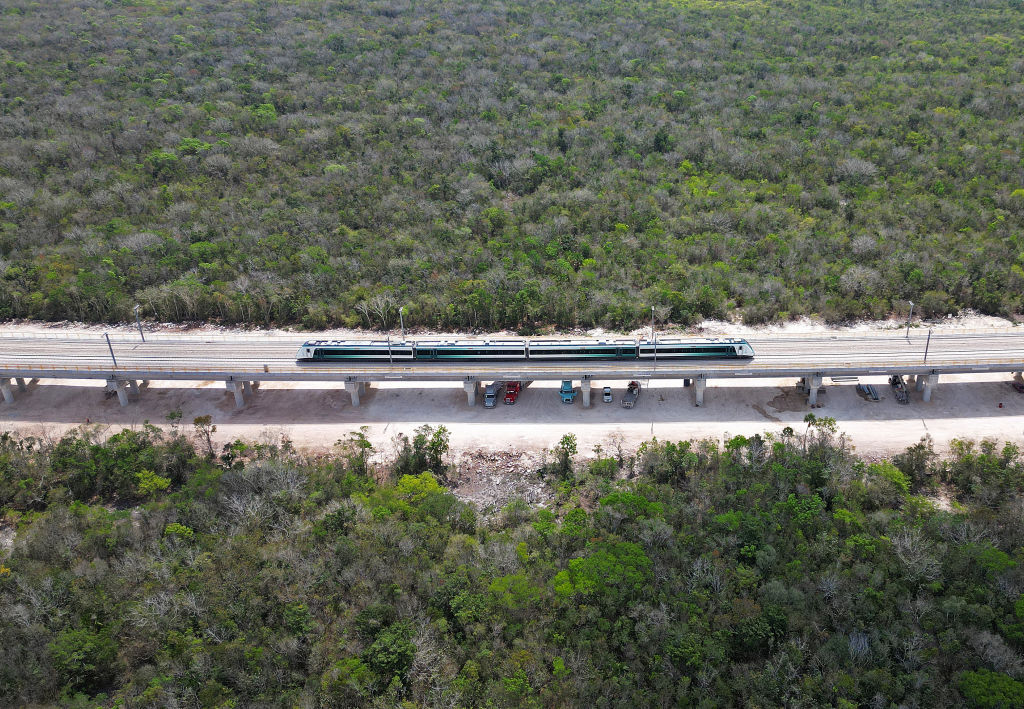
We’re on the Tren Maya, a 965-mile railway which encircles Mexico’s Yucatan Peninsula. Yet if my fellow travellers seem happy enough, staring at the vines and flocks of multicoloured birds, the project has become a source of deep controversy — and not simply because the Tren Maya has left a building site of swathes of wilderness. Rather, as the country gears up to host the World Cup next month, the scheme has turned into a political battleground, pitting exuberant socialist developmentalism against degrowth-orientated Indigenismo.
There are strong arguments for the Tren Maya. Cutting through hills, plains and beach resorts, it joins together the Yucatan’s main towns. Apart from being a boon for tourists — who flock for the sea at Cancún and the ancient ruins near Campeche — the tracks also traverse some of Mexico’s poorest indigenous areas. The Mexican government claims that the train has helped these communities, providing work on construction, easy commutes to resort towns, and a much-needed economic boost to campesinos in the south, many of whom might otherwise migrate to America.
These economic arguments help explain why the railway is a brainchild of the Left. The inaugural project of Mexico’s former President Andrés Manuel López Obrador (AMLO), he won power for his Left-populist, nationalist Morena Party in 2018, ending decades of neoliberal dominance at the hands of the old establishment Institutional Revolutionary Party (PRI). By 2018, the PRI had been in power, barring a 12-year gap, since 1929. In reaction to this long tenure, the Peruvian novelist Mario Vargas Llosa once mockingly described the PRI’s 77-year-long rule as “the perfect dictatorship”.
Over its later period of rule, the PRI became associated with car-centric development and the privatisation of public transport. To distinguish himself from Mexico’s ancien régime, AMLO staked his political success on the railway, pushing through legal objections, construction delays and concern about archeological sites by controversially drafting in the Mexican army to oversee the project and declaring the train a “national security issue”.
The president’s approach was a success, with Tren Maya completed in under five years. It’s certainly been a long-time coming. Almost all of Mexico’s passenger train lines closed in 1999 during privatisation efforts by the PRI, leaving Mexicans reliant on long-haul buses and cars. Not that the vanishing of the country’s extensive railway system — over 15,000 kilometres at its height in 1964 and known as Ferrocarriles Nacionales de Mexico — was merely a utilitarian matter of infrastructure. Trains are deeply resonant here, ghostly symbols of Mexico’s stalled progress.
In the late-19th and early-20th centuries, Mexico’s railways were employed as symbols of technocratic “progress” by dictator Porfirio Díaz. In turn, they prompted resistance from indigenous communities who often lost land to concessions, before being commandeered by rebels like Pancho Villa and Emiliano Zapata during the revolution of 1910. Villa, especially, in the north, was famed for capturing trains, and then using them to transport rebel troops across thousands of miles of inhospitable desert.
AMLO’s Tren Maya is a reclamation, one might even say a resurrection, of this imagery. For many Mexicans, the train is not simply a moving box with windows. Rather, it aims to secure Mexico’s independence from foreign investors through heavy state involvement, while also reducing outward migration to the US. Most ambitiously of all, Tren Maya could eventually join the Yucatan Peninsula and its Gulf ports to another Morena megaproject: the Interoceanic Corridor, a land-based alternative to the Panama Canal aiming to undercut Chinese and American dominance in Latin America.
All these projects are part of Morena’s cryptic “Fourth Transformation” (4T). Essentially, 4T frames AMLO, and the recently elected president Claudia Sheinbaum, as successors to revolutionary Mexican history. Yet quietly, and somewhat awkwardly, the scheme adopts many of the development-orientated policies of Diaz the 19th-century dictator.
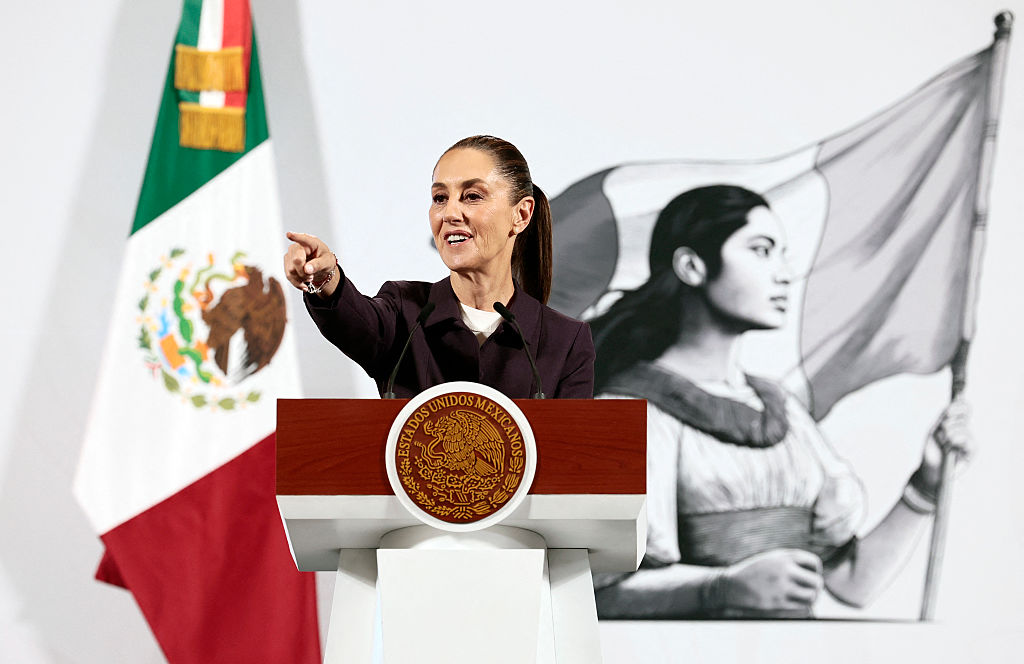
Notably, there are constant references in Morena-alligned media to Miguel Hidalgo, the leader of the War of Independence against Spain, as well as the 19th-century liberal hero Benito Juarez and the poncho-wearing revolutionaries of 1910. Trains are central to this self-image, with government videos of the railway racking up millions of views on X. “During the neoliberal period,” proclaims Sheinbaum, “passenger trains were privatised. With the Fourth Transformation, they have been REBORN.”
Though numbers are scarce, there are some signs that the train is helping Mexico’s poorest. During a never-ending storm, in Cinco de Febrero, a small hamlet in the southern state of Campeche, I find myself sheltering in a cow farmer’s cabin, a lean-to structure made from breezeblocks and corrugated iron. “Tren Maya has boosted ecotourism in the area,” says its owner. “This has, in turn, brought money in, improving the forest road from Cinco de Febrero into the jungle.”
“Before, one could only traverse the road by horse with packs, now we can get around by motorbike.” The owner and his wife have a fire going. By the door, a huge Morena poster is nailed between two posts. It’s as much to keep out the rain as for propaganda, yet the couple seems happy about the train. Before it came, after all, the farmer had to spend six months a year as an itinerant labourer on far-off agave farms. Now, Guadalope says, he can “stay in the campo”, even as he can more easily take his cattle to market.
Still, other Mexicans seem unsure about Sheinbaum’s locomotive triumphalism. One family I meet is taking the train south, 460km to the rural state of Chiapas, where the grandfather, decked out in a ranchero outfit and huge cowboy hat, has family. “The train needs to be more extensive,” his American-born son says, as he leans against a wall in boardshorts and flip-flops. “There are so few roads connecting places in Yucatan. I mean, look at Mérida to Progreso,” he adds, referring to the journey from the Yucatan’s capital to a seaside town nearby. “That’s what, like one or two roads — I don’t want to drive dodging jaguars!”
My own inaugural journey on Tren Maya is from Mérida to Campeche, another state capital some 150 miles to the south. It’s not an especially auspicious start: Mérida station is a vast minimalist white cube, about a half-hour taxi journey out of town, a fact that’s already frustrating the locals. Fabiene, an accountancy student in his twenties, complains that the station’s remoteness is offputting, as is the price. Tickets are discounted for Mexican citizens and even more for locals — with short journeys only costing 1-2% of a weekly wage. Still, long-range trips between, say, Merida and Campeche can cost as much as 17% of an average weekly wage in the impoverished south. As one shopkeeper in Cinco de Febrero tells me, this is “a train for the rich”.
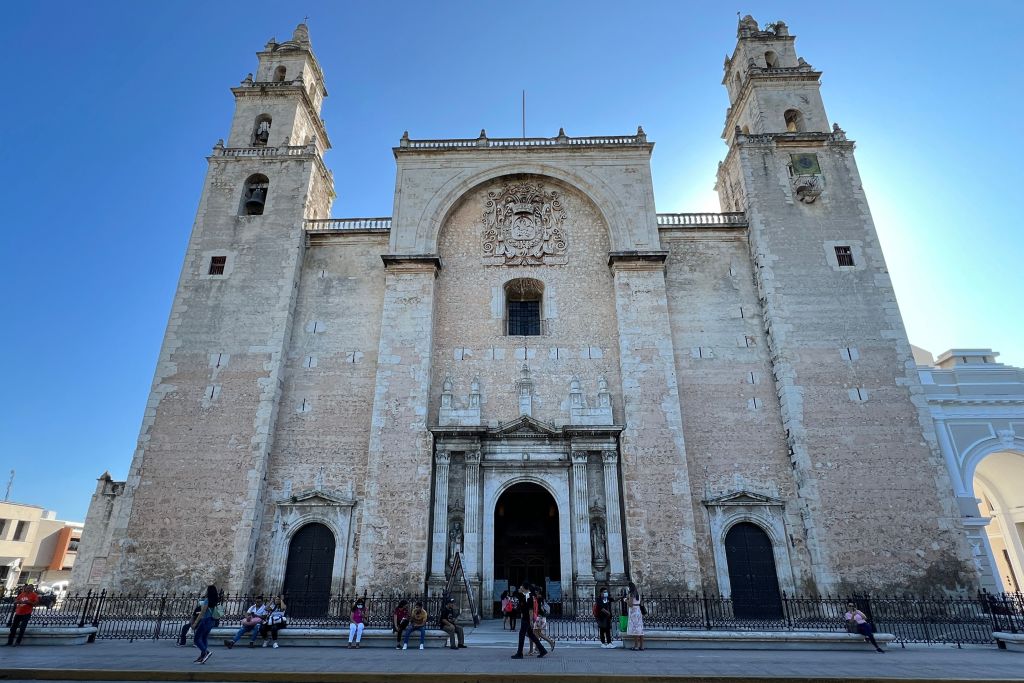
And if one taxi driver tells me he’s made a killing ferrying tourists from the station to Mérida’s pretty colonial centre, the whole process of boarding the train, including having to show my passport, feels more like an international airport than civic infrastructure. To get there, you have to drive out past serried ranks of strip clubs, squat evangelical churches, and National Guard patrols kitted out with truck-mounted automatic machine guns. To make matters even worse, Mérida already had a station before the cube was unveiled, a 19th-century building with a handsome yellow-brick tower. Unfortunately, it closed in 1974, and remains so to this day.
Taken together, then, some here suspect that the Tren Maya is more tourist boondoggle than genuine homegrown infrastructure. And there are other worries too. “Is that worth all the deforestation?” wonders Fabiene, echoed by graffitied signs in Mérida proclaiming that “Tren Mata Jaguares” (“the train kills jaguars”). Mexican environmentalist groups, like Sélvame del Tren, have claimed that over 10 million trees have been cut down since the project began in 2020. The Mexican government has countered with a much lower number of 3.5 million. Either way, there are other worries, with activists worrying that the new tracks create barriers in the migration routes of Mexico’s jaguars.
These natural wonders are important culturally too, not least to the Yucatan’s indigenous Maya. There are some 11 million of them, scattered across Mexico, Guatemala and Belize, and they’ve not always had a placid relationship with the post-colonial Mexican state, erupting into widespread rebellion between 1847 and 1901.
To understand how this ancient culture intersects with the Tren Maya, I visit Playa del Carmen, a beach town of cheap cocktails and American tourists in Quintana Roo. There, I meet Guillermo Christy, one of the leaders of Cenotes Urbanos, an activist caving group that works to protect cenotes, natural sinkholes that are sacred in Mayan culture.
Christy drives me out from the resort town and down a remote jungle path, where we reach a chained-up gate and a military zone. We hop over the fence, looking out for soldiers, and walk several miles down a small path to a cave opening: in the distance, I can hear the Tren Maya rumbling along its tracks and military jeeps whirring past. I put on a pair of swimming boots, lent to me by Christy, shaking out hordes of angry red ants.
Then we venture into a cenote, a huge sinkhole caused by the collapse of limestone bedrock into groundwater. This particular cave, named Cenote Oppenheimer, after the father of the atom bomb, is a huge dark maw, emerging from the folds of the green jungle. Christy and I swim through a cave system until we reach a point directly under the railway — where we find huge pillars of concrete drilled through the roof of the grotto. Christy shines his head torch down and points out the huge deposits of iron and steel leaking into the pristine blue of the cave’s waters. “The government,” he says, “promised us this wouldn’t happen.”
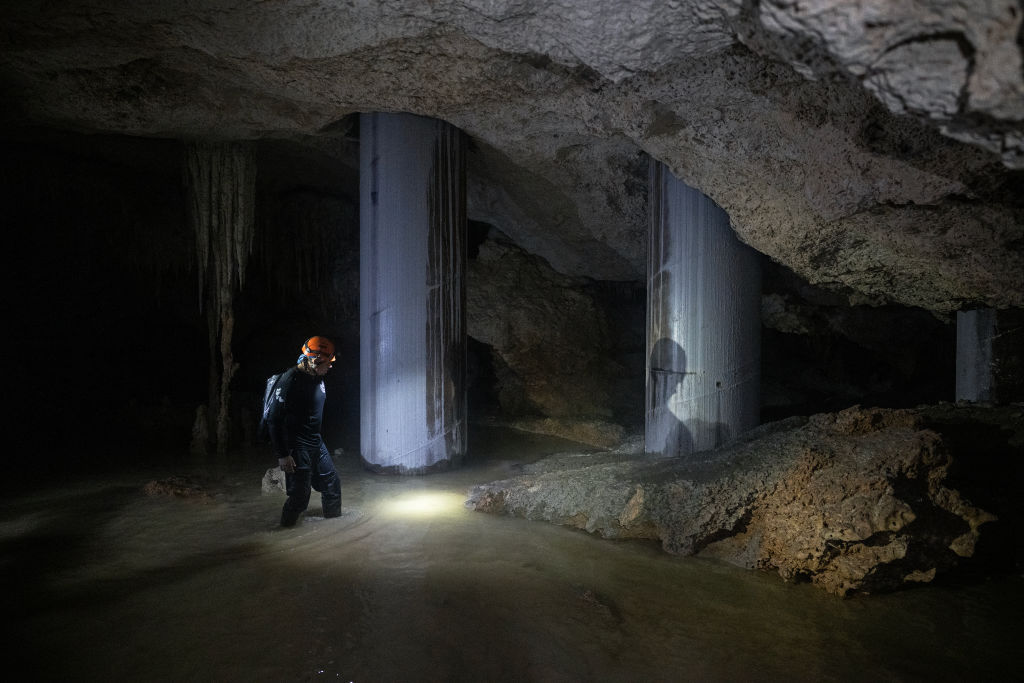
To be fair, these worries aren’t universal. “There’s a lot of glorifying nature without caring about people in the Yucatan,” argues Etienne Von Bertrab, a long-standing expert on the train, emphasising that groups like the Maya are “living cultures, not frozen in aspic”. And, certainly, Sheinbaum’s position is that the benefits of the train — economic improvement, fewer cars on the roads, less carbon emitted — more than outweigh the damage caused to cenotes.
Yet there’s another issue here, too, one that arguably cuts to the heart of Moreno’s populist pretensions. According to many I speak to, the Tren Maya was pushed through essentially by government fiat, with critics of the project excluded from consultations.
That’s shadowed by some pretty blunt financial incentives. In the tiny village of Cinco de Febrero, a hamlet of concrete block dwellings deep in the jungle, the local council leader tells me that in addition to government forestry funding, the community also received an eye-watering £236,000 in state compensation for allowing the train to pass through its land.
Little wonder, then, that some radical anti-government groups are so unhappy, with one far-Left militia dismissing the train as a dangerous “pharaonic project”. Yet it’s telling, too, that even moderate Mexicans have similar critiques. “Tren Maya is a very old-fashioned way of viewing infrastructure,” says Antonio Azuela, former general attorney for the environment under the PRI between 1994 to 2000 “That trains will bring transformation. This is magical thinking.”
More than that, Azuela suggests, Morena gave management of the train to the military — exactly the kind of interference in civilian life the party is meant to abhor, and which has been a scourge of Mexican politics for generations.
Of course, most Mexicans have little time for such highfalutin arguments. In the small towns that pepper the Yucatan, life goes on much the same. Mayan communities, in many different ways, adapt around the train, just as they have to roads, telephone poles, and the internet: balancing continuity and modernity with apparent ease. Perhaps that’s just as well. Last year, after all, Sheinbaum announced that her government now plans to build another railway, spanning the 1,800 miles between Mexico City and the US border. Expect more tracks, and more debate, very soon.
Samuel McIlhagga is a British writer and journalist. He works on political thought and theory, culture and foreign affairs.
 McilhaggaSamuel