




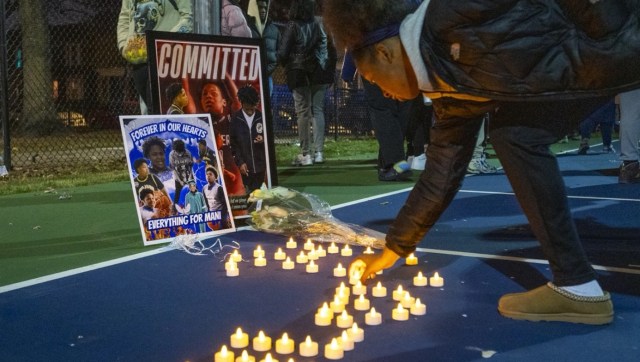
A tribute to Jai’mani Amir Rivera, a 7-year-old killed by a stray bullet from a teenager’s gun in Chicago. Credit: BUILD Chicago





Last summer, Chicago’s progressive Mayor Brandon Johnson used his first veto to kill an ordinance passed by the city council that would have given police authority to impose last-minute “snap” curfews for minors. The council had hoped to contain the city’s growing teen-takeover problem, in which large groups of predominantly black youth, organized on social media, descend on public destinations, and which often result in disorderly conduct and violence. Johnson argued that it was not constructive to “demonize youth who have otherwise been starved of opportunities in their own communities.” Four months later, a teen takeover ended in two separate instances of gunfire hours after the city’s Christmas tree lighting event, leaving eight teenagers shot, 14-year-old Armani Floyd dead, and 17-year-old Damaurion Cherry charged with seven counts of attempted murder.
America has a black-youth gun-violence problem. It’s long been with us, but the latest iteration is different, and it is getting worse in ways that the country’s establishment liberals and urban leaders seem either unwilling or unable to confront.
You won’t find much about this crime surge in the national mainstream news. Since the wave picked up speed during the pandemic, establishment liberals have remained largely uncomfortable talking about it. The press coverage of teen takeovers illustrates this tendency. Local police departments have been documenting and responding to these gatherings since at least 2023, yet it took The New York Times and CNN nearly three years to cover the phenomenon in meaningful depth. They finally did so only last week, as takeovers and shootings continue to grow across major cities this spring. Even then, CNN’s piece ran nearly 1,000 words on the violence without mentioning race once. And in typical fashion, the Times mentioned race only to suggest that concern about the gatherings was itself a form of racial bias.
To get a real picture of what is happening, you have to piece it together yourself, poring over local news coverage, Centers for Disease Control and Prevention records, and state-level data. What emerges is a crisis defined by two characteristics: a younger perpetrator profile and crimes more brazen and senseless in nature.
The shooters are younger than before, many of them school-age black male youth between 12 and 19 who obtain firearms illegally through social media, which have made acquiring a gun easier than ever. The disputes that trigger the violence increasingly begin as interpersonal conflicts with other black male teens, escalating through online exchanges before erupting in person. In March, for example, a 15-year-old approached 16-year-old Jaylen Bailey at a mall in Champaign, Ill., over an existing dispute, before he shot Bailey in the parking lot, near his mother and siblings.
Others erupt more wantonly, with many occurring during the alcohol-and-marijuana-fueled teen takeovers, whose young male participants often arrive armed. What begins as a fun gathering can turn violent quickly. An accidental bump or shouted insult can be enough to escalate into drawn firearms and open fire. In the majority of such events broken up by police across the country in recent months, officers have recovered multiple firearms among those arrested.
This gun violence is also no longer contained to low-income residential neighborhoods. Increasingly, it’s spilling into the few remaining malls, commercial districts, and public parks that Americans of all walks of life share. And in doing so, it is injuring and killing a growing number of bystanders who had no part in the dispute.
On April 23, at the Mall of Louisiana in Baton Rouge, the largest shopping center in the Bayou State, 17-year-old Markel Lee drew a semiautomatic weapon during a dispute with another young black teen in a crowded food court and opened fire, killing Martha Odom, a high-school honors student from Ascension Episcopal School, and seriously injuring five other bystanders. In a state that ranks third in the nation in overall gun homicides and first in child gun deaths, the Mall of Louisiana shooting drew a swift and unusually sharp response from lawmakers. Gov. Jeff Landry held a news conference the following day alongside more than a dozen visibly frustrated state law-enforcement officials, using the word “spillover” to describe how the violence had reached one of the state’s most popular commercial destinations, and took the opportunity to criticize the Democratic-run city of Baton Rouge for its failure to stem it.
The numbers behind this crisis are stark. According to CDC mortality data, firearm homicide deaths among black youth 19 and under spiked to 1,553 in 2024, up from 1,125 six years earlier. The 1,553 deaths represented 65% of all youth firearm homicide deaths nationally, despite black youth comprising roughly 14% of the youth population.
In Florida, homicide arrest intakes of black youth 18 and under rose 52% between fiscal years 2018-19 and 2024-25. Felony firearm arrests in the Sunshine State among black youth rose 31% over the same period, from 656 to 859. This surge is almost entirely isolated to black youth. Over that same period, felony firearm arrests among white youth in Florida fell 27% and homicide arrest intakes were flat.
In Texas, homicide referrals to the state’s juvenile justice system doubled by fiscal 2024 compared to 2018, and firearm offenses rose 58%. By 2024, nearly 1 in 12 youth admitted to the Texas Juvenile Justice Department had committed murder, up from 1 in 100 in 2018. In Washington, DC, the share of homicides and nonfatal shootings committed by perpetrators aged 15 to 20 rose to more than 21% of all such cases by mid-2024, up from roughly 11% in 2021.
The data tell a more nuanced story than a general surge in black youth crime. Data from the Florida Department of Juvenile Justice shows misdemeanor offenses among black youth have declined since 2018, and felony property crimes have returned to pre-pandemic levels, a pattern that has been observed by other local law enforcement agencies across the country. It’s not that more black youth are getting into trouble with the law — but the nature of that trouble has changed. The lethal presence of firearms in adolescent interpersonal disputes that once ended in a fistfight and a juvenile-court hearing is turning mistakes into felony assault and even murder charges that prosecutors are compelled to bring in adult court. Taken together, the data point to a troubling reality: the first post-Obama, post-Black Lives Matter generation of black teens are more likely to die by firearm homicide than at any point in at least a quarter century or serve lengthy sentences in adult prison than any earlier generation.
All the more troubling: the surge wasn’t inevitable. It is, in large part, the consequence of progressive groups and establishment liberals abandoning effective crime-reduction strategies in favor of activist narratives. To understand how this unfolded, we have to go back to 2013.
On July 11 of that year, the CDC released a public-health report with a remarkable finding: the nation’s youth homicide rate had fallen to a 30-year low. After holding relatively steady through the early aughts at around 9.3 per 100,000, the rate had fallen to 7.5 per 100,000, the lowest recorded since 1981, and remained on a downward trajectory.
The report should have been a moment of national celebration. Buried within it was data indicating real progress was being made to stem the staggeringly high murder rates for black youth. That figure had plunged to 25.9 per 100,000 in 2013, down from 32.8 per 100,000 in 2006 — a 21% decline.
But there would be no celebratory announcement from the Obama administration, nor would the findings receive significant national attention. That’s because a debate about race and policing that had been building for years in the country’s most liberal universities and law schools, catalyzed by works like Michelle Alexander’s influential 2010 book, The New Jim Crow, was about to spill into the broader culture.
On July 13, two days after the CDC study was published, a Florida jury acquitted George Zimmerman in the killing of 17-year-old Trayvon Martin, a legal outcome that would ignite a national debate and dominate American political life for the next decade. Hours after the verdict, the #BlackLivesMatter hashtag was created, and it would serve as the rhetorical basis of a new social movement asserting that law enforcement and other public institutions systematically mistreated black Americans, particularly black male youth; fixing this, in the BLM telling, required fundamentally dismantling or restructuring policing itself.
In the ensuing years, the movement proved remarkably successful at influencing mainstream media, the Democratic Party, and academic and corporate institutions. That institutional legitimacy would eventually be converted into a powerful political force, as philanthropy organizations, including the Open Society Foundations and the Ford Foundation, poured well more than $1 billion into a growing network of racial-justice nonprofits, advocacy groups, and the campaigns of office-seekers who adopted the movement’s worldview.
The policy reforms that followed were sweeping, including reducing patrols in high-crime communities, ending cash bail for most misdemeanor offenses, reducing or outright eliminating punishment for property crimes, and cutting local police budgets in favor of alternative programs like social workers and “violence disruptors.” Democratic-run cities across the country began uncritically implementing these changes, driven by a new class of well-funded, ideologically driven nonprofits that had rapidly proliferated across major American cities.
The movement reached its peak in the summer of 2020, when the death of George Floyd following his arrest by Minneapolis police ignited protests and riots across major American cities. In the months that followed, multiple Democratic-run cities, energized by the political moment and the broader anti-Trump coalition, moved to slash police budgets and roll back law-enforcement practices that had brought about the successes of the previous decade. But instead of delivering racial justice, the concrete result was the single largest surge in youth violence in a generation. A CDC analysis found the youth homicide rate for Americans aged 10 to 24 jumped 37% between 2019 and 2020, to nearly 11 in 100,000, up from 7.8. For black youth, the picture was even more grim. Their homicide rate jumped 39% in that same single year, to nearly 46 per 100,000, up from 33, and continued climbing to a peak of 47.3 in 2021, nearly double the rate recorded at the low point of 25.6 in 2014.
Over the course of a decade, the movement carved a swath of destruction across American cities, defunding and demoralizing local police departments, stripping prosecutors and the criminal justice system of their most effective deterrence tools, and convincing a generation of young black Americans that the institutions around them were illegitimate instruments of oppression. It is the ultimate indictment of Black Lives Matter that the movement wiped out the very progress in reducing homicides that had been underway when it first launched.
The current black-youth gun-violence surge is a problem worth solving. Failing to address it means condemning still more members of this generation and future ones to death or lengthy incarceration, two outcomes that should be unacceptable, especially since American policymakers have shown before that it is possible to break crime waves, most recently in the mid-2010s.
Any meaningful solution requires major reform, including the return of many of the hard-on-crime approaches used to stem previous crime waves, as well as more funding of the criminal- and juvenile-justice system, particularly at the local level. Republican-led states are better positioned to pressure Democratic-run cities into making the policy corrections they have grown increasingly reluctant to make on their own. But in Democratic strongholds like California, Illinois, and New York, meaningful change is unlikely so long as establishment liberals retain their outsized influence over state and local policy, while refusing to acknowledge that a decade of uncritically embracing radical progressive ideas dismantled what was working and set the conditions for this surge. Until they reckon with that, the crisis will only worsen.
The coming summer will make that reckoning harder to avoid. More shootings and more teen takeovers will likely mean more confrontations between GOP-led states and Democratic-run cities, which will keep the issue in the public eye. The Trump administration, which has shown little hesitation in pursuing federal intervention on crime, will likely raise the pressure further. Establishment liberal institutions will find it increasingly difficult to ignore the crisis — or their role in creating it.