




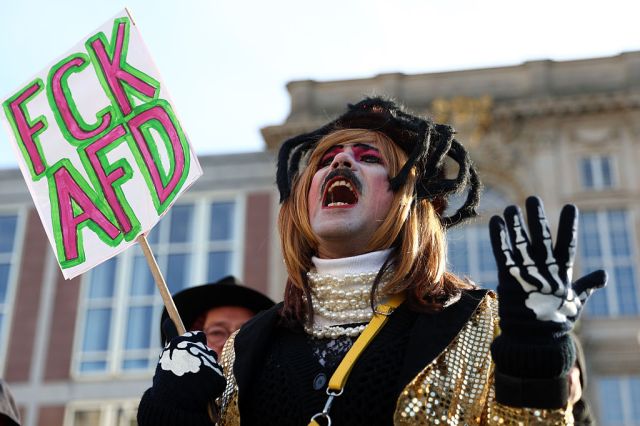
Will they heed the lessons of history? (Maryam Majd/Getty)





On 4 July 1926, Weimar witnessed something strange. An infamous firebrand called Adolf Hitler stood on the town’s ancient market square, as hundreds of his brownshirts marched by. Elevated on a platform, he held his arm raised in the fascist salute. Yet far from issuing the angry rhetoric he was already known for, Hitler’s mouth remained firmly shut. No matter how much his men goaded him, he stood in rigid silence.
Hitler was complying with a public speaking ban issued by Walter Felix Mueller, Weimar’s mayor. Everyone knew the Nazi leader was dangerous. He had tried to overthrow the government in the so-called Munich Putsch just three years earlier. Now, here he was in Weimar, once home to Goethe, and where the German Republic had been founded in 1919, stamping the town’s name on its fragile democratic experiment. Mueller was determined that the cradle of the new democracy would not become its grave. So he silenced Hitler by law — for one weekend in July 1926 anyway. History would soon prove this a futile gesture, one that neither slowed the death of the Weimar Republic nor Hitler’s rise to power.
I’ve spent the last few years studying the German interwar years for my new book, which focuses on the town of Weimar between 1918 and 1939. A century on, we seem to look to this period for guidance more than ever, but one conclusion is rarely drawn: there is little evidence to suggest that the Nazi Party could have been legislated out of history.
This was clear enough that summer day in 1926. Although Mueller’s speaking ban stopped Hitler from addressing his followers in Weimar’s market square, it didn’t stop people from wanting to listen to him. And since the mayor had no power over private gatherings, the Nazis simply held indoor invitation-only meetings instead. Indeed, the very same day that Hitler stood silent on the market square, the Hitler Youth received its name at the nearby Crossbow Society, while in other meetings, central Nazi rituals and symbols were decided. All party publications, for instance, were to be marked with a standardised emblem: an eagle holding an oak wreath with a swastika in the middle. This would later become the official emblem of the Nazi state. Hitler himself also spoke — entirely playing by the rules — behind closed doors at the German National Theatre in Weimar: the very birthplace of the republic. In short, Mueller’s ban had done absolutely nothing to stop Hitler, not even for a single weekend.
Despite such evidence to the contrary, many Germans today seem to believe that the lesson from Weimar is that growing public discontent is best tackled by legislating against the parties that channel it. This is particularly noticeable when it comes to the Alternative für Deutschland (AfD) party, whose rapid rise is causing a fair amount of angst in Germany. Haunted by their Nazi past, Germans long believed that there would never again be a significant political party to the Right of conservatism. Now, the AfD is not only occupying that space but is even leading the opinion polls. How should Germany respond? “Learn from history and ban the AfD!” says the far-Left Die Linke party.
They are not alone. At their party conference last year, pretty much the only thing the deeply divided centre-left Social Democrats (SPD) could wholeheartedly agree on was initiating legal proceedings towards an AfD ban because, as one senior party figure put it, “we all have a responsibility to learn from our history.” Even the German President, Frank-Walter Steinmeier, whose role is meant to put him above party politics, asked in a speech last year: “Is it actually possible that we haven’t learnt from history?”, warning that “a party that walks the path of aggressive anti-constitutionalism always had to reckon with the possibility of a ban.”
At the local level, meanwhile, some politicians are trying to tackle the AfD the same way Mueller tried to hem in Hitler. Earlier this year, two Bavarian municipalities issued speaking bans against Björn Höcke, an AfD politician who had planned to appear at campaign rallies. In the end, a court declared this gambit illegal. When Höcke finally spoke, it turned out that his audience now contained people who’d just come to see what the hype was about.
Höcke is a point in case for the argument that legal action does little to diminish the appeal of radical politics. Intense, radical and ambitious, he is infamous in Germany for leading the most extreme faction of the AfD, and has been convicted twice for using Nazi slogans at campaign rallies. Yet Höcke leads one of the most successful AfD branches in the country, with his Thuringian party coming first in regional elections in 2024 and now polling at 38% of the vote share. As a former history teacher, Höcke is conscious of the same history his enemies hope to use to defeat him.
There are indeed many striking parallels between past and present. Thuringia, that central German state where Höcke today has his power base, was pivotal to the rise of the Nazis, as indeed was Weimar, the state’s capital after the First World War. Hitler himself visited Weimar over 40 times, because he found ideal political conditions there despite temporary speaking bans. In many ways, Thuringia became a safe haven for the nascent Nazi movement. Some German states had instituted regional bans of the party from 1922, followed by a nationwide ban after Hitler’s botched 1923 coup. Yet Nazi politicians and fellow-travellers simply stood for election as independents, or in newly formed ersatz parties. In this way, seven far-Right men made it into the Thuringian state parliament in 1924, three of whom were card-carrying National Socialists.
Due to the parliamentary arithmetic, these Thuringian Nazi MPs were needed to form a Right-wing majority in the state, and they duly agreed to back the ruling coalition in exchange for a re-legalisation of the local Nazi Party. They got what they asked for, forcing a local lifting of the ban as early as March 1924 and granting Hitler’s party a political sanctuary from which to rebuild his movement until the national ban fell in 1925. It’s no coincidence that the first formal Nazi rally, that one with Hitler silent on the stage, happened not in Nuremberg — but in Weimar. The town would, in time, become the seat of the first state government to appoint a Nazi minister, a full three years before Hitler became German chancellor.
Höcke knows all of this — and so do many of his party colleagues. Take the time and location of this year’s national AfD conference. It is being held in Erfurt, which is today the capital of Thuringia. The date for the meet-up is 4 July 2026, exactly 100 years after the crucial Weimar rally of 1926. Make of that what you will, but the AfD certainly doesn’t go out of its way to reject the political legacy of Hitlerism. In fact, it often outright flirts with the phrases, symbols and gestures of the Thirties. The latest example is the federal AfD MP Matthias Moosdorf, who has recently been charged with greeting a party colleague with the Nazi salute in the Berlin parliament.
To be clear, the AfD is not the reincarnation of the Nazi Party. For one thing, it doesn’t have or seek to acquire a private army. By contrast, Hitler’s stormstroopers eventually counted over four million members. Even at the rally in 1926, when he wanted to be seen to stick to the rules, Hitler’s men caused a veritable blood bath in Weimar, provoking brutal street battles. One policeman was shot and wounded on the street, right in front of the train station. So far, there is no sign that the AfD has a comparable appetite for brutal illegality.
That’s another good reason for mainstream politicians to keep their heads — and focus not on the AfD itself but on the causes that have helped it grow. Again, there are parallels to the past. For all its campaigning and consolidating, and for all of Hitler’s personal charisma, the Nazi Party only got 2.6% of the vote in the 1928 elections. Then came the Wall Street Crash, causing such rage and despair that no party ban could have stopped it.
What ordinary Germans wanted most after 1929 wasn’t extremism or ideology: but tangible, drastic and effective reforms to address the misery they found themselves in. That it was possible to absorb such despair — and turn it into optimism by democratic means — is shown by the election of Franklin D. Roosevelt as President of the United States. FDR came to power in 1933, the same year Hitler became chancellor of Germany. Of course, the comparison isn’t perfect: unlike Germany, the US boasted a long tradition of democratic politics. All the same, both Roosevelt and Hitler ultimately dealt with the same economic crisis. We will never know if a charismatic, capable and democratic-minded politician could have pulled Germany from the brink. But there is nothing inevitable about the way German history turned in the interwar period.
That is doubly true today: the causes for the rise of the AfD are far less severe than those that brought the Nazis to power. Between 1929 and 1933, the Great Depression caused mass unemployment at a time when many German families had only just begun to rebuild from the traumas of the First World War and the turmoil that followed in its wake. Today, the AfD is growing not because of external economic collapse, but because people are frustrated with political choices made by recent governments, primarily on immigration, but also on energy policy, economic reforms and cultural issues. All of these are eminently fixable with reforms centrist politicians could themselves enact. Surveys show, for instance, that the stricter stance on controlling immigration that the current German government has taken has led to this issue being seen as less of a concern by voters.
Instead of burying their heads in the sands of time, German politicians should focus on the here and now, tackling the reasons that cause people to turn to radical politics. Suffocating the fires of discontent is never as effective as depriving them of fuel. The Weimar Republic may be the most terrifying example of a fallen democracy in Western history, but fear shouldn’t tempt its successors into trying to legislate against a repeat. The lessons from Weimar are complex and nuanced — yet it’s clear they don’t boil down to party and speaking bans as guarantors for a better future.
Katja Hoyer is a German-British historian and writer. Her latest book Weimar: Life on the Edge of Catastrophe will be released in May 2026.
 hoyer_kat