




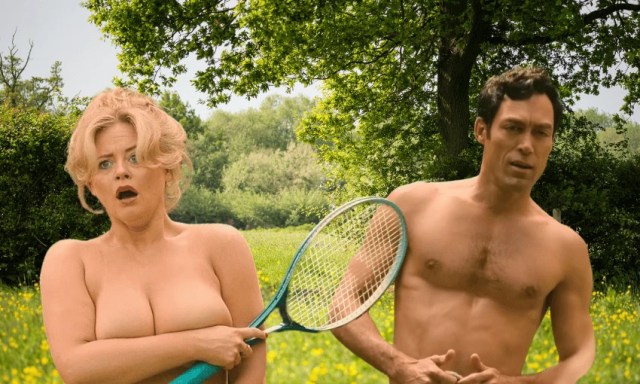
In Cooperworld, copious shagging is mandatory. (Disney +)





There’s a form of therapy for dementia sufferers which immerses them in a comfortingly familiar Fifties town, complete with retro-style diner, vintage department store, and bowling alley. Rivals functions a bit like that for Brits who were alive in the Eighties. It is sometimes hard to concentrate on watching the TV adaptation of Jilly Cooper’s bonkbuster, so flooded are the synapses with long-suppressed memories. Suddenly you are 17-years old again, dressed in a cerise batwing jumper and pedal pushers, your wrists reeking of Cacherel’s Lou Lou, your mouth burning horribly on Findus crispy pancakes.
And my God it’s fun to watch. Though the polka dot dresses, Twilight Teaser lipsticks, and boil-in-the-bag cod mornays have survived in this second season, the dead wood of Cooper’s original novel — in which too many pages are spent on the ins and outs of TV production meetings, and not in a good way — has been radically pruned. What is left is a series of wildly Dionysian set pieces and no hangover. Copious shagging is mandatory, though rarely between husbands and wives. Fags are smoked constantly. Everyone is half cut from 10 in the morning, washing down dry martinis and bottles of Krug with glorious insouciance. Beautiful people are enthusiastically desired by members of the opposite sex; men rut with women half their age, and vice versa. There’s even the odd bit of light-hearted sexual assault, Eighties-style, dealt with afterwards only by an abject apology. The tango music accompanying the titles sets the tone, overlayed with operatic warbling. Its composers have told BBC Music Magazine their aim was to create the “musical version of an orgasm”.
When I first heard that Cooper’s Rutshire Chronicles were being dramatised for a new audience, it seemed inconceivable that such enthusiastically heteronormative novels could survive 21st-century focus groups. But by some miracle, the politically incorrect attitudes expressed in the books have arrived on screen largely intact. And there is no heavy-handed prompting of the audience to rouse their disapproval, either. Though there is — of course — a degree of distancing camp, it is judicially applied, and doesn’t overwhelm the production. The viewer is treated as an adult with a functioning brain, which only adds to the nostalgia.
Another unfashionable element is the naked classism, transferred straightforwardly from the books. Cooper’s fictional world is divided up into three kinds of people: sympathetic ones who know their place; ghastly upstarts who don’t; and unreadable foreigners who can provide a love interest. In Rivals, the former group includes the arrogant aristocrat Rupert Campbell-Black; the upper-middle class romantic novelist Lizzie Vereker (a stand in for Cooper herself); and working-class Freddie Jones, a self-made Essex millionaire played by Danny Dyer. It also includes various pasty-faced Gloucestershire yokels, milling anonymously about the grounds of stately homes and looking suitably gormless.
Ghastly upstarts include Freddie’s wife, Valerie, whose gauche attempts to fit in with the Cotswolds smart set make her a laughing-stock; and the book’s chippy villain, TV mogul Tony Baddingham, a former grammar schoolboy “brought up behind net curtains in a boring semi in the suburbs of Cheltenham”, according to the book. As Freddie hissed at Tony in the first series: “I hate snobs, Tony, and you’re the worst kind there is — the kind that’s forgotten where he came from.” Classless foreigners include the American Cameron Cook and the Irish couple Declan and Maud O’Hara, though these are imagined in terms of national stereotypes instead (respectively: androgynous ballbreaker and emotionally volatile drunkards).
Coincidentally, a day after the second series of Rivals launched, the Guardian published the results of a new class survey. Over a third of British people say they have changed social class since childhood, with those self-identifying as upper and upper-middles more likely to claim they are members of several classes as once. For these people, researchers have coined the term “polyclass”. Presumably Cooper, who died in 2025, would have been as scathing about the idea of polyclasses as she would have been about idea of polyamory, preferring the sort of marital infidelity that doesn’t require earnest discussion beforehand. Indeed, in 1979 she wrote an entertaining though somewhat sociologically unreliable book touching on both topics. It was called Class: A View From Middle England. It stayed on the bestseller list for 20 weeks.
Class presents the reader with several caricatural families, each supposedly occupying a distinct stratum of English life. At the top there is the Hon. Harry Stow-Crat, formerly of Eton and the Coldstream guards, and his wife Caroline. They “love their dogs more than each other” — for upper-class marriages are made for status not romance — and Harry has numerous children “both regularly and irregularly conceived”. Then there are the upper-middles, Gideon and Serena Upward: “the most intelligent and highly educated of all the classes, and therefore the silliest and the most receptive to every new trend.” They went to minor public schools but now read the Guardian, are worried about the environment, and try to share domestic duties between them. Their children are called Zacharias and Thalia.
Lower down, there are the middle-middles (Howard and Eileen Weybrige, Surrey conservatives who haunt the golf club and the gardening centre) and lower-middles (Bryan and Jen Teale, using “refained” accents, net curtains, and privet hedges to keep away the working classes just beneath them). Cooper’s own crashing snobbery gets more strident as she intrepidly descends the social scale and away from her own kind, culminating in her callous depiction of the lowest echelon: the people she calls the Definitely-Disgustings, who seem to be forerunners of Hillary Cinton’s Deplorables. They do manual labour and domestic work, stuff their kids’ faces full of sweets, watch too much telly, and mix socially only with members of their own vast families. She later claimed, very unconvincingly, that she chose the name only because of the working-class habit of calling everything it didn’t like “Disgusting! Definitely”.
But even with a politer name for the proles, it is impossible to imagine a book like Class succeeding nowadays. Class warfare goes in all directions, but there always was something distinctly unsporting in the fact that, in the Seventies and Eighties, the upper-middle Pandoras and Jagos who ran publishing and broadcasting could viciously caricature the working classes in books and on screen, while the latter group lacked the cultural resources and connections to fight back. Made uncomfortably aware of this disparity, today’s Pandoras and Jagos have responded, not by relinquishing much of their cultural grip on the discourse, but by moving instead towards warmly sentimental depictions of working-class people — authentic, Northern, gritty, jocular, and so on. A huge group with many different stories is now largely reduced to a reassuringly down-to-earth voiceover during a teabag advert.
Permissible vituperation, meanwhile, has shifted towards the aristos just above the upper-middles on the ladder. And so toffs have become synonymous in popular fiction with being selfish and grasping, and also — to compress a devastating character assassination into a single phrase — “Right-wing”. Whenever some fox-hunting posho appears in a BBC drama, there is a strong chance he will turn out to be the show’s evil antagonist. It’s ironic when you consider that 32% of the corporation’s highest earners went to private schools.
Social climbing has also changed since the Seventies. In Class, the worst culprits are the “Nouveau-Richards”, prone to being rude to domestics and asking loudly “whether gold plate will spoil in the dish-washer”. Rivals’ Valerie Jones is another such grotesque parvenu. In old sitcoms, lower-middles used to be depicted as frightful social climbers, since the implication was that they were working-class, but giving themselves fake airs and graces. Their famous archetype was Hyacinth Bouquet in Keeping Up Appearances.
In the present, there is less need for the lower-middles to be seen to escape their roots, because working-class identity is positively desirable — or at least, the sentimentalised version of it. This has been going on for a while: indeed, arguably it started in the Seventies, when there was a short phase of thinking “working class is beautiful”, according to Cooper. She observes that the timing of this trend explains why Prince Charles sounds just like his mother but Prince Andrew sounds more common.
But to properly blend in with the all-powerful upper-middles these days, it’s all about the morals. You can’t be seen to be obstreperous or sharp-elbowed like Valerie, and must be kind and empathic to the oppressed instead. Where there used to be a crocheted cover on the loo roll, there now should be unbleached bamboo toilet paper; where a gay son used to be a disgraceful secret, you should now throw him a coming-out party. And where pressuring your offspring to do well at school used to be a reliable route up the ladder, it’s now the private diagnosis of mental disorder that’s really chic. Even in 1979, Cooper was noticing this emerging trend, observing that “paediatricians are coining it in testing middle-class children because they aren’t coming top of the class”.
Thankfully, she kept this distinctly modern sounding observation out of Rivals; and the programme-makers didn’t break the spell either. To watch this series is to bathe in a world where the 21st Century is blissfully absent. Class war is out in the open, with no covert operations or feigned surrender. Competition between individuals is pursued openly and energetically, not passive-aggressively behind a kind face. Heated arguments about language are not about pronouns, but concern “swimming costume” over “bathing suit” or “teacher” over “schoolmistress”. The only mental disorders come from aristocratic inbreeding. The only kind of surrogate mother anyone has ever heard of is a nanny. Do yourself a favour and open some booze, have a cheeky fag, and take a holiday to the sexy, sybaritic Eighties — whether or not you get a happy ending there, you’ll return feeling strangely rejuvenated.
