




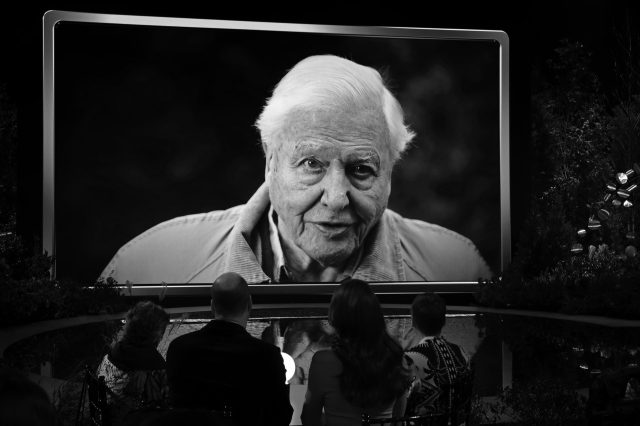
The Earthshot Prize 2022. (Chris Jackson/Getty)





In 2016, the British people were given a say in a matter of supreme national importance. They deliberated on the question set before them and voted for their desired outcome. But the so-called experts, the enemies of the people, resolved in their wisdom that the vote had gone the wrong way. “Boaty McBoatface” simply would not do: an important research vessel demanded something more serious. The name that was eventually chosen had received less than 10% of Boaty’s overall vote-share, but the experts decreed that it summed up everything that made Britain Great. The will of the people was overturned in favour of our most precious “national treasure”, and the vessel was duly christened the RRS Sir David Attenborough.
When, exactly, did the term “national treasure” come to mean persons rather than things? In its bald sense it refers simply to the state finances: there is a government ministry called the Treasury, and it stands to reason that the Treasury controlled the “national treasure”. But Jane Austen’s ring has also been proclaimed a national treasure. The status can carry an official meaning: these items are deemed to be of such value that they are not to be removed from our soil. It is only natural now to stretch the term to any item, tangible or not, liable to kindle some feeling of patriotic warmth: if Austen’s ring can be called a national treasure, then why not each of her novels? From there, in turn, it’s only a small step towards asking: why not Austen herself?
To be canonised as a saint by the Catholic Church, one first has to be dead. We used to hold our national treasures to a similar standard. In a speech of 1984, a close ally of Margaret Thatcher’s, Lord McAlpine, made the case for the rights of the living. “If we were in Japan,” he declared — a country famous for its culture of deference — “many of our artists would, even in their own lifetimes, be called living national treasures.” But, he lamented, in Britain we are “more timid about rushing to such judgements”.
Lord McAlpine got his way in the end: that timidity no longer afflicts us. Our national treasures don’t need to be dead — though it helps if they aren’t far off. The 2000s and 2010s spawned an entire pantheon of “national treasures”, spurred on by the twee sentimentalism that suffused popular culture around that time. The grey and gritty Daniel Craig-era of James Bond gave us, as a sop, Dame Judi Dench; The Great British Bake-Off treated us to the whimsically innuendo-prone Mary Berry; the Harry Potter films brought international stardom to the wizened sages of the British stage. To console the nation through the drab stretches of lockdown, Captain Sir Tom was summoned back from our Finest Hour.
No one was safe. Not even Tony Benn — once described as the “most dangerous man in Britain” — could escape “national treasure” status when it called out to him in his final years. Benn still thought of himself still as a firebrand and chafed against it. “If I’m a national treasure in the Telegraph,” he said, “something’s gone wrong.” To be designated a national treasure, as Benn recognised, carries an air of condescension: it turns complex people into Paddington Bear. National treasures exist in order to give us nostalgic comfort: their task is to serve as “living links” with better times. Many other cultures have “community elders”: in Britain we like to think that they are under collective ownership. A national treasure is a public good. He or she belongs to us.
At the head of the pantheon, surpassing even the late Queen, Attenborough presides. In the run-up to his 100th birthday tomorrow, the homages have already been coming in thick and fast; there has been suggestion in parliament of building a “permanent public monument” in his honour. There is a sense, as there was with the late Queen, that the public needs to take a deep breath in preparation for the inevitable. In the first episode of the British SNL, Attenborough sits as Christ at a Last Supper of “history’s greatest Britons”. “I’m David Attenborough,” the sketch begins, “and it can’t be long now.”
Attenborough is the safe pick for those boring questions about whom you would invite to your dream dinner party; the people who give him as their answer are the equivalents of men who say Margot Robbie is their celebrity crush. Who ought to replace Churchill on the £5 note? Knowing now that they wouldn’t be allowed “Money McMoneyface”, the British public opts for Paddington Bear, the Sycamore Gap tree (†), or, of all the human options, Sir David Attenborough.
For his part, Attenborough is bemused by all the veneration. Asked on Desert Island Discs whether he feels any pressure being one of those “public figures with that rare unimpeachable quality”, he wittily retorts, “I’m very peachable, if people know how to peach”. It can seem at times that he alone has inherited all the positive feelings that once attached to his lifetime employer, the BBC. The BBC is still riding on the coattails of its mid-century highpoint, and Attenborough has helped to stretch it into the present. The mere existence of a state broadcaster is predicated on the notion that there remains such a thing as a coherent “national life”. David Attenborough is the old BBC made flesh — gentle, informative, and above all, unifying.
He is also a relic of a time which was at once comfy and exciting, when English boys in khaki shorts cycled around the countryside collecting ammonites and inspecting slow worms. He is an unmistakably conservative figure, conjured up from our mythical past. His Britain was an imperial Britain, in that Scouting for Boys kind of way; his BBC, likewise, was in its Reithian pomp, before the brand had been blighted by controversy and scandal. He is the last in Britain’s storied tradition of natural history, going back to Darwin; he is that familiar figure, the eccentric collector, driven through life by a childlike curiosity about the world. What people liked to say of his exact contemporary, the Queen — that she somehow embodied an entire chapter of British life — has always been much truer of him.
Attenborough sums up the trajectory and aspirations of Britain’s intellectual middle classes in the 20th century. His mother was a suffragette and campaigner for the rights and welfare of refugee children; they welcomed in two Jewish girls during War. His father went from being a Cambridge don to administering one of the newly sprung semi-universities, University College, Leicester. David, the middle son, continued his father’s project of democratising education — bringing knowledge now not just to the provinces, but into the homes of ordinary people through the new medium of television. Attenborough embodies a certain reverence for television, and for the BBC, as a truly national institution, above all. As controller of BBC Two, he brought to the screens such milestones as Monty Python’s Flying Circus and Kenneth Clark’s Civilisation. Remove all his nature programmes, and he still would have made a profound imprint on British culture.
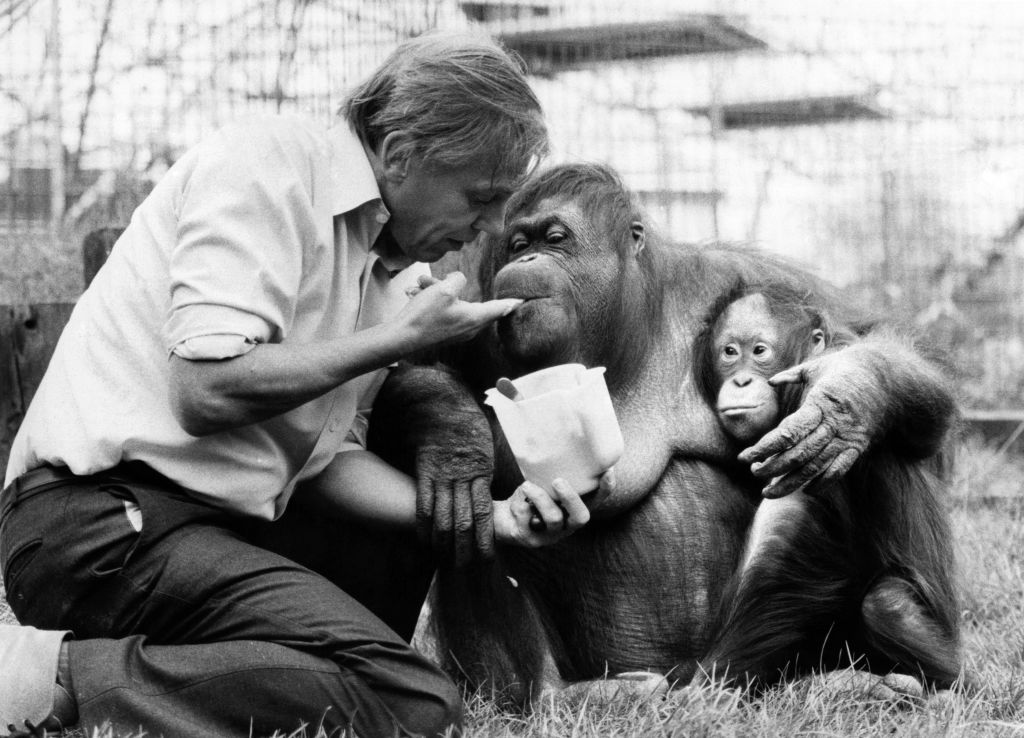
The BBC must be relieved that Attenborough tends to avoid sensitive subject-matter. The issue on which he is most outspoken, the environment, seems somehow to befit a national treasure: we British, after all, pride ourselves on our love of nature and animals. When Attenborough does wade in on such issues as immigration, as in 2016, he does not always toe the line: part of his success might owe to the fact that he is more aligned than other “national treasures” with the sentiments of the British public. But in all his career he has only ever had one small brush with controversy, and a rather minor one at that. It came in 2013, in an interview with the Telegraph. “What are all these famines in Ethiopia?”, he asked, “what are they about? They’re about too many people for too little land.” As such, it was “barmy” for the UN to send bags of flour as humanitarian aid: better to let them starve, to let the Malthusian process take its course. He knows that such a position can seem callous and unpopular. But overpopulation is, in his view, at the root of all the world’s problems, and so it is important to “just keep on about it”.
And so he has. A Life on Our Planet begins each part with statistics showing levels of carbon dioxide in the atmosphere and the percentage of the planet still covered by wilderness — and then the total human population, as though this is also an obvious index of the brewing catastrophe. In 2018 he declared before the World Economic Forum that the planet “can’t cope” with overpopulation. The “cure” would either be meted out by nature, through famine or disease, or else we shall have to take matters into our own hands.
Attenborough is faithful to an old sort of environmentalism, the environmentalism of the late Paul Ehrlich. He shares it, in fact, with the Royal Family. Prince Philip infamously hoped to be reincarnated as a deadly virus, “to contribute something to the problem of overpopulation”. His son thought similarly. In 1970, Charles, freshly minted as Prince of Wales, delivered a speech in his principality concerning the environment. Fifty years later, in 2020, he reflected on it in a video posted to the official Royal Family YouTube channel. That video was intended as a kind of “I told you so”, a means of showing how much he had always been ahead of the curve. It is telling, though, what Charles chose not to revisit. In 1970, he had said “in many places the number of people is increasing faster than the resources of the local environment can cope”, and referred ominously to two possible solutions to the problem. “One is that nothing need be done about population because nature is bound to react by producing a particularly virulent plague or virus” — nature, here, is imagined as a particularly vindictive god. The other is that “something certainly needs to be done by man to prevent his overpopulation”. Such sentiments have been cautiously omitted from his more recent public musings.
That entire line of thinking has gone out of fashion now. What, after all, can man do to prevent his overpopulation? One thinks immediately of Indira Gandhi’s vicious programme of mass sterilisation, or China’s disastrous one-child policy. The argument also, especially when departing royal mouths, has an unsettlingly aristocratic ring to it, as though one is speaking about culling deer on the Balmoral estate. Most importantly, though, it has simply been proved wrong by events. The extraordinary rise in the world population has not brought the catastrophe which Ehrlich confidently predicted. On the contrary: living standards across the world have improved. The problem facing us now, it is widely agreed — especially in the West, with our low fertility rates — is depopulation, not overpopulation. Even in poorer parts of the world, the size of the population is expected to plateau.
Still Attenborough cleaves to the old doctrine, if now he is careful to express himself in a circumspect manner. In his dotage, the BBC has done its best to massage his ideas about the environment, to try to co-opt them and tailor them to the fashionable green politics of the present. They play his earnest and long-held beliefs to their own advantage; it does not matter, in the end, that his environmentalism is of a fundamentally different nature from the kind that prevails among young people today. Before she embarked on her new life on the high seas, the BBC made a documentary about Greta Thunberg, A Year to Change the World. The crucial moment involves Thunberg meeting Attenborough. It is presented as the passing of a baton from the old to the young, a jedi training up his padawan. The set-piece also allowed the BBC to pat itself on the back — to claim, like the Royal Family, that on the hot-button and cutting-edge issue of the environment, they have always been one step ahead. Would Thunberg support withholding aid from starving populations, in order to let nature take its course? It strikes me as doubtful. But no matter. The point was to make Attenborough some kind of national prophet. It was to put him at the very centre of Britain’s moral and national life, through all its fluctuations and upheavals. That might always have been too much weight for any mortal man to bear. And the BBC’s own claim to its centrality in British life, once unchallenged, now hangs by a thin, 100-year-old thread.
