




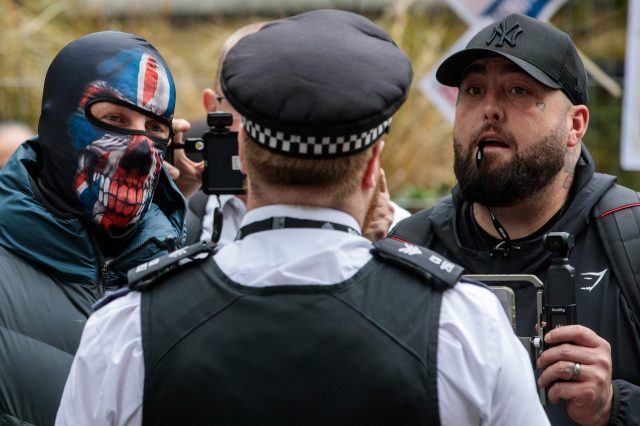
Protests at the Britannia Hotel at Canary Wharf. (Mark Kerrison?Getty)





In Middle England, where I live, the traditional May bank holiday pastime is taking things to the tip. Since Covid, my local “Recycling Centre” has embraced a system that forbids you to participate in this festive tradition, without first making a reservation via a council website. There, after many popups and many clicks, you submit every personal detail short of a DNA swab before being allocated a 20-minute slot in which to make your offerings to the God of Recycling.
On the whole, people seem remarkably tolerant of these hurdles. At least: the tip is always busy. But whenever I’m obliged to wrangle this system, it strikes me that deliberately making it difficult for law-abiding people to clear out the garage may have unintended consequences.
Out running last week, I met an example of these consequences: two council workers in a lay-by, gloomily loading fly-tipped waste onto a truck. Latterly, this has become an increasingly regular sight. The same phenomenon also appears, writ large, in the growing blight of “unlicensed waste facilities”, such as the 30,000 tons of waste recently found in a protected marshland in Leicestershire. This follows the discovery of another massive illegal tip in Oxfordshire last year, and ongoing wrangles over another such dump near Wigan.
It’s easy to tell this as a story of civic decline. But what it actually reveals is more sinister: a Britain that’s increasingly two-tier not just in its policing, but also in its social structures. For the law-abiding and conscientious, a thicket of paralysing, economically ruinous regulation; for the criminal, almost entirely consequence-free liberty. The American polemicist Sam Francis called this “anarcho-tyranny”; we might say on the one hand “Official Britain” and on the other “You Can Just Do Things Britain”.
The governing character of Official Britain is a perverse and increasingly vindictive opt-in tyranny. The more determined you are to abide by the rules, the more difficult Official Britain will make your life. Its citizens are the people who dutifully fill in the timed registration form for a timed tip slot, before showing up at their allotted time and dropping things into the correct skip, according to the type of waste.
You Can Just Do Things Britain simply ignores this kind of fussy infrastructure and petty rules, and dumps waste in a hedgerow for someone else, probably from Official Britain, to clean up. The two Britains rarely interact directly so much as compete for space and ownership of public resources. But the increasingly testy and hostile nature of this competition is apparent across a host of now depressingly common public-order issues.
It’s not just making it as difficult as possible to dispose of garden waste. Up and down the country, small business owners in Official Britain try to follow the rules — only to go bankrupt in the attempt. Employing people with a right to work; paying them minimum wage; offering holidays and other statutory benefits as required; abiding by the plethora of working directives and business obligations; paying business rates, paying corporation tax; et cetera and so on. Each of these is reasonable enough, on its own. But taken together, and set against rising energy, rate, and material costs, and cash-strapped customers, the cumulative burden is often now so onerous that such businesses are unable to make ends meet.
Meanwhile, for those who simply ignore the rules, often the only consequence is that someone will be along later to mitigate the damage you leave behind. The small business owners of Just Do Things Britain occupy high-street premises, but employ illegal migrants; house them on filthy mattresses in back rooms; operate as fronts for drug-running, people smuggling, and other criminal activities. They do just fine, and their persistence attests that more often than not, they operate with impunity.
This is at least in part because the kind of people who get jobs with Trading Standards are, by definition, themselves part of Official Britain. And until recently, they have been more accustomed to engaging with fellow-citizens of this official national polity, where polite reminders to follow the rules tends to result in compliance. By contrast, confronting the denizens of You Can Just Do Things Britain does not have this effect. Rather, it results in midnight death threats by phone, cars trying to ram you off the road, and threatening strangers turning up at your house. Understandably, this breeds reluctance to rock the boat, reinforcing the dynamic of two-tier enforcement.
The same pattern obtains, too, in the housing market. Successive governments have clamped down, with escalating intensity, on private landlords; the latest such salvo, Labour’s new Renters’ Rights Act, has already triggered a large-scale exodus from the lettings business, as small-time landlords who still live in Official Britain stare in dismay at the mountain of regulations and conclude that landlording is now more trouble than it’s worth.
Across the invisible barrier in Just Do Things Britain, though, the property business has never been better. The most profitable sector is HMOs, which are duly springing up everywhere, including a lively sector without official licences. Occasionally the accommodation itself is so manifestly grim that Official Britain will bestir itself to prosecute, as in the recent £91,000 fine issued to a landlord in Wembley for offences including housing a couple and a baby in an unheated garden prefab. But fewer than 2% of tenant complaints result in prosecution, despite councils receiving thousands of such complaints every year.
Petty theft is another battlefront in the turf war between the Official and Just Do Things Britains. Effectively decriminalised via lax criminal justice and police response, we find individual action also foreclosed by a thicket of health and safety rules. The result can be almost gleefully perverse: as, for example, when Walker Smith was recently fired by Waitrose, after 17 years’ service, for trying to stop a known repeat shoplifter walking out with a bag full of luxury Easter eggs.
Why is this happening at all? The reflex response, usually from the internet Right, is to blame immigration. And it’s true that (as with the gangs prevalent in “Turkish Barber” enterprises) Just Do Things Britain is noticeably more multicultural than Official Britain. Indeed immigration itself is also a front in the struggle between Official and Just Do Things Britain. The less conscientious you are about following immigration rules in your manner of arriving, the more likely you are to be plied with housing, pocket money, and (grey economy) employment opportunities.
But if the blessings of modern Britain do manifestly include a new diversity of criminal cultures and law-breaking styles, as well as of takeaway menus, the backdrop against which this emerges is of our own making. Like taking things to the tip on a Bank Holiday, Official Britain reflects a deep-seated instinct in the modern English soul: a national urge to find out what people are doing, and stop them. Our large and well-organised anti-housing lobby is one notorious example. So, too, is the generalised campaign to prevent infrastructure.
But perhaps the most florid recent case in point is the effort, by the massed armies of Official Britain, to stop Britain improving its energy security. The interventions made by that most Official of Official Britain quangos, Natural England, at the construction site for Hinkley Point, are already the stuff of legend. EDF have spent millions on a device whose aim is to use sound waves to deter fish from approaching the plant’s water intake pump. Dubbed a “fish disco”, reports of its cost vary from £50 million to £700 million. but Natural England has still decreed it inadequate, and demanded a local farmer’s land be flooded to create new salt marshes as well.
The more charitable interpretation of this culture of obstruction is a desire, at every point, to make everything as good as it can be. This urge to make the bureaucratic best the enemy of the good must prevail, even where it means pursuing mutually exclusive aims, such as keeping the countryside untouched while also tearing it up to build roads or high-speed rail. In practice, it produces so crippling a state of general paralysis that the only remaining people to feel empowered to do anything at all are those who either aren’t part of this culture or generally don’t care about rules: that is, foreigners and criminals.
To be clear: I’m not saying Britain’s high streets deserve to become shop-fronts for Kurdish gangs as a punishment for excessive paperwork. It’s more like a condition of learned helplessness. But for all that Official Britain induces this condition in those who accept its premises, it strikes me that loading all the blame onto outsiders, for exploiting it, merely replicates the helplessness in a different form.
Criminals are, of course, responsible for their own actions, whatever their culture. But we are also responsible for our inaction. How, then, are we to reclaim the spirit of just doing things, for the decent majority? I don’t think we can just demand a “bonfire of the quangos” or “UK Doge”. In fact every government in the last half-century has promised a bonfire of this kind, only for the opposite to happen. It doesn’t work, as long as the underlying culture remains unchanged: a culture whose natural product is Official Britain, like the natural product of coral polyps is coral reefs.
There are two ways out of this predicament. It’s possible that, eventually, the coral reef of Official Britain will grow so stiff and hollow it’s demolished for parts by the Just Do Things Britain coalescing under its surface. Indeed, this state of affairs is arguably already under way: a piecemeal dismantling and re-purposing of Britain’s rulebook, analogous to the re-purposing of former family homes in outer London boroughs as slum housing for the ambiguously documented. Or, alternatively, we remember who we were, before Britain was a nation of pettifoggers. King Arthur and Robin Hood just did things. Henry VIII, the most Just Do Things monarch in history, nationalised Christianity then sold off all the church treasure to fund his wars. A private British company sailed to India to make money and ended up taking over the governance of the subcontinent. We know how to just do things.
When the rules stop serving the people who created them, one way or another they’ll end up abandoned. We now have two choices. We can stand by helplessly while opportunists dismantle the country for parts under our noses. Or we can stop complaining about rule-breakers, and start rewriting the rules to suit ourselves.
