




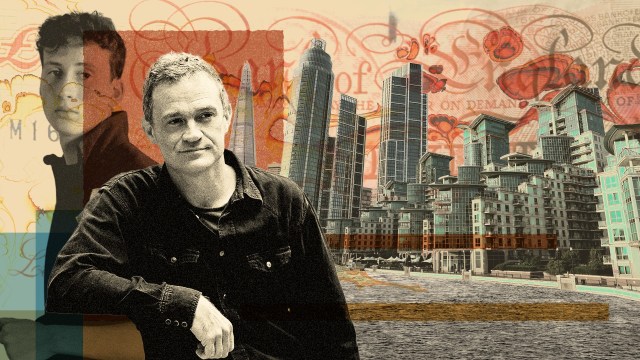
Nothing to see here. (Getty)





They used to call it the Silent Highway. Compared to its imperial heyday, there is far less traffic on the Thames now — mainly tourist catamarans, rusting barges, the odd police patrol, and occasional rib-pulling stunts. Once, it was “teeming, thrumming with commerce… the pulsing artery of London’s industrial boom”. Today, though the highway has largely ceased, the silence remains.
Death has long stalked the river. An 1858 illustration in Punch features a skeletal Silent Highway-Man rowing along the putrid river during the Great Stink, when tens of thousands died of cholera. It’s the site of innumerable suicides and murders. Though much of the violence of empire was outsourced globally, the bodies of river pirates hung in gibbets as a warning — don’t even think of stealing a piece of the grand colonial larceny. And though deindustrialisation and globalisation brought the naval works to a close, the Isle of Dogs became the location of a new empire of capital. The skyscrapers looming over Canary Wharf, and the City further upriver, have been busy for decades laundering the world’s blood money. Silence can be a sign of absence but also concealment, and not everything can be hidden forever.
On 29 November 2019, a 19-year-old man named Zac Brettler leapt from the fifth-floor balcony of Riverwalk in Pimlico. His last moments were captured on CCTV from the MI6 building across the river in Vauxhall: he fell, struck the embankment wall and disappeared into the murk. As with any suspected suicide, the family’s grief was compounded by endless torturous contingencies. These only deepened when they learned that their precocious son had been closely associating with violent underworld figures, and had constructed a bewildering web of lies around himself. As their image of their son was thrown into doubt, so too was their belief in British justice. Patrick Radden Keefe’s latest bestseller, London Falling, is a rigorous, thought-provoking and moving account of this unfolding tragedy. It assembles a portrait of a lost soul and through it, a damning portrait of London itself begins to emerge.
At first, it seemed like an open and shut case of heartbreaking self-destruction. Brettler appeared, after all, to jump of his own accord. Context, however, is everything. The teenager had been living a fictional life, creating a Russian persona, altering his family tree to appear like the scion of oligarchs. In reality, he was a Jewish upper middle-class kid from West London with a father in finance and a journalist mother. But he was in way over his head, it seemed, the pressure got to him.
On the night Brettler died, however, another occupant of the Riverwalk flat — owned by “Indian Dave”, a gangland figure — had sent a text to an acquaintance: “I am not fucking playing. I have just been heating up knives and clearing up blood.” Records show the last thing Brettler typed into Google that night was “what to do with skin burns”. The police promised the Brettler family “no unanswered questions”. They merely created more.
Radden Keefe’s account has many strengths. It contains genuine insights and he has a noble duty of care towards the Brettler family, which is often absent in nonfiction. The story is gripping from start to finish, even as you swim through someone else’s misery. But London Falling is not without flaws. A view from the outside can be enlightening but it can also lead to inaccuracies. The view of Eighties London suddenly rousing itself from monochrome post-war austerity is too convenient a simplification as it erases the Sixties. And the author’s commendable closeness and sensitivity towards the family may have dulled his critical eye. There is also an exhausting tendency to finish each subchapter with a cliffhanger, which feels like a stylistic seepage from true crime podcasts. But these are minor qualms.
A larger issue lies with Radden Keefe’s worldview. He explores the criminal underbelly, quite courageously, and he intimates throughout that “glitzy mercenary” London is far more corrupt than many care to acknowledge. He is right to present the capital as “twenty-four-hour laundromat for dirty money… full of crooks with pretensions to legitimacy”. Yet there is something, a benevolent liberal worldview perhaps, that prevents him from fully staring into the heart of darkness. His portrait of the capital remains compelling but only partially developed because it still feels reliant on an assumption that humans are intrinsically decent and institutions are there to protect us, a view that is fading, sadly but necessarily, into extinction.
The death of Zac Brettler was a singular event, yet it is an encapsulation, rather than an aberration, of how London functions. There is a chasm between the London Zac’s parents thought they knew, and London as it actually is. This is a common understandable misconception in bourgeois circles. Respectability and lack of exposure can be blinkers. There is a sudden dawning when Zac’s parents realise that the state isn’t going to protect them or bring justice. The author is correct in noting that their earlier “unexamined confidence” was misplaced. Yet he does not fully examine whether this is how the system is actually built to function rather than some terrible mistake.
The hypocrisy of the West’s political and media class is demonstrated by how it “others” corruption. It always belongs somewhere else, usually to the east or the south. The truth is that corruption here is so endemic it is not even recognised as corruption. We threw our doors open to Russia’s oligarchs when it threw off its communist shackles; we bolstered the kleptocratic class by coercing IMF-led “shock therapy” of privatisation on the nation. When the ex-KGB tough guy Putin gets into power, Britain offered these well-heeled thieves a sanctuary, further debasing itself by offering up football clubs, luxury apartments and private schools as investment vehicles. Once the autocratic world-boss, Britain was now reimagined as the sycophantic butler. Other places are merely more honest about their dishonesty. Here it has acceptable names — expenses, moonlighting, PFI, offshore entities, super-injunctions, non-doms, shell companies. Colossal wealth transfer takes place all the time from the public purse to private banks via opaque and unaccountable bureaucracies. This is not the exception but the rule. Legality is superfluous when those who make the laws are themselves confidence tricksters.
There are two layers of society that know this Darwinian or even Hobbesian truth, and give little credence to any chatter of progress or etiquette. The working class know because they face the consequences every day (consequences, like taxes, are only for the little people). The establishment know because they reap the benefits. It is those in the middle who are oblivious, their knowledge of the world not caring to extend beyond the unreliable narrator midwittery of The Rest is Politics or The News Agents, “a lot of Londoners found themselves priced out of this new version of their city, forced to relocate and commute from distant suburbs.” But in fact, it goes much further than that.
There has also been an asset-stripping hollowing-out of the city’s soul. The cockneys are gone. The old markets closed or replaced. The nightlife is being put through a slow euthanasia. London Falling implies that these are side effects or errors when actually they are the main game: profitable for the few over the many. This is suggested in the hostility the commentariat show to anyone who points out London’s very obvious decline, denying and obfuscating anything that happens outside of leafy gentrified enclaves. There is a cruelty in denying palpable concerns, especially from those upon whom the entire capital relies. There is also delusion, aided by mantras like “greatest city in the world” or “just the cost of living in a city” while the metropolis slowly falls apart. Crime is deemed more palatable than noticing or even experiencing crime. Multiculturalism has been abandoned in favour of exploitation and Balkanisation. It is reminiscent of the scene in La Haine where a man falling from a building repeats with every passing floor, ‘So far, so good.’
What makes this a particularly terrifying book, then, especially for any parent, is the societal feeling of vertigo when they start to realise no one in authority is going to protect them or their children. Faced with their son’s lies, Zac Brettler’s parents experience “a kind of woozy vertigo, as what had previously seemed to be the solid factual underpinnings of their family’s existence began to shudder and torque”. The state is not constructed to protect its citizens. It is designed to protect a status quo or engineer a new and profitable one. There are numerous lines in London Falling that are indicative of the permitted degeneracy of our times — a business address with “no fewer than twenty-five buzzers”, a recidivist criminal serving time in 33 different prisons, no comment uttered “nearly two hundred times”. Britain is broken and it’s by design. Wealth may not trickle down but the moral expediency of grifting does, regardless of the cost to any semblance of justice or meritocracy. It is there in the high-end funds pouring in from Qatar and the Gulf States, designed successfully to influence those in power, and it is there in the cynical façade of high street candy shops and barbers, laundering money and on occasion selling drugs, at the other end of the spectrum. One is inscrutable, the other unavoidable for those with open eyes. They are however two sides of the same coin.
Radden Keefe’s admirable sensitivity towards the Brettler family means that he takes a soft approach to any question of whether their son was a pathological liar. If we are callous enough to ask the question, it deserves an answer. Zac Brettler’s lies may have spun out of control, but they were rational. They were attempts to manipulate and gain status in a system built on manipulation and status. His mistake was not being well-connected enough to be protected in high-end circles and not brutal enough to survive in the low-life.
Young Brettler may have lost his bearings, but he did not create the maze in which he was wandering. In the end, it seems that he confused different worlds, seeking sympathy (via claims of grief and heroin addiction) from people to whom it was very dangerous to show weakness or duplicity. He mistook high-stakes life and death manoeuvrings for a game, and lacked the protections the establishment affords. In this London, you are either a shark or a mark.
Perhaps it was ever thus. Radden Keefe quotes Voltaire’s view of London in 1733 where people of many different creeds flocked to the city to “transact together, as though they all professed the same religion, and give the name of infidel to none but bankrupts”. We like to think garish excess and legalised profiteering are a new development, but tradition shrouds the crimes of the past. “This is what you get when you found a political system,” as Christopher Hitchens noted, “on the family values of Henry VIII.” The king was no stranger to ostentation (the Field of the Cloth of Gold for instance) or fuelling his lifestyle by crippling those doing social good (the Dissolution of the Monasteries). And so it remains. Whatever the etiquette or the vestiges of tradition, power has always been a scam. Its prey, from the peasants who believed in the divine right of kings to those who went over the top in 1914 to those who vote now for their own immiseration, are always those who believe in the prevailing establishment narrative.
Radden Keefe identifies Thatcher’s deregulation of the City of London as the Big Bang, offering ambitious young men “something that looked like meritocracy” while the Tories simultaneously laid waste to trades and industries. Simply put, instead of making things, Britain would launder money and place bets. Like the empire before it, it was extractive rather than generative, parasitic rather than wealth-creating. The ingenuity of the Industrial Revolution, the visionaries who dreamt it into being and the communities that carried it have long been betrayed, decimated by a globalisation initiated by a mercantile elite who have loyalty to nothing outside the financial. “To launder something — whether it is cash or a reputation — is to mingle the dirty with the clean,” Radden Keefe notes. This was true with the subprime mortgages that crashed the world in 2008. It is also true of “London’s obsequious hospitality” to the global hyper-rich, regardless of their crimes. Yet to witness Keir Starmer oozing out of No. 10 to greet decapitator-in-chief Ahmed al-Sharaa, you realise none is clean.
Again, they never were. A strange mirroring of the colonial age makes this abundantly clear as Radden Keefe notes, “In earlier eras, English aristocrats would occasionally throw Orientalist costume parties at which they dressed up as sultans, maharajas and other grand foreign types. Now, at Annabel’s rich foreigners could dress up as English aristocrats.” He reminds us that “England has a colourful history of imposters who used to turn up… and pose as titled aristocrats,” yet it was arguably an imposture from the beginning; the “silver spoon fairy tale” was always a swindle by invaders and warlords from the Normans onwards, more interested in Faustian pacts than social contracts. And it always fed off the populace — from the Harrying of the North to the rookeries of Dickensian London.
Admitting decline, though, is anathema to those benefiting from it. And so free speech is suppressed. Enquiries bury or soften bad news. The Official Secrets Act kicks unpleasantness into the long grass. Super-injunctions abound. The Brettler family found their case simply fade away, “nobody ever told them ‘no’ explicitly, but months and eventually years went by”. When they started to question, they were treated with hostility. The police are caught between infiltration from “below” by organised crime and from “above” by the security services, with protected informants bridging both realms. The all-seeing eye of the state can turn blind when certain interests needed protection. An impaled fixer for oligarchs, a child drowned in a storm drain, a care home of horrors, a spy found in a holdall in his Pimlico flat, a few hundred thousand working class girls, a Jewish kid who cosplayed as a gangster. Maybe law and order wasn’t ever really about justice. Now it’s seemingly no longer about order either. Lady Justice is blindfolded after all. “Ultimately, it’s all transactional,” Zac’s mother sadly notes.
If you navigate through the flocks of tourists around the Tower of London, you’ll find a strange recess under Tower Bridge called Iron Gate Stairs or Dead Man’s Hole. It was here that bodies of the drowned would wash up and be displayed in a morbid form of voyeurism. Yet disappearances are worse. Unsolved crimes. Unexplained fates. Cases closed with suspect haste. Secrets still wash up by the riverside though, even if they are sent from worlds that few want to look into. The dismembered body of Zoe Parker. The chemical attacker Abdul Ezedi. The suspected ritual child killing of “Adam”. Welcome to the city of silences. Nothing to see here. Move along.