




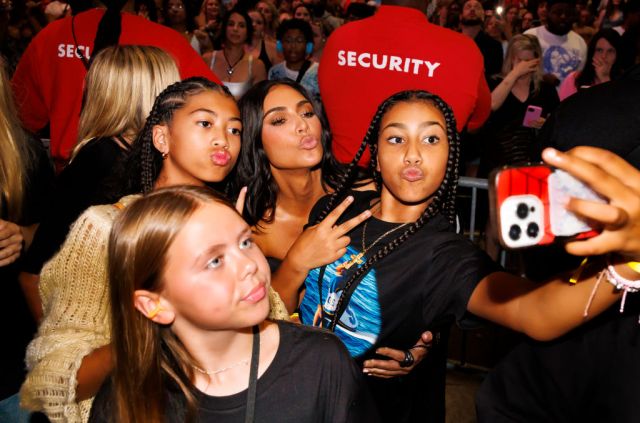
North West posing for a photo. (Christopher Polk/Billboard/Getty Images)





If any of us were asked to write a six-song EP at the age of 12, the lyrics might have gone a little like this: “I wanna die, wanna die / But don’t really wanna die.” Angst upon moody angst, dark but vague hinterlands, the slings and arrows of Year 7. “Know it’s been a hard time for me lately / I’ve been deep in the dark you can’t save me.” Rageful emo weltschmerz against a welt barely explored, spliced with the true passions of preteens: “I want more piercings and tatts/I love blue hair put it in some plaits.” Welcome to the mortifying secret life of tweenage girls, bogged down by post-primary blues and trying on, for the first time, the grown-up attitude of existential gloom. Welcome to the oeuvre of North West.
Northie, the daughter of Kanye West and Kim Kardashian, is Gen Alpha’s Adrian Mole. Her debut album — N0rth4evr, released on Friday — is a catalogue of the grandiose woes of phase-stricken tweens, recognisable to all former miniature diarists. Powered by the sounds and styles of metal and K-pop, North sings about the ennui of her mega-famous upbringing. In case you didn’t know, it can get lonely “in the back of the Lamb”; in fact, “all this money turn my heart into a black hole”. She rises to these challenges with her father’s hustler braggadocio: “I ain’t steppin’ out unless somebody pay me.” Presumably this pocket money is going towards indulgences more extravagant than Claire’s clip-on earrings and fruity Maybelline lipgloss, but ultimately North is still, if you needed reminding, only 12.
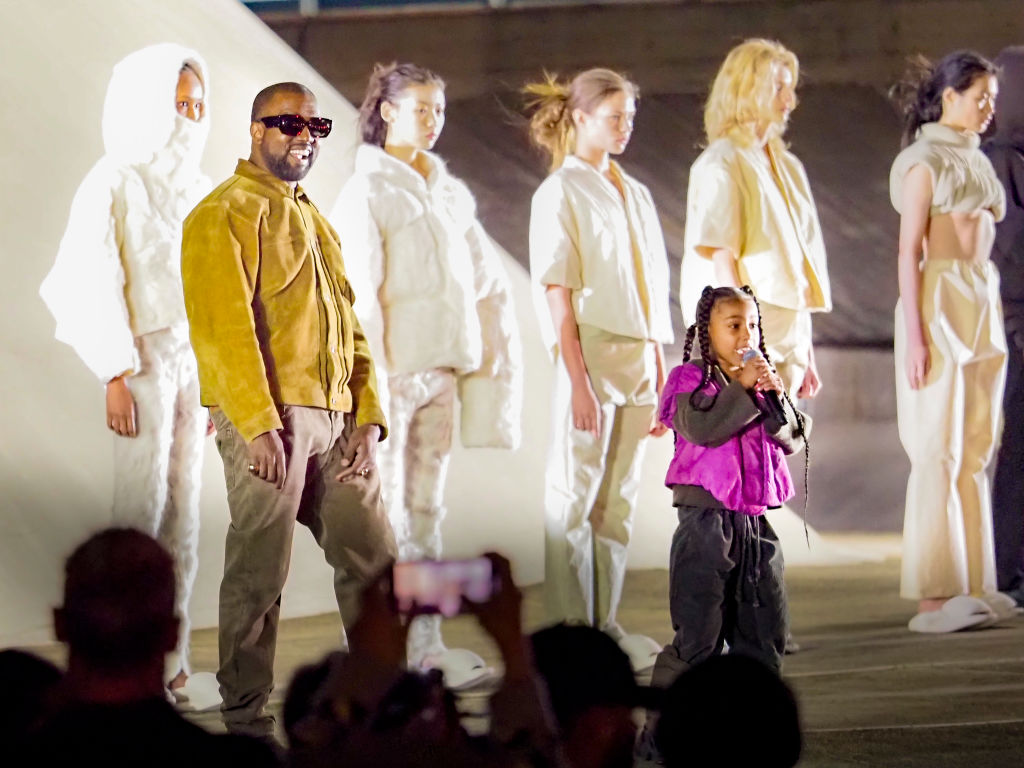
Mademoiselle West’s charmed childhood has been an internet obsession since she was delivered to the strains of Bohemian Rhapsody in West Hollywood in 2013 (Kanye was doing some delivery-room DJing, perhaps the most compelling incident in a crowded field for which he deserved punching). North was described as the world’s most famous baby, a crown shared with our very own Prince George; like a true royal, she was baptised in a cathedral during a tour of Jerusalem. From there, the marketing ramped up: who can forget her musical debut at the age of six at Paris Fashion Week, during which the puffa-coated rap progeny yelled into a mic at a heroically straight-faced row of models: “What are those? These are clothes. What are those? These are clothes.” Ye grinned on stage at his mini-me; Kim wept in the front row. Since then she has starred in The Lion King, collaborated with FKA Twigs and performed two songs at the 70,000-seater SoFi stadium during Kanye’s comeback show in LA last month. And, of course, she’s now released an album.
All the while, like every boundary-prodding preteen, North has been shocking curtain-twitchers with her “too grown-up” look. Black grills on her teeth, long blue wigs, finger piercings, full-beat makeup. Like Beyoncé and Jay-Z’s daughter, 14-year-old Blue Ivy, North has been the focus of much hand-wringing and finger-wagging about the provocative styling of child celebrities. West, never one to pass up an opportunity to swipe at his ex-wife, is thought to have accused Kim of crossing “the line” in allowing North’s at-times eyebrow-raising outfits; a source said he thought his daughter was “way too young to be parading around like this” (on that occasion, in a corset), with threats of “rais[ing] hell with the lawyers”. This, supposedly, from a man who appears to encourage his wife Bianca Censori to go to events in the nude.
But observers who fret about North’s breakneck-speed entry into adulthood, littering comment sections with refrains such as “how about go be a kid” and “this is just sad”, are missing the point. North is precocious in the way only nepo babies can be; opportunities to dance on stage in Rick Owens boots are not forthcoming to most anonymous preteens. Her polished public image and drastic overexposure is the result of inconceivable fame — with its attendant stylists and agents and fixers. But she is also in many ways typical of her age group: her ultra-public childhood has millions of analogues the world over. Online pre-adolescence today is by definition grotesquely stage-managed, publicised, even monetised — and mostly by children themselves. Even those from more conventional homes than North West are fashioning their own digital cults of personalities, with their own curated TikTok shopfronts, their own sullen lip-syncing clips and their own fake-eyelash experiments beamed to strangers across the globe.
The fact is that childhood as a category was too fragile to withstand the totalising force of social media. In-built features like the gatekeeping and chastisement of parents, the creativity of boredom, the privacy of loneliness, were traded in for intoxicating external moral codes, constant stimulation and the paranoia of exposure as soon as social media companies established Instagram, YouTube and TikTok as essential presences in young lives. The difficult tween years are periods of excruciating fashion experimentation (in my case, those undocumented crimes involved lace-fringed leggings) and rolling identity crisis: phase after phase, bad outfit after criminally bad outfit. The braces, swoopy side fringes and crippling self-consciousness of those years are formative; to develop personality and resilience, you need privacy. And yet, privacy is no longer an option. Kim Kardashian said of North’s occasional faux pas: “Unfortunately, we made that mistake in front of the whole world.” But really, today, who doesn’t?
North West, Aged 12 and ¾, is treating official album releases like most of us used cringe diary entries that should never see the light of day — but then so are all Gen Alphas, who use TikToks to broadcast to their albeit smaller followings their own middle-school malaise. All this expression jeopardises the authenticity of feelings and opinions: for many online children today, all private thoughts are subconsciously optioned for public posts, which must result in a strange new self-fashioning. Always mindful of an imagined audience, children’s emotional lives mirror the viral feelings of others. Just as North West sings of “every scar, all the blood”, her “shady” entourage or the loneliness of that Lambo in imitation of her goth faves and her grimmo father, preteens the world over simulate the views and feelings of others. Like North, they perform angst without the required depth of introspection or experience; it’s just cool to do.
As a great imitator, Miss Westie is a herald for Gen Alpha’s ascent to the public sphere. When her generation becomes the culture-shaping twentysomethings, we should brace for a wave of hollow authenticity: these children are relentlessly expressive mimics trained from infancy to perfect public image. A cohort of copycats.
North represents the near-universal condition of modern youth: she is what childhood looks like when buffers against the adult world disappear; when that separate sphere of shielded development dissolves. Personally, I like her. The choices she makes — her odd fashion sense, her musical homages to passing obsessions — remind me very much of being her age. She is bizarre and fascinating, and living the girlhood dream. But if you think she is overexposed, thin on talent and fatally overconfident then brace yourself — a whole generation of Norths is ready to rush the stage.
