




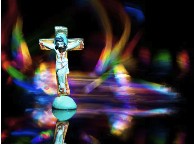
Statue of lord Jesus in a light motion background. (partha dalal photography/Getty)





Reverend Megan Hollaway is an unlikely psychonaut. An Episcopal priest and clinical social worker, she has a calm, sensible demeanour that has served her well as the chaplain of a college preparatory school. As she sits beneath the orange trees and towering Ponderosa pines in the back garden of her home in Pasadena, California, there is more than a trace of surprise in her voice when she recounts the moment during a pandemic-era lockdown that she found herself growing her own psychedelics. “My husband was making sourdough bread,” she recalls. “And I decided to grow mushrooms in our bathroom.”
A few months earlier, while on maternity leave with her third child, Rev. Hollaway had read How To Change Your Mind, Michael Pollan’s discourse-shifting 2018 book about the potential mental health benefits of psychedelic drug use. “My response to it was: there’s a question for the church on every page,” she says. “The fact that increased mystical-type experiences will result in better therapeutic outcomes ought to make us pay attention.” Keen to learn more, she signed up for training as a psychedelic facilitator at the California Institute of Integral Studies. “I was completely psychedelically naive, and I didn’t want to start this year-long programme when I’d never experienced it,” she says. Hence, magic mushrooms in the tub.
Rev. Hollaway is not alone in believing that psilocybin and LSD may ask serious questions of the Christian church. In the last decade, progressive members of the clergy in many different denominations across the United States have begun to explore how they might support those in their congregations who wish to integrate their psychedelic experiences into their faith.
Back in 2016, a minister at Emmanuel Episcopal Church just outside of Seattle named Hunt Priest was one of 30 religious leaders from a variety of backgrounds who took part in a groundbreaking study into psilocybin and sacred experiences at Baltimore’s Johns Hopkins University. While the research project can’t help but sound like a joke (a Catholic priest, a rabbi and a Zen Buddhist roshi walk into a drug lab…), the impact that Priest’s first experience with psilocybin had on his life was very real.
“I went in thinking I would just see some weird colours and stuff,” Priest remembers when we speak over a video call from his home in Georgia. “But pretty immediately I started having a reaction that felt deeply Pentecostal.”
Pentecostalism is the fastest-growing Christian denomination in the world, adding around 13 million new worshippers each year. The tradition places a strong emphasis on miracles and embodied experiences, emphasising the direct relationship between the worshipper and God through the Holy Spirit — best exemplified by speaking in tongues. This was not at all how Priest had previously understood his faith. “That’s certainly not the Episcopalian, Anglican, way of thinking about Christianity,” he adds. “It was probably my first deep, embodied experience of the Holy Spirit.”
Other participants in the study reported similar effects: 96% of the religious leaders rated their psilocybin trip among the top five most significant spiritual experiences of their lives; 79% said they felt the experience had enriched their daily prayer, made them better at their jobs and increased their sense of the sacred in their everyday lives.
Priest, who had been feeling burned out and directionless prior to the experience, returned to his life with renewed vigour. He moved to a new church in Georgia, and in 2021 founded Ligare, a non-profit organisation that takes its name from the Latin verb meaning “to bind”, the etymological root of “religion”. The group’s stated mission is to bridge gaps between Christian organisations, mental health advocates and the psychedelic community — and to “empower and educate religious leaders and communities about the profound opportunities and significant challenges within the resurgence of psychedelics”.
You may be surprised to learn that the idea of priests preaching the Gospel of hallucinogens has not always gone down well with church elders. Last August, a former Ligare intern named Joe Welker resigned from the group and reported Priest to his church diocese, who launched an investigation. It eventually found that Priest had engaged in “conduct unbecoming a member of the clergy” by using his position to supposedly endorse the use of banned substances. Despite the opening up of medical research, psychedelics remain federally illegal across the United States. Only a trio of states — Oregon, Colorado and New Mexico — have moved to relax their local laws.
In Georgia, a bishop in the Episcopal Church gave Priest the choice to either resign from Ligare — or resign his ordination. He chose to continue his work with Ligare. “I don’t mean to sound haughty or anything, but it’s my ministry,” he tells me. “I still consider myself an Episcopalian. Obviously, I consider myself a Christian. I’m here for the church when it’s ready to learn about this. I hope their position will change, but I went with my calling. I’m not angry. I was disappointed and hurt, but it’ll turn around.”
Priest’s frustration is palpable. After all, the substance he consumed is produced naturally in a mushroom, and is it not written in Genesis 1:29 that God gave the plants “upon the face of all the earth” to humanity? Furthermore, in his Epistle to the Romans 12:2, Saint Paul instructs Christians to “be not conformed to this world: but be ye transformed by the renewing of your mind, that ye may prove what is that good, and acceptable, and perfect, will of God”.
Renewing his mind is exactly what Priest felt he had done. To be told that his church has no place for what he believes was a direct encounter with the Holy Spirit is hard to comprehend. “It goes back to Genesis 1: ‘God saw that it was good,’” he argues. “There’s a reason we have receptors in our brains for psilocybin: an ancient evolutionary connection. That’s not to say that there isn’t a risk and you don’t have to be careful — but used with the right intention, in the right way, it’s beautiful.”
As far as Priest is concerned, the only people who should really be worried about psychedelics are atheists. “I’ve talked to so many people who say things like: ‘Holy shit, Mary Magdalene came to me… Who’s that?’” he says. “So many people have experiences of God, or Jesus, and it opens this awareness of spirituality or mysticism that we don’t often get in our waking lives or in our religious tradition. There’s definitely a vibrant Christian conversation going on right now, it just needs to be bigger. And it will be.”
* * *
When psychedelic drugs first began to permeate the American consciousness in the early Sixties, any spiritual or religious associations tended to be with Eastern religions, New Age philosophies or slightly indeterminate fusions of the two, such as the Hare Krishna movement. However, it didn’t take long before certain Christians were beginning to wonder whether they too might have something to learn from an hallucinogenic sacrament.
On Good Friday in 1962, at Boston University’s Marsh Chapel, a graduate student in theology from Harvard Divinity School named Walter Pahnke ran a double-blind experiment with 20 divinity students in which half were given a placebo and the other half were dosed with psilocybin. The experiment, which was supervised by Harvard professors Timothy Leary and Richard Alpert (today better known as Ram Dass), had a profound impact on many of its participants. The religious scholar Huston Smith later described the Good Friday experiment as “the most powerful cosmic homecoming I have ever experienced”.
While for some this gave weight to the theory that psychedelics are entheogens, capable of reliably producing direct religious experiences, for others it suggested that Christianity may itself be a product of hallucination. In 1970, the archaeologist John Marco Allegro published The Sacred Mushroom and the Cross, making the dramatic claim that the gospels are coded stories written by a fertility cult, and that Jesus is in fact merely a metaphor for a psychoactive mushroom. The book and its theories are pet favourites of the podcaster Joe Rogan, and partly inspired Philip K. Dick’s 1982 novel The Transmigration of Timothy Archer, in which an Episcopal bishop travels to the Holy Lands to investigate whether mushroom use could help explain the resurrection.
In more recent times, historians and theologians have suggested various ways that biblical stories might be reinterpreted if it is accepted that Abrahamic prophets used psychedelics in their rituals. In the 2000s, the Israeli academic Benny Shanon advanced the theory that when Moses heard the voice of God from a burning bush on Mount Horeb he was under the influence of ayahuasca. Meanwhile, in his 2020 book The Immortality Key, Brian Muraresku explored the possibility that what early Christians called “wine” was in fact a type of psychedelic brew. Could it be that when Jesus turned the water into wine he did so not by miraculous means, but simply by lacing it with psilocybin?
* * *
Whether or not early Christians took part in psychedelic rituals is a matter of speculation, but the influence Priest’s first hallucinogenic experience had on him is easily verifiable. When he walked out of Johns Hopkins a decade ago he was met by Reverend Timothy Tutt, an ordained minister in the United Church of Christ, who immediately recognised that something had changed in his companion. “I spent the next 24 hours with him, and what I saw was my friend of several years glowing and sparkling,” recalls Rev. Tutt when we speak via a call from his home in Washington, D.C.. “I don’t know any other way to say it.”
Sometime later, Rev. Tutt decided to pursue a psychedelic experience of his own in a group setting along with several other Christian clergy and congregation members. He, too, had a profound experience. He established a direct connection with the divine and says that this helped him to address a deep-seated trauma.
“I’ll just be quite honest: through one of my psychedelic experiences, I was able to come to terms with an event of childhood sexual abuse that happened in a church setting,” he says. “It is not uncommon for the American church or other churches to have those experiences. I had done a great deal of work around it with my therapist, but really, psychedelics helped me come to terms with it in a way that nothing else had.”
The potential for psychedelics to address and begin to heal trauma — which Pollan explored at length in his 2018 book — is a subject that many of the clergy people I spoke to for this story returned to. Reverend Molly Baskette is a longtime pastor in the United Church of Christ who has decided to retire from parish ministry to set up a legal ketamine clinic in the San Francisco Bay Area.
“I’ve been a working pastor for almost 30 years at this point, and there are a lot of hard things about serving a very diverse population,” Rev. Baskette tells me. “We have ex-evangelicals — queer people who have fled more fundamentalist queer-phobic traditions. We have homeless mentally ill people, and housed mentally ill people. We have people with substance abuse disorders who think we don’t know their secret. We have a lot of people with PTSD. In some ways, a pastor becomes an untrained — or badly trained — therapist. When I read How To Change Your Mind, I was like: ‘Thank Christ!’ Literally, not as an expletive. Here is a possible solution for people who are suffering and sick — and isn’t the church about relieving suffering?”
Rev. Baskette may be retiring from her parish, but she has no plans to leave her church. She remains part of a working group within the UCC that aims to normalise the concept of using psychedelics for healing and spiritual growth and intends to pass a resolution publicly affirming the church’s support for legislation. Another member of the group is Reverend Molli Mitchell, who recently became the first ordained minister to become a legally authorised psilocybin practitioner in Oregon.
Rev. Mitchell began her career as a social worker before her life was upended by a stage-three breast cancer diagnosis. After going through treatment and reassessing her life she entered a seminary, but not before heading out on a camping trip to the desert and trying mushrooms. She describes this as a “phenomenally powerful, life-changing experience.”
Today, she serves as a hospice chaplain, a local church pastor and a facilitator at the Portland-based psilocybin centre 7 Gates Sanctuary. She sees all of these roles as different aspects of her ministry — and believes the church is well-placed to bring psychedelic healing into the mainstream. “The church can play a significant role in the same way that it played a significant role in increasing access to healthcare,” she says. “Churches founded hospitals, and founded hospices. They founded them because Jesus was a healer. We have hurdles to overcome in terms of stigma, and historic Christian ethics that said ‘all drugs are bad’. But this is not outside of the scope of what we care about and why.”
It makes sense that churches would want to ease the suffering of their congregations. Still, it’s also easy to imagine why those at the top of the church’s traditional power structures might not be so keen on throwing their weight behind psychedelics.
Allyssa Jomei, who works with Ligare as an Interfaith Spiritual Director, acknowledges that the spiritual experiences people have while taking psychedelics may not be recognisably Christian at all. “What folks are dealing with as they have these experiences and are curious about it is just a total dismantling of faith systems,” she says.
This is part of what makes psychedelics so challenging for traditional religions to truly embrace. While some people who take these substances may well have experiences that align with the theology they already understand, others may find themselves confronting something totally alien. “That’s a hard thing, and it really strikes us at the core of who we are,” says Jomei. “That’s why it’s useful to have someone with an interfaith background, because when people are grappling with something bigger than what they thought they were, it’s really helpful to have some different perspective and different language as they’re deconstructing and reconstructing.”
Back in Pasadena, Rev. Hollaway sounds a note of caution for Christians who believe rushing out to champion psychedelics might be a panacea to revive flagging interest in church services or offer a speed-dial to the divine. Although it might sound like an ingenious ploy to boost church attendance among the young — Come for the psilocybin, stay for the psalms — Rev. Hollaway suggests that the church would do well not to lose itself in a headlong rush to occupy ground it does not fully understand.
“I would say the church can play a role in tempering enthusiasm,” she says. “Any religious tradition that has been around a good while has developed the resources to take a longer view. In psychedelics, when we talk about preparation and integration, we’re usually talking about three meetings before and three meetings after an experience. What about talking about lifelong spiritual formation, and what that actually means? A religious life and a religious experience are two different things.”
A looming question remains over how traditional churches might realistically integrate the regular or semi-regular use of psychedelics into their traditions. Certainly, it seems unlikely that any self-respecting priest will be swapping their communion wafers for acid tabs any time soon. Some of those I speak to advocate for annual retreats, where clergy and other committed congregation members could trip together and “reset” their spiritual connection. Others see psychedelics as primarily a therapeutic tool, a medicine to be used to treat trauma or ease anxiety for those fearful about dying.
Even among those who have had found themselves reconfigured by a mind-altering religious experience, there remains a significant amount of skepticism about exactly what role the church itself might have to play in all this. When I ask Rev. Hollaway what she believes the church embracing psychedelics would look like, she expresses that most fundamental of Christian instincts: doubt.
“I can picture it a lot of ways, and the truth is I don’t know,” she says. “I want to have enough humility to say that I don’t know how it’s going to play out. I don’t even know that it should.”