




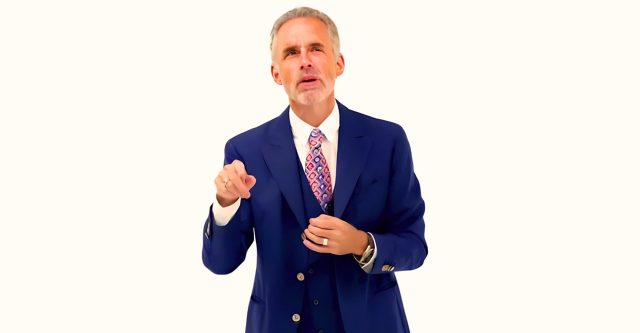
Not Galileo. (YouTube/Jordan B Peterson)





Once upon a time, Jordan Peterson was seen as something like the Galileo of anti-wokeness. No longer. Following a highly publicised struggle with benzodiazepine addiction, requiring extended treatment overseas, the erstwhile academic seems a shadow of his former self. Just last month, his daughter Mikhaila delivered the news that “dad” is again suffering from sustained neurological complications — casting a shadow over his once-relentless public presence.
At his peak, Peterson was a true force to be reckoned with: one of the first Anglosphere academics to stand up to the madness not only of gender ideology, but of the excesses of wokeness more generally. When nearly everyone else was too afraid to speak up, Peterson planted his flag against the crybullies. Following his resignation from the University of Toronto, and ejection into the wilds of self-employment, thousands of frustrated people began discovering Peterson’s psychology lectures on YouTube.
That space, far from the petty tyranny of campus HR officers and faculty subcommittees, is one many still believe offers the ultimate balance between freedom of thought and financial gain — especially when combined with social media fame. Peterson’s trajectory, alongside that of others in what came to be called the “intellectual dark web”, suggests otherwise. More than that, far from providing the space to explore new and challenging ideas, social media fame demands a brand of conformity every bit as anti-intellectual as its progressive mirror.
The intellectual dark web, as a phrase if not a movement, emerged from an unlikely source: The New York Times. The term was coined in 2018, by then-columnist Bari Weiss. The Free Press founder would, of course, go on to have a varied and dramatic career herself, but in those early days she looked to others for inspiration. That included Peterson, but also Bret Weinstein, Christina Hoff Summers, Sam Harris, Steven Pinker and Jonathan Haidt.
In her piece, Weiss praised Peterson and the rest’s willingness to “disagree ferociously, but talk civilly about nearly every meaningful subject”, as well as their readiness to be “purged from institutions that have become increasingly hostile to unorthodox thought — and have found receptive audiences elsewhere.” Weiss wasn’t wrong there. But what she didn’t anticipate, a pattern reflected in her own trajectory too, is how those “receptive audiences” would ultimately constrain these same “heterodox” thinkers.
To understand Weiss’s enthusiasm you must first appreciate the political context of 2018. With Trump’s first term riven by liberal angst and pussy-hat protests, there was much talk of a new heterodox movement that could finally question the assumptions of the emerging woke orthodoxy. By its very nature, the concept of “heterodoxy” entails something almost Marxian in the sense of the theorist’s famous call for a “ruthless criticism of everything that exists.” And while that might seem odd coming from intellectuals on the Right, in those early days the idea of building new, fearless institutions, ones that encouraged a relentless criticism of all sides, seemed not only necessary but possible. That possibility has since evaporated.
In the same way it’s now clear that Trumpism amounts to little more than a corrupt, less competent version of Bush-era neoconservatism, it’s equally obvious that the heterodoxy once promised by Peterson, Weinstein, and Weiss amounts to little more than a reaction to the social excesses of Obama-era wokeness — echoing, in a thinner and much less serious form, the communitarian philosophical movement of the Eighties.
Like today’s heterodox push, communitarianism’s campaign against the narcissism of the Sixties “me generation” was quickly co-opted by both the establishment Left and establishment Right. But while communitarianism never amounted to much policy-wise, it at least produced volumes of serious scholarship. Philip Selznick, for instance, warned that market logic was eroding the moral foundations necessary for democratic life, while Michael Sandel’s critiques of hyper-individualism challenged the notion that people could be understood merely as atomised consumers.
More recent heterodox enthusiasts simply lack these insights. Just look at Peterson. Over the last few years, he has devolved from an earnest Toronto professor to an archetypal over-tanned Arizona snowbird, one who claims that Marx was summoning the power of the Devil. Or else there’s Weiss, who first rose to prominence criticising the feminist Left’s embrace of antisemites — but whose brand of “viewpoint diversity” now leaves little space for thoughtful critiques of Wall Street, tech monopolies or Israel.
It’s clear, at this point, that the intellectual “heterodoxy” movement died on the vine. Whatever promise heterodoxy had is now long gone, with Peterson most recently becoming a podcast host on Ben Shapiro’s shamelessly partisan Daily Wire operation.
Peterson, then, is no Galileo — and that’s a pity. After all, he was an elegant example of Canada’s Tory tradition, a brand of conservatism largely absent from US politics since the Revolution. Unlike the American Right’s fixation on radical individualism and market absolutism, the Canadian Tory tradition emphasised social cohesion, moral order, and the idea that communities and institutions possess obligations that transcend pure economic efficiency. Its greatest modern theorist was the philosopher George Grant, whose 1965 classic Lament for a Nation warned that American-style capitalism was dissolving older forms of communal life.
Introducing Daily Wire fans to ideas of a Grantian hue — or even Burke or Oakeshott — would have been a genuinely heterodox accomplishment. How frustrating, then, that once the professor became an American media personality, he did little more than mimic the wealthy libertarian mentality that punk rock critics like Jello Biafra once dubbed “kill the poor”.
How to explain the heterodox crowd’s dreary lack of economic imagination? Part of the answer lies in the fact that most of its leading figures never truly departed from the assumptions of market liberalism. Peterson, for instance, has repeatedly argued that inequality is an unavoidable feature of “competence hierarchies”, while describing redistributive politics as driven mostly by “hatred of the rich”. Sam Harris, meanwhile, has often spoken about populist economics as though it were merely another form of irrational tribalism.
This is surely a marker of the IDW’s financial success. It’s easy to demean people reliant on government “entitlements” when you’re given multi-million-dollar contracts to host podcasts without any journalistic experience. If you just “clean your room,” “work hard” and “show up,” everything does indeed work out for you: assuming, that is, you’re considered a prodigy from a very young age.
Funding is important in other ways too. Much of the seed money for the Daily Wire’s initial startup came from the Texas billionaire brothers Farris and Dan Wilks, Christian nationalists in their social bent and Social Darwinists in their economics. These billionaire brothers also fund Ted Cruz, PragerU, and, of course, Donald Trump’s presidential campaigns. Little wonder almost none of the big-name heterodox critics, aside from outliers like Musa al-Gharbi, dare touch income inequality or issues of class — because even raising those questions remains professionally radioactive.
I speak here from direct experience. When I taught in one of the country’s first higher education civics departments at Arizona State University, there was plenty of talk both publicly and privately about “viewpoint diversity”. That even included welcoming “heterodoxy.” And so, for three years, I hosted a podcast for my department, one that said positive things about labour unions and which expressed scepticism that middle-class harmony could ever return without them. Then, all of a sudden, within weeks of publishing some work sympathetic to New Deal-style social safety nets, the director of the programme informed me that my podcast would now have to be “supervised” by their marketing director.
This 28-year-old staffer now had to edit all my podcast interviews, without my ultimate approval, before they went live on the university’s public media platform. Otherwise, the project would be immediately stripped of all its funding. When I refused and reported the issue to the university’s faculty ombudsman, my department director refused to meet with him, then swiftly filed paperwork to cancel my teaching contract for the following year. (Yes, this type of thing is completely legal in red states).
Overnight, I went from being invited to events all across “heterodox” academia, receiving awards I hadn’t applied to, to being effectively blacklisted. I had touched American politics’ forbidden fruit — but isn’t that exactly what heterodox thinkers are supposed to do?
Apparently, intellectual heterodoxy and all its calls for “viewpoint diversity” do not include welcoming anything that challenges the economic fundamentals of our low-wage, low-benefits neoliberal order, an economic paradigm where nearly all productivity gains are funnelled to the tech industry, real estate hoarders, and market speculators. All those injustices are just fine for the heterodox crowd, it seems, so long as we get rid of DEI schemes and gender pronouns in email bios. Economically speaking, it’s the same arrangement with different branding.
Wokeness has always been a convenient distraction from the fact that the middle-class equilibrium that once underwrote liberal democracy has vanished and shows no signs of returning. In its place we have credentialed serfdom, institutional capture, and a cultural caste system dressed up in platitudes about “equity” and “inclusion.”
Of course, we cannot talk enough about the damage done when higher education institutions across the English-speaking world abandoned the pursuit of truth in favour of fashionable concepts of “social justice”. Yet a broader development is that contrarian thinkers — no matter their political bent — have been forced out of the academy entirely. The right to put forth unpopular ideas, which tenure was meant to protect, is simply no longer possible inside higher education, while the disappointments of the “heterodox” gang prove that social media stardom provides no sanctuary either. If anything, it just imposes a different kind of conformist pressure.
As Andrew Keen presciently argued a decade ago, social media not only produces but practically demands what he called the “culture of the amateur”. After being cast out of their academic positions, Peterson — as well as Weinstein, who left a job at Evergreen State College under similar circumstances — had almost no choice but to lean into their fame among the online Right and make the best of it. Whether by hook or by crook, they both ended up becoming little better than any other podcast talking head riffing on contemporary political topics and international affairs, subjects neither man studied nor worked in professionally. The result? Embarrassing displays like Weinstein’s cringe-worthy 2020 proposal for a “unity” presidential ticket: pairing a centre-left and centre-right candidate selected through online polling to run jointly for the presidency. The problems with such an idea are too obvious to dwell on. But that’s just the culture of the amateur running its course.
For scholars to pursue knowledge without the audience pressure that comes from journalism and modern mass media, they ultimately need three things. First, the space and time to pursue their studies. Second, a community of knowledgeable and earnest interlocutors who can sharpen their ideas and push back on pitfalls. Third, a stable income independent of random funders with political axes to grind.
Academic peer review was designed for just this purpose, but it long ago broke down. It’s simply far too easy for journal editors to “desk reject” ideas they don’t like, flatly refusing to send work out for review — or else purposefully sending undesirable research to reviewers who’ll reject it — based on cherished orthodoxies or to protect the reputation of favoured colleagues.
This doesn’t mean peer review is unnecessary, nor that a genuine heterodox movement couldn’t prosper. It just means that, as with so much else in contemporary politics, we were promised one thing and delivered another. The communitarians, for their part, benefited from doing their best work at a time when peer review and academic hiring were still mostly non-ideological. Their heterodox successors, of course, enjoyed no such luck. And if that led to an intellectual collapse, I’d also argue that the unhealthy incentives foisted on the IDW have led to a striking degree of personal suffering.
Whatever demons Selznick or Sandel may have faced, their far gentler milieu meant they could easily slip back into obscurity. Unfortunately for Peterson, his health struggles have become a punchline on both the online Right and Left. But this bipartisan fixation on the oddity of his condition — armchair diagnosing it, mocking it, politicising it — obscures what Peterson’s sad trajectory actually reveals. The Canadian’s fall from grace is not just a personal failing, nor merely a story of fame gone wrong. It reflects, rather, how the absence of any stable, supportive intellectual home reduces heterodox thinkers to circus acts, dancing for the nickels of the donor class and moronic reply guys.
Inside academia, heterodox work is still very much constrained, if not actively punished. Outside it, the incentives of audience capture, donor pressure, and constant performance distort it to the point that those attempting to sustain heterodox thought become caricatures of themselves — unstable, unreliable, and easily dismissed by the institutions they once challenged. And no wonder. Wokeness was never a glitch in the neoliberal order, instead reflecting, as the communitarians understood, the natural outgrowth of instrumentalist reasoning and deepening inequality. Both are part and parcel of liberal capitalism pushed to its functional limits. What a shame that heterodoxy as currently constituted leaves all of this untouched.
B. Duncan Moench is a writer and scholar of American political culture. He also writes the Producerist Substack.
 DuncanMoench