




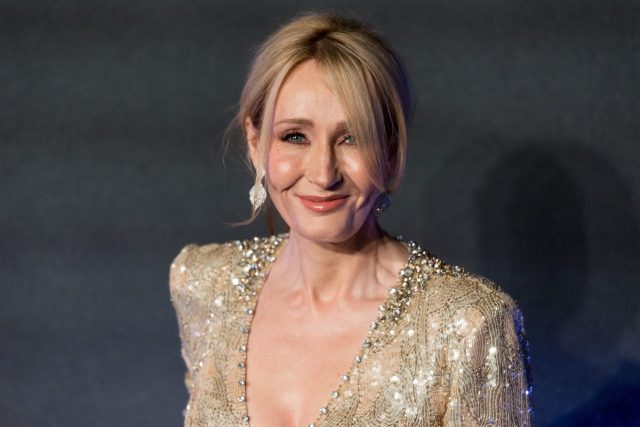
I’d be lying if I said I love everything about Rowling’s social media style (Ray Tang/Anadolu Agency/Getty Images)





What happened to JK Rowling? If only there were some kind of primary source that could tell us why she became interested in the clash between trans activism and women’s rights — say, a first-person essay. But alas, the archive is silent. It must be, because why else would two male podcasters have taken it upon themselves to solve this supposed mystery?
This week, the Origin Story podcast, hosted by indistinguishable journalists Ian Dunt and Dorian Lynskey, bravely shouldered the burden of analysing Rowling over the course of two episodes. Do they succeed? Not remotely. But they do offer a fascinating insight into what happens when a certain kind of progressive man becomes radicalised by Bluesky.
And if you think I’m being patronising and pathologising, wait until you get a load of the podcast, which is predicated on the idea that Rowling has undergone a metamorphosis so bizarre, only psychological fracture can explain it. “It’s just such a weird story,” says Dunt. “She gets to say whatever she likes, but year by year, it gets quite a bit less kind until you just see this thing left over.”
Neither host notes that Dunt has referred to Rowling as “this thing”, as though a lack of appropriate “kindness” has turned her into something monstrous. (The “kindness” demanded only flows in one direction — there’s no expectation that trans activists could “kindly” respect women’s boundaries.) Nor do they seem to truly believe that Rowling, or any woman with gender-critical beliefs, should get to “say whatever she likes”. Any deference they pay to free speech is strictly pro-forma.
Despite a cursory show of aiming for balance, Dunt and Lynskey aren’t coming to this subject as neutral parties. They have a point of view, and their point of view is that trans activism is the decent, liberal, commonsense stance: any dissent is at best silly, and at worst (gasp) Right-wing. The assumption which shapes the entire podcast is that there is no legitimate way to be gender critical.
Ten years ago, when Stonewall’s “no debate” position held sway, this was the standard stance in most of the UK media. Today, it has substantially collapsed, but it persists in certain pockets. One of these is Bluesky — the X-replacement social media platform memorably described by Josh Barro as a “containment dome” for extremist Left-wing opinions, and a site where Dunt and Lynskey both enjoy hefty followings.
On Bluesky, the gender argument never left 2016. Lynskey treats the idea that you can support trans people’s rights while criticising the politics and precepts of trans activism as inherently bad faith: “It’s very hard to separate those two things considering that, without gender identity, how do trans people make sense?” In other words, if you don’t accept trans people’s understanding of the world, you’re a transphobe.
This is obviously ludicrous. There are innumerable creeds that I don’t share, while also believing that the people who hold them are entitled to freedom from discrimination: Christians, Muslims, vegans, even people who think “two male podcasters giving an etiquette seminar to a woman they don’t know” is an acceptable form of entertainment. If the belief in gender identity requires everyone else to adhere to it, that’s pretty totalitarian.
Dunt and Lynskey find it easy to embrace their own gender identities. In a moment of hearty masculine backslapping, they agree that it would be “mad” to object to the term cisgender. “We’re both cisgender. It’s like, whatever,” shrugs Lynskey obliviously. Oh, do you identify as naturally of the sex class that does less housework and isn’t expected to put other people’s feelings first? How nice for you! (Then, having agreed that “cisgender” is “a really valid and useful word”, neither uses it for the entire rest of the first podcast. Truly, an indispensable piece of language.)
They take the same attitude to the word “terf”. “It’s weird the way it’s treated like a slur and yet it’s not factually inaccurate,” ponders Lynskey, which is exactly the kind of thing racists have historically said about the P-word and the N-word. A word becomes a slur because of the way it’s used — and, as the linguist Deborah Cameron noted in 2016, “terf” is used to make violent threats like “slit their throats” and “every terf out there needs to die”.
But it’s a strange quirk of this podcast: listening to it, you’d have no idea that trans activism contains a long history of misogynistic abuse. At one point, Lynskey refers to Julie Bindel’s 2004 Guardian column, “Gender Benders, Beware” as “viciously transphobic” and “ugly stuff”. What he doesn’t mention is that the column was written in response to a grotesque trans activist attack on the feminist organisation Vancouver Rape Relief, for the crime of trying to run a female-only service. (The headline was the Guardian’s own choice: Bindel doesn’t even use the phrase “gender benders” in the copy.)
When it comes to Rowling, there’s not even the tiniest acknowledgement that there may have been an element of sexism in the way she was hounded. The nearest Dunt and Lynskey come to sympathising with her is in a discussion of the domestic violence she suffered from her first husband — and this comes with an intimation that the experience has made her fragile and unreliable. It’s the classic double bind for the female victim: your experience of male violence disqualifies you to talk about male violence.
And even to refer to “male violence” would likely send Dunt and Lynskey into apoplexy: accurate references to sex are a dreadful taboo here. Throughout the episodes, they act scandalised at anyone referring to a trans woman as male or a man. Lynskey makes an audible “oof” when Dunt quotes Maya Forstater calling Pips Bunce, the gender-fluid Credit Suisse executive who was anointed one of the 100 top women executives in the Financial Times, “a white man who likes to dress in women’s clothes”.
But to anyone not marinated in Bluesky, there is nothing shocking at all about calling Bunce a man. This is someone clearly male who, half the time, wears a suit; who has a wife and a career in finance; and who expects everyone to fall in line with his self-perception and treat him as a woman when he decides to wear a wig. Bunce’s behaviour is as male-pattern as his baldness. If Dunt and Lynskey think “man” is the most insulting epithet that could be thrown at him, I’m happy to sit here and call them both men all day.
Dunt and Lynskey are the proverbial last Japanese soldiers in the jungle, still fighting a war that’s been settled elsewhere. According to them, rapid onset gender dysphoria is a discredited “clown car” theory: actually, the increase in girls identifying out of their sex in adolescence without a previous history of gender variance was confirmed by the Cass report. Ah, but Cass too can be dismissed: she’s “not a gender specialist”. (She is, of course, one of the most experienced and respected paediatricians in the country, but what does that weigh compared to a podcast?)
In Origin Story land, autogynephilia — the theory that some men transition because they are turned on by the idea of themselves as a woman — is similarly “discredited”. Who’s going to tell the American critic and trans woman Andrea Long Chu that he was wrong when he wrote that he transitioned “for Daisy Dukes, bikini tops, and all the dresses, and, my god, for the breasts”?
In the podcast, Imane Khelif is the “female Algerian boxer”, and it’s sheerest cruelty to point out that Khelif is actually a male athlete who, regardless of DSDs, therefore doesn’t belong in women’s sport. There’s even a throwaway reprise of the once-popular “Michael Phelps’s armspan” argument, which claims that being male in a female competition is no different to any other physical advantage an athlete might have. I wanted to ask Dunt and Lynskey to do clownfish as an encore.
When Dunt and Lynskey absolutely have to acknowledge that trans inclusion has costs for women, they can’t concede that this is built into the system they are endorsing. Referring to the case of the rapist Karen White, who reoffended while held in a women’s prison, they agree that this was an “insane” decision by the prison service: “however trans inclusive you are, it’s quite hard to [say] that a rapist who then transitioned should be put in there without any consideration,” says Lynskey.
Well, it should have been a hard argument to make. And yet trans activists made it, and prison policy was shaped by it. The women who were assaulted are not figments of a terrible Right-wing imagination — even though I and other feminists were called “terfs”, “transphobes” and “genital obsessives” for pointing out that self-identity made cases like this inevitable.
If the terfs had been listened to, a young female psychiatric patient who identified as male would never have been placed on a male ward, where she was raped. (The NHS trust that enforced this “inclusive” policy also deliberately obstructed the police investigation into the crime.) It’s the funny thing about being called trans exclusionary: I know perfectly well why trans people should be included in the services that fit their birth sex. The “kindness” Dunt and Lynskey demand in their idiotic podcast led, in this instance, to a vulnerable trans person suffering the worst kind of violation.
Even the fact that Rowling funds a centre for female victims of violence is held against her, because Beira’s Place is women-only and therefore tarnished in the eyes of these reasonable men. Her greatest crime of all, though, is funding For Women Scotland’s Supreme Court case against the Scottish government, which ultimately clarified that the Equality Act protects sex, and not gender identity. The Equality Act also, separately, protects trans people, but apparently it’s intolerable for women to have even one clause of legislation to themselves.
By writing this, I’m laying myself open to the charge of “obsession”. “Once I see a writer become obsessed with this issue, they cannot let it go. It becomes almost all they write about,” says Lynskey. But this reveals more about his fixation than mine. The gender-critical writers named in the podcast — Jesse Singal, Victoria Smith, Bindel, me, Rowling — all cover a vast number of other topics, from the Super Bowl to surrogacy to celebrity sex tapes to extremely long crime novels. It’s Lynskey and Dunt who are only able to see trans.
I’d be lying if I said I love everything about Rowling’s social media style: certainly I wish she’d spent less time beefing with India Willoughby, if only because it seems beneath her dignity to pay attention to a voluntarily castrated ex-weatherman. But there’s no hidden truth, no sinister “origin story”, about what happened to her. She’s always been fighty on social media. (Remember Indyref? Or Brexit? Or all the times she sassed Trump?) She’s always been committed to feminism.
This podcast is nothing but a whine of fury that Rowling has shown she values women’s rights more than pandering to men’s feelings. I’m sure that Dunt and Lynskey consider themselves as far from the manosphere as it’s possible to be, and yet the message of Origin Story is that defying men makes a woman subhuman. Such chauvinism has always been embedded in trans activism. That’s why so many feminists rebelled against the doctrine, and it’s also why some liberal men have such a hard time giving it up.
