




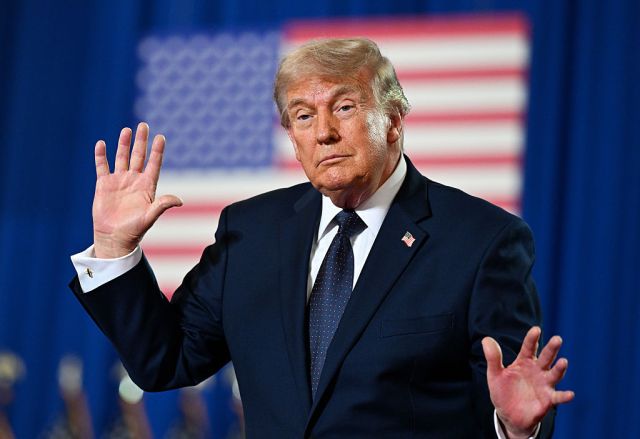
‘American domestic politics makes it politically easy to start wars and hard to end them.’ (Roberto Schmidt/Getty)





America’s latest hot war with the Islamic Republic appears to be limping to its conclusion. Washington has resumed limited bombing in the Persian Gulf, even as a memorandum of understanding between Washington and Tehran awaits the approval of President Trump and Iranian Supreme Leader Mojtaba Khamenei. Trump might go blue in the face insisting he “won” the war. But the prospect that the surviving rulers in Iran will end their quest for nuclear weapons and their support for anti-Israel proxies across the region seems as unlikely as the country normalizing relations with the Jewish state and joining the Abraham Accords. At present, the most likely outcome is years or decades of low-intensity conflict — similar to what happened in Iraq between the Gulf War in 1991 and the US invasion of 2003.
An inconclusive failure, then.
Yet instead of asking why America’s war in Iran has been a failure, the better question is: why would anyone expect any major American war, anywhere in the world, to be a success? Far from being an isolated instance that can be blamed on Trump’s incompetence, this war is only the latest in a series of American expeditions that drag on for years, only to backfire and empower US enemies. From Korea to Iran, the story of American military policy since World War II has been one blunder after another, in which tactical achievements are followed by strategic defeat.
It is popular to blame the American president’s bad decisions or personal traits for such fiascos, but the history of major American strategic failures since 1945 can’t be explained solely or even primarily based on the performance of leaders from Truman to Trump. The underlying cause of America’s strategic tragedy — its chain of short-term tactical successes followed by strategic failures — is what experts describe as the American Way of War — a failing style that future American leaders must seek to reform.
Like President Barack Obama before him, Trump was elected in part because he was viewed as an alternative to the hawks who brought about the “forever wars” in Afghanistan and Iraq. And just as Obama proceeded to launch new American military campaigns in Libya and Syria, so Trump in his second term has brought about the war in Iran, with immediate consequences for the global economy, caused by rising prices for oil, that are far more consequential than were the global consequences of the Korean, Vietnam, and Afghan wars in the eras in which they were fought.
But the pattern isn’t all that different from those earlier adventures. The Korean War, which caught the United States by surprise, began with Communist North Korea’s invasion of the Western-aligned South on June 25, 1950, influenced by an American blunder: Secretary of State Dean Acheson’s exclusion of South Korea from America’s defense perimeter in Asia, in an unwise speech on Jan. 12, 1950.
Stalin was quick to take advantage of the invasion, urging Mao’s Communist regime, which had seized power in China a year earlier, to enter the war. The result was a bloody stalemate that Stalin, the sponsor and supplier of North Korea and China, kept going in order to drain American resources. At the same time, Stalin orchestrated the parallel war of Soviet-backed Vietnamese Communists against American-backed France in Indochina. Only after Stalin died, on March 3, 1953, did his successors in Moscow negotiate the partition of Korea and Vietnam with the United States and its allies in 1954. At the cost of more than 36,000 American fatalities and more than a million Korean lives, Washington was only able to restore the former division between the two Koreas at the 38th parallel.
The tense, armed truce in Korea has persisted to this day. In Vietnam, the North Vietnamese Communist regime and its South Vietnamese insurgent allies, backed by the Soviet Union and Mao’s China, fought to establish a united Vietnam and succeeded in 1975, after a failed Americanization of the conflict that took the lives of more than 58,000 Americans dead, as well as those of some 2 million to 3 million Vietnamese, plus more in Cambodia and Laos. The great-power victor of the Vietnam War was the Soviet Union, which for the remainder of the Cold War turned Vietnam into its largest military base outside of Eastern Europe.
The all-out invasion of Iraq in 2003 by the United States, following the earlier, limited Gulf War of 1991, similarly resulted in an “own goal” for Washington. Undertaken along with the war in Afghanistan, in the aftermath of 9/11, the US invasion caused Iraq to disintegrate along ethnic and sectarian lines into anarchy, in which al-Qaeda, ISIS, and other Islamist organizations flourished. Instead of bringing to power a pro-American democracy that would permit permanent bases on Iraqi soil, the war replaced Saddam’s secular Baathist regime with a satrapy of Shiite Iran. Last January, Iraq declared that the withdrawal of US forces from its territory was complete.
Obama, elected in part on the basis of his opposition to George W. Bush’s disastrous Iraq War, then led America into new military quagmires in Libya and Syria. In 2011, NATO, led by the United States, deposed Libya’s dictator Muammar Qaddafi. The result has been continuing fragmentation and anarchy in Libya. In Syria, beginning in 2014, Washington perversely waged a low-level war simultaneously against both sides in a civil war — Islamist militants, on the one hand, and the government of dictator Bashar al-Assad, on the other. Once again, the American strategy backfired. At the end of 2024, Assad and his family fled to Russia. Syria’s president today is Ahmed al-Sharaa, an al-Qaeda warlord whom the US until 2025 had named on its Specially Designated Global Terrorist List.
This brings us to the war in Afghanistan (2001-2021), the longest war in American history. The purpose of the war was to topple the Taliban, the Islamist faction that had provided a safe haven for Osama bin Laden and his allies before the 9/11 attacks. The result? Following years of warfare under the Bush, Obama, Trump, and Biden administrations, the Biden administration beat a chaotic retreat in August 2021. The victor is the Taliban, which came to power and has imposed a repressive Islamist regime, stripping women, ethnic minorities, and dissidents of rights and carrying out public floggings and executions for crimes including “illicit relationships.”
What is striking is the frequency with which major American wars have ended by bringing US enemies to power or allowing them to remain in power. Today, following the deaths of more than 80,000 American soldiers, and millions of Koreans and Indochinese, North Korean Communists aligned with Beijing and Moscow rule North Korea, while Vietnamese Communists rule united Vietnam. Syria and Afghanistan are governed by former anti-American jihadists.
In the case of Korea, it can be argued that the 72-year truce was a partial success that has allowed South Korea to develop and flourish. Even so, North Korea has nuclear weapons with which it threatens America and its East Asian allies, has deployed thousands of troops to fight in Putin’s war in Ukraine, and continues to tie down American military forces in Asia.
To these humiliating American strategic failures, the Ukraine war might soon be added. In 2022, following Russia’s invasion of Ukraine, President Joe Biden declared, “For God’s sake, this man cannot remain in power.” Today, Putin is still in power and Biden is out of power. The Ukraine War, which has been prolonged as a result of Western military and economic support for Kiev, is likely to end at some point in Russian control of both Crimea and much of eastern Ukraine — yet another embarrassing and costly strategic defeat for the Uncle Sam.
“But other than that, how was the play, Mrs. Lincoln?” Compared to the strategic defeats of US foreign policy in Vietnam, Afghanistan, Syria, and Libya, US strategic victories in the last seven decades have been few and far between. The most significant strategic victory came with the success of the US strategy, shared with post-Maoist China, in arming insurgents to drive the Soviets out of Afghanistan in 1989 — a policy that did not require the commitment of any American troops. The United States and its NATO allies, with minimal coalition losses, and together with Russia, also helped to bring an end to the wars of the Yugoslav Secession by 1995. Otherwise, the few US strategic victories in recent decades have involved small-scale interventions, both peaceful and violent, in America’s western hemisphere sphere of influence — Panama (1989), Haiti (1994), Venezuela (2026).
All of this can be attributed to the American Way of War, which is shaped by the goal of achieving maximum military objectives with minimum American fatalities, due to the US public’s aversion to significant losses, not only of draftees but also of professional American soldiers in combat. To minimize American losses, the United States has long relied on technology, hoping that air power and conventional big-unit warfare will break the will of enemy regimes.
During the Korean War, the United States dropped more bombs on the Korean peninsula than were dropped in America’s entire Pacific campaign during World War II. In Vietnam, instead of engaging in a classic, low-level counterinsurgency campaign, Uncle Sam relied on bombing and air-support by helicopters against insurgents and North Vietnamese infiltrators in South Vietnam, and deployed defoliants and herbicides like Agent Orange to destroy South Vietnamese forests and crops. In Afghanistan, the United States sought to minimize the loss of pilots by using expensive drones. In all of these cases, America’s advantages in high-tech industrialized warfare failed to prevent strategic stalemate (Korea) or total defeat (Vietnam, Afghanistan). Given these historic precedents, it comes as no surprise that America’s initial tactical successes in the war against Iran, including the massacre of Iran’s top leaders and the degrading of much of its military capacity, have failed to dislodge the repressive Islamist regime or end the conflict.
The unsuccessful American Way of War is not merely technological, but also political — a category that includes both domestic US politics and geopolitics.
In domestic politics, when a president launches what is hoped to be a brief, successful war, there is often a “rally-around-the-flag” effect (though this has been missing in the case of the US-Israel war against Iran). If there are American casualties, however, over time the rising number of body bags and the perception that no end to the conflict is in sight lead the American public to turn against the war, to the point that most Americans come to prefer abandoning the effort and “bugging out” to further losses in blood and treasure.
But even after the public has turned against a war, domestic political factors can result in its prolongation for years — or, in the case of Afghanistan, for decades — through multiple presidencies. On the one hand, wartime presidents are mindful of rising public opposition to a doomed war. At the same time, they fear that they or their party will be accused of weakness and defeatism by hawks in both parties and will suffer electoral setbacks. So in order to avoid blame, presidents from Johnson to Bush, including Trump in his first term, have flinched from withdrawing from a quagmire and passed the disaster to a successor in the White House who can serve as the scapegoat for American military defeat.
American domestic politics, then, makes it politically easy to start wars and hard to end them.
At the geopolitical level, American leaders’ lack of commitment provides an advantage for US enemies. What is a vital interest for the enemy — the survival of the North Korean regime, the conquest of all of Vietnam by Communists, the survival and if possible the triumph of the Taliban — is only a lesser interest for Washington. In the case of enemy dictatorships, the existential threat is personal. A lost war may mean execution, imprisonment, or exile for dictators and their allies and families.
To be sure, America’s war leaders pretend that the United States, like its enemies, has vital interests in the foreign war, often invoking memories of the Nazis and World War II or warning of “domino effects” throughout a region or nuclear mushroom clouds rising above American cities. But this has proved insincere: Washington has refused to mobilize the country for all-out war, eschewing means such as regimentation of the economy and a wartime draft, suggesting that the threats haven’t been existential, after all.
The underlying problem, then, is the American Way of War itself, with respect to both military means and strategic ends. Since World War II, there has been a mismatch between America’s reliance on high-tech, air-power-intensive, big-unit warfare and the actual requirements for success in many low-intensity conflicts, as well as a mismatch between American public opinion and the trigger-happiness of much of America’s bipartisan political elite.
The American people and American politicians alike prefer a war like World War II, which for the United States lasted only four years and ended with total victory and regime change in the enemy countries. At the same time, the US Army would prefer to fight Field Marshall Rommel in North Africa, with few collateral civilian casualties, and the US Navy would prefer naval battles far from centers of population. What Americans want is a limited war in which a complete victory against demonized or genuinely demonic enemies is possible. When that cannot be achieved, war is unpopular with American civilians and soldiers alike. There is no appetite for brutal, protracted, low-level counterinsurgency campaigns in foreign mountains or jungles, where enemy soldiers and civilians are intermingled.
It’s unlikely that Americans will ever support the transformation of the US military into a permanent colonial-style constabulary specialized in assisting proxies and fighting or assisting insurgencies in broken countries around the world. In light of this, the only way to avoid repeated strategic failures is for there to be much higher domestic political obstacles to American presidents’ tendency to resort to war.
But Congress lost control of the process for launching war to the executive branch in the Truman years; there has not been a formal declaration of war by the United States since 1942, when Congress declared war against Romania, Bulgaria, and Hungary, having earlier declared war against Japan, Germany, and Italy following the Pearl Harbor attack in 1941. The launching of new and failed wars like those in Libya, Syria, and Iran by presidents like Obama and Trump after they campaigned as relative doves proves that it is still too easy for American presidents to drag America into war and still too hard for presidents to get out.
Breaking this sad pattern of repeated, large-scale American strategic and military failure will require Washington to align its foreign policy with the values of most Americans, not simply replacing one dove-turned-hawk with another in the White House.