




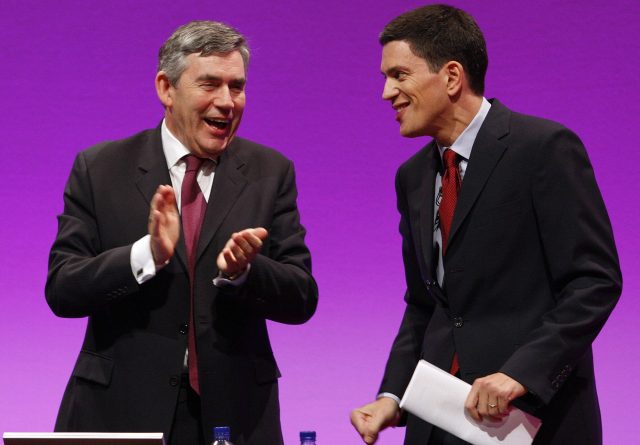
Gordon Brown and David Miliband. (Paul Ellis/AFP/Getty)





Successful democratic coups are strange things. They must appear both ruthless and constitutional at once. Too much brutality and the plotters look unhinged. Too much procedural delicacy and the leader survives long enough for the conspiracy to collapse under the weight of its own anxiety. Move too early and the leader appears victimised. Move too late and everyone has psychologically adapted to defeat.
Labour and the Conservatives have always taken very different approaches to the business of changes of leadership. Tories care mainly about electability. Margaret Thatcher’s ideological legacy was adored by many Tories — and indeed still is. When they knifed her in 1990, her Cabinet were more concerned that the electorate had fallen out of love with her. Tellingly, John Major’s turn at the helm didn’t herald a decisive shift in ideology; he was simply a more acceptable face of Thatcherism for the Nineties.
When Labour looks for a new leader, though, it inevitably becomes an internal referendum on the political direction of the party. That helps explain the violent swing, say, from the Bennite Jeremy Corbyn to the centrist Keir Starmer that left the Labour faithful gasping for breath. But despite the bloodshed, modern political parties are not versions of Terry Pratchett’s Assassins’ Guild, where advancement comes through the elimination of rivals. Michael Heseltine’s proclamation that “he who wields the knife never wears the crown” has proven to be remarkably reliable. Either way, Starmer’s position is not new — but you don’t get the impression he’s relying much on the lessons of history.
Two years on from its famous landslide victory of 1945, Clement Attlee’s Labour government was already in bad shape. Chancellor Hugh Dalton was reportedly taking Benzedrine to keep going. Herbert Morrison, leader of the House of Commons, was recovering from a serious illness. Foreign Secretary Ernest Bevin was drifting between office and hospital. Churchill had described Attlee as “a modest man with much to be modest about” — but he was clearly easy to underestimate. When Attlee’s internal enemies decided to oust him in 1947, their leader Stafford Cripps left his fateful meeting with the PM having accepted a new position as the Minister for Economic Affairs — a position created especially for him. In keeping his enemy close, Attlee took a somewhat different approach to Starmer, who first refused to meet with Wes Streeting, only to frostily dispatch him after 17 minutes of conversation the next day.
Hugh Gaitskell succeeded Attlee as Labour leader in 1955 but never became prime minister, dying suddenly in 1963. Harold Wilson took over and won the general election the following year, but before long the rumblings in his party about his leadership became too loud to ignore. By the late-Sixties, the Home Secretary Roy Jenkins seemed the most obvious choice to replace him.
Starmer claims his political hero is Wilson; Streeting has declared himself a Labour revisionist in the ideological mode of Jenkins and Anthony Crosland, who argued for reducing inequality, improving opportunities and dispensing with socialist dogma. Jenkins was admired by almost everyone who mattered in late-Sixties Britain, intelligent journalists, broadcasters, civil servants, captains of industry, and had a coterie of well-heeled and glamorous mistresses. He looked and sounded like the future. Wilson looked like the present, stretching out to infinity.
All Jenkins had to do was pick his moment — and the aftermath of the disastrous local elections of 1968 would have been ideal. He was egged on by his enthusiastic supporters, the Friends of Roy, whom Gerald Kaufman compared to a group of schoolchildren with a crush on the hockey mistress. But to his eternal regret, Jenkins failed to act. He later admitted that successful prime ministers generally possess “a seam of utter ruthlessness”, and wondered if perhaps he lacked it. Elsewhere, he observed that if you fired a shot at your enemy, you had better make sure they ended up dead. This is a conundrum that Streeting must have grappled with himself in recent days. As for Wilson, still the greatest Houdini figure in modern British politics, he governed on and off until 1976, by which time he had moved from a modernist belief in the “white heat of technology” to being more of a national headmaster figure, permanently disappointed with everyone.
Still, worse than failing to act is sending your foot-soldiers over the top and then failing to follow them yourself, creating only bitterness and resentment. A prime example was James Purnell resigning from the Cabinet to trigger a coup against Gordon Brown, only to find that his ally David Miliband had bottled it and failed to follow through with his own resignation. Purnell left British politics soon after: the Labour Party is not kind to failed assassins.
And there is another danger that Jenkins, who was at Bletchley Park during the war, would have appreciated more than most. This is the concept of political game theory — specifically, the tragedy of the first mover whose act will always benefit the second mover. The first mover bears all the costs while exposing themselves to a counter-strike, neatly explaining Heseltine’s famous quip, which he learned the hard way in his own doomed attempt to replace Magaret Thatcher. So while Jenkins could have mortally wounded Wilson with a challenge, in doing so, he may have allowed one of his rivals — whether Denis Healey, Jim Callaghan or Michael Foot — to take the prize and unite the party behind them. This was something the wily Wilson also knew, which was why he surrounded himself with a collection of powerful lieutenants, each the commandant of a different Labour faction. If one faction thought the other faction might triumph, that persuaded them to back the status quo instead. Another reason why David Miliband didn’t challenge Brown was because he thought the party might turn to Alan Johnson if Brown went, and not him.
A successful challenger must perform three functions at once. They must reassure markets and elites; they must excite activists and MPs; and they must appear plausible to ordinary voters. That combination is exceptionally rare. Tony Blair certainly managed it. Jenkins only managed two out of three (he was probably too patrician to appeal to regular voters, especially as the Sixties started swinging). And Streeting perhaps manages two or even three as well. He is one of the few figures in the current Cabinet whom Labour MPs can plausibly imagine facing Nigel Farage across a television studio without visibly shrinking. He is fluent, a self-declared revisionist, emotionally direct in the modern political style with a powerful backstory. But Labour history is not especially kind to obvious heirs, even when they look much more likely to be successful. The party distrusts naked ambition on almost theological grounds because surely true Left-wingers would want to put the common good first.
So, a politician seeking the leadership must appear ready without appearing too eager. The advice that Brown always tried to give himself was to do a good job, and not look like he was actively plotting against Blair, simply being available when a vacancy arose. A wise dictum — albeit one that fell apart as his desire to enter No. 10 rose to almost pathological levels. In 2006, his ally Tom Watson launched the so-called “curry house” plot against Blair. However, in what became a running joke in Westminster, the conspirators’ attempts to keep the meeting secret spectacularly failed after they signed the restaurant’s visitors’ book, which was then leaked to the BBC.
Brown finally inherited the premiership in June 2007, after years of subterranean warfare — though not before Labour briefly descended into the sort of factional farce that only Labour can produce. Michael Meacher and John McDonnell manoeuvred against Brown simultaneously, prompting one weary figure to remark that “the left hand doesn’t know what the far-left hand is doing”. But even that was not as peculiar as Barry Gardiner flying home from Dubai to run for leader, only to throw in the towel upon landing.
Coups fail when ministers hesitate, factions freelance, allies leak against one another, and everybody assumes someone else has counted the numbers properly. Most failed Labour coups begin in perfect agreement that the party leader is intolerable — only to end with catastrophic disagreement about who should replace him. Starmer’s saving grace is that those calling for his replacement have yet to choose their champion. In the coming days Angela Rayner, Ed Miliband and Andy Burnham might all join the contest — assuming Burnham can find a seat in time. If Starmer chooses to stay and fight, he may ultimately survive a bruising leadership challenge simply because his enemies can’t shape their forces into a single fatal implement.
As the clouds of dissatisfaction swirl about him, Starmer seemingly faces a choice. He could adopt a wait-and-see approach; or he could use Attlee’s method of coopting rivals into allies. Yet, instead, his experience as a former prosecutor seems to be governing his actions. He blocked Burnham from standing in Gorton and Denton (even turning up to vote against in person); suspended the whip from MPs who sided with the SNP over the two-child benefit cap; and insisted that Rayner resign over her tax problems. Now that those seem to be resolved in any case, wouldn’t it have been better to have kept her inside the tent? Lawyer first, politician second, this purge-and-eliminate approach looks more like something out of the Neil Kinnock playbook than anything else.
Through the Eighties, Kinnock played an enormously important part in preparing Labour for a return to power. That meant he had to be ruthless in purging the hard-Left — as in his landmark 1985 conference speech, where he railed against the hard-Left militant faction in Liverpool. The rest of the party knew that the radicals were harming their electoral chances, and so were prepared to back Kinnock all the way.
Starmer has followed the Kinnock approach, albeit without the conditions to make it work. Notably, he lacks an external threat that the grassroots feel they need protecting from. The Conservatives have collapsed, and though the Greens and Reform are both a source of deep anxiety, they’ve yet to prove themselves as potent parliamentary forces. Besides, whoever ends up leading the party three months from now, the next election is still years away. The purge-and-eliminate strategy hardly seems wise in the circumstances. Maybe Heseltine’s dictum will need to be rewritten for Starmer. The leader who wields the knife loses the crown.