




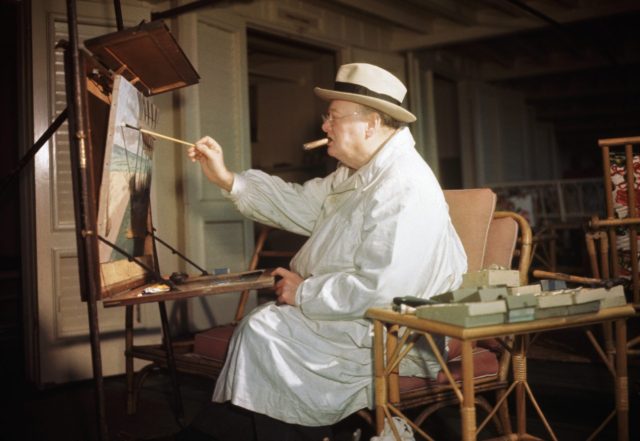
Churchill painted like a Whig and governed like a Tory. (Getty)





Real history has a habit of confusing those who go to it for comfort or outrage, for simple fairy tales or neat moral fables. From 1928 until the Seventies, Irish banknotes bore the image of the legendary heroine Kathleen Ni Houlihan: the hallowed embodiment of national virtue. This mythical Kathleen, however, also taught Winston Churchill how to paint.
To be specific: Hazel, Lady Lavery — whose features her artist husband Sir John Lavery enlisted as model for the Irish Free State’s legal-tender notes — set Churchill the artist free. She came calling while, brush in hand, the novice stood terrified before a virgin canvas. “My hand seemed arrested by silent veto,” Churchill’s 1921 essay “Painting as a Pastime” recalls. The Irish-American heiress, trained artist, and political salonnière born as Hazel Martyn grabbed the brush. She lustily applied splashes of vivid blue to “the absolutely cowering canvas”. Liberated, Churchill felt that “my sickly inhibitions rolled away”. He seized the largest implement he could find (there’s something phallic in this account) and set to work with “berserk fury”. As it often would for him, audacity prevailed.
Hazel Lavery, a Nationalist whose key backstage role in securing the Anglo-Irish treaty of 1921 may have included an affair with the Sinn Fein commander Michael Collins, had initiated the future icon of imperial Englishness into the pleasures of the easel. Churchill did receive some formal instruction in technique as well. That came later from the artists William Nicholson and Walter Sickert, but first from his Kensington neighbour John Lavery: a slum-born Ulster Catholic, and high-society portraitist, touted after independence as a suitable Governor-General of the Free State. The Lavery home at Cromwell Place convivially brought together political — even military — antagonists. For Churchill, from the outset, painting meant not diligent adherence to the rules but hedonistic self-expression fuelled by friendship. A quasi-erotic thrill runs through his descriptions of the craft: “The colours are lovely to look at, and delicious to squeeze out.”
Churchill created more than 500 artworks (mostly oils, but watercolours too) after he took up painting as a hobby following the débâcle of the Dardanelles campaign in 1915. His naval strategy a fiasco, his career shattered, the ousted First Lord of the Admiralty quit as Liberal MP for Dundee. He faced “long hours of utterly unwonted leisure in which to contemplate the frightful unfolding of the War”. While “a spectator of the tragedy, placed cruelly in a front seat”, the disgraced minister found that “the Muse of Painting came to my rescue”. When he saw his sister-in-law, Lady Gwendoline Bertie (“Goonie”), happily at work with a paintbox, he decided to have a go himself.
Although peak productivity for his oils and sketches coincided with periods out of office, or in respite from its cares, he did paint scenes of the Western Front while an officer with the Royal Scots Fusiliers in 1916. Some French Riviera seascapes in 1921 — the fruit of a painting trip with Lavery — were executed after the then Colonial Secretary had helped shape the map of the modern Middle East at the Cairo Conference. During his years as wartime prime minister, Churchill claimed to have finished only one work, but ranked it among his best: a view of the Koutoubia Mosque in Marrakech, with the Atlas peaks behind it, painted after the Casablanca Conference in 1943, and given to President Roosevelt.
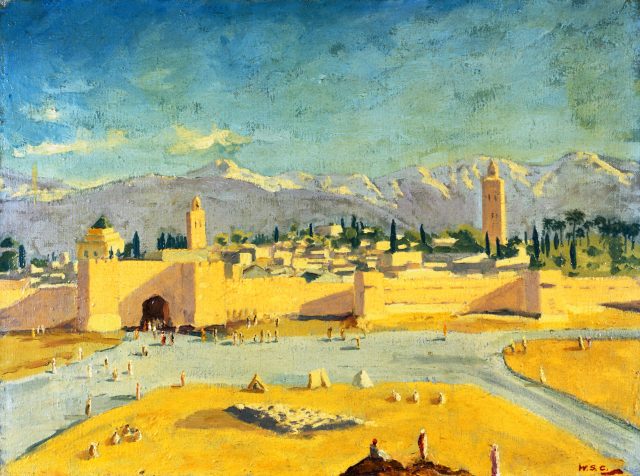
To his devotees, holy relics; to his detractors, amateurish daubs: Churchill’s pictures attracted large crowds when a selection toured the US and Commonwealth countries in 1958-9 (with support from the founder of Hallmark Cards), then came home in triumph to the Royal Academy. Their maker had been created a “Royal Academician Extraordinaire” in 1948. Since then, the auction market for his work has boomed. Once the property of Angelina Jolie, that Marrakech scene was sold by Christie’s in 2021 for £8.2m. However, the six decades since his death have seen no large-scale public shows. Opening tomorrow, the Wallace Collection’s exhibition Winston Churchill: the Painter gathers more than 50 pieces, half in private hands. For the Wallace’s director Xavier Bray, this carefully-curated sample of his strongest pieces not only narrates “an autobiography through visual means”, but represents “the closest we’ll get to an apotheosis of Churchill as painter”.
Dappled garden vistas and shadowed pools at his Chartwell home in Kent; sunlit Mediterranean coasts under azure skies; armies of pines massing beside sandy shores; storm-roiled Highland glens and peaks; Moroccan townscapes and valleys washed in eerie desert light: Churchill’s art throbs with a vibrant sense of place. Save for some melancholy scenes of wreckage on the Western Front — such as the forlorn shell-stripped trees above idling troops at “Plugstreet” (Ploegsteert) in Flanders — his painting escapes into landscape in search of solace and uplift. Art here means the commemoration of sensuous pleasure: in colour, light, heat, atmosphere. As he wrote about the French Impressionists and their successors (guiding spirits for his work) they “brought back to the pictorial art a new draught of the joie de vivre”.
How good is Churchill’s art? At the time, anonymised works impressed experts. When, exhibiting as “Charles Morin”, he had a small show at a Paris gallery in 1921, four out of five works sold, at £30 each. In 1925, a bold, free, thickly-painted view of Chartwell under snow won a competition for amateurs, with no name attached; one adjudicator wanted to exclude it because it was clearly the work of a professional. A certain “David Winter” submitted two paintings to the Royal Academy Summer Exhibition in 1947: both were accepted under that name.
Churchill struggled with human figures, as many amateurs do — although an angular, dramatically lit, self-portrait hints that he could have achieved more had he tried. Still, the balance and contrast of shade and texture in the strongest landscapes show both command of form and zestful close-focus attention to ever-changing effects of light, wind and water. He makes a captivating effort to match the plein air dynamism and fluidity of the Impressionists he loved. Unlike his dark and shady prose, Churchill’s paint exults in acid, strident colours. “I rejoice with the brilliant ones,” he wrote of his preferred palette, “and am genuinely sorry for the poor browns”. The brighter, the better: the Mediterranean littoral, with its deep-hued collisions of sea, rock, tree, scrub and flower, always excited the ardent Francophile.
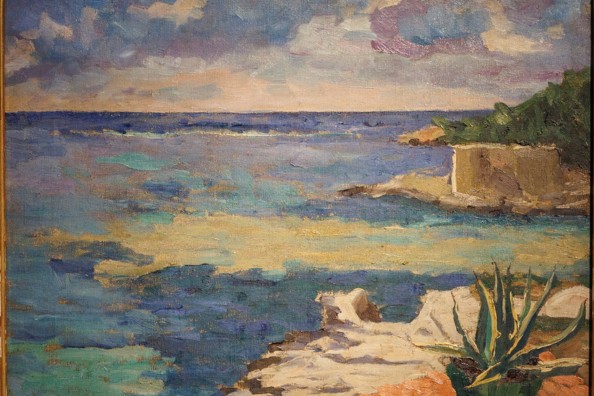
Let’s not invoke Cézanne, Monet or Matisse, his favourites: Churchill knew his limits and felt content with “a joy-ride in a paintbox”. His loose, mobile brushwork and zestful, garish palette can sometimes seem more slapdash and casual than truly evocative. High-level dilettante pieces they may be, but they both reflect, and convey, that delight in process and practice. When he apes the quicksilver Impressionist pursuit of light and wind, his relative clumsiness can slow down, and weigh down, the work. Churchill was correct to think that Morocco — which he visited six times between 1935 and 1959 — brought out the best in his painting and yielded works “a cut above everything I have done so far”. A firmer control of plane and volume in this clarifying air joins with starker, though coherently connected, blocks of colour: ochre, rose, purple, leaf-green, deep blue. This landscape has shape and sinew as well as shimmer.
The great art critic Sir Ernst Gombrich — who had fled Hitler’s Europe in 1936 — delivered a judicious verdict in 1965, the year of Churchill’s death. For Gombrich, Churchill’s “basic idiom was that of his whole generation of British painters”. Rebels against strict academic procedure, they hailed the Impressionists and their heirs as liberators, and never quite escaped their shadow. They revelled in “the joy of painting boldly in strong colours without retreating from likeness”, but didn’t opt to follow the Picasso generation into abstraction. Churchill shared, and indulged, that cult of “spontaneity” and “freshness of vision”, and his work could achieve — as his RA acceptance shows — “a standard of competence that satisfied the guardians of traditional skills”.
Churchill, however, was a writer — over many “wilderness” years, a well-paid author and journalist — before he was a painter. What really impresses Gombrich is the critical acumen displayed in “Painting as a Pastime”. These meditations on art “beat most professional critics hollow”. Churchill treats picture-planning and execution as a heroic exercise in strategy, vision and realisation. So the overarching design of a Turner, say, testifies to “an intellectual manifestation the equal in quality and intensity of the finest achievements of war-like action”, or of “scientific or philosophical adjudication”. As Gombrich glosses Churchill’s argument, “if painting is like generalship, then generalship is like painting”. The artist’s war to execute a vision ranks with the art of war itself.
Can we plausibly relate Churchill’s painting to his politics? After all, Adolf Hitler also loved painting — from early youth, rather than as a middle-aged latecomer — and was, notoriously, twice rejected in his applications to the Vienna Academy of Fine Arts, in 1907 and 1908. Gombrich sounds a justifiable note of caution about the hunt for an essential bond between Churchill the epoch-making statesman and the holidaymaker at his easel. He warns against “trivial and deceptive” equations of style and ideology: “Hitler, the screaming demagogue, painted tame watercolours.” For Gombrich, “nobody could learn much worth knowing about either of the protagonists of World War Two from a contemplation of their works”.
For sure, specious attempts to contrast Churchill’s “freedom-loving” outdoor vistas with Hitler’s “repressive” views of Vienna landmarks seldom convince. Anti-Churchillians will quickly point out that an aesthetic taste for rule-breaking spontaneity and happy-go-lucky self-expression did not extend to striking trade unionists (in his early career) or colonised Indians (before and during the Second World War). The apostle of liberty could also be the enforcer of unjust order. Likewise, Hitler’s fussy, anxious architectural sketches that failed to please the Vienna selectors may have revealed only a hesitant nobody from Linz, not the future maestro of genocide. The professor who spotted the young aspirant’s lack of interest in human figures grasped that his strengths lay in architectural form. He thought that the candidate should consider an architecture course instead — and, as Führer, Hitler would empower Albert Speer to fulfil his megalomaniac master-planning dreams.
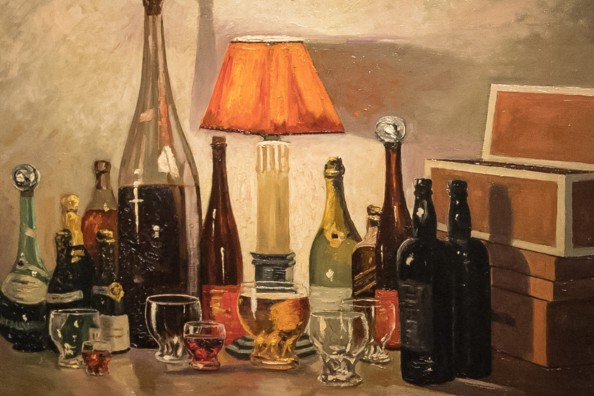
But Churchill, too, tended to avoid the figure — although the Wallace show does feature still-lifes whose poignant assemblies of abandoned bottles and jugs (one, from 1926, is entitled “Bottlescape”) somehow summon the forms of absent drinkers. In both cases, artistic difficulty rather than private psychopathy may explain a reluctance to put the body in the frame. All the same, it will be difficult for many visitors not to extrapolate some kind of socio-political personality from the landscapes in these rooms.
Great freedom of method and effect — as in the open, rapid, busy brushwork of the sea in “Cannes Harbour at Sunset” — coincides with an urge, sometimes thwarted, to find balance and harmony in the tonal relations of the scene, and the pattern of its elements. Gombrich might disapprove, but quite a few of these works do seem to blend a bold, even erratic, enjoyment of surface liberties with an underlying quest for structural order. You might even call it Whig (rather than Tory) art. In contrast, the young Hitler’s ultra-disciplined landscapes lock nature, and its perception, into a rigid topographical frame.
The Wallace Collection show will hardly shift the opinions of Churchill disciples, or dissidents. To them he will remain either the spotless warrior hero of the Anglosphere, or the incarnation of imperialist brutality. It does reveal a public man for whom the dedicated pursuit of pleasure, and relaxation, mattered: not as a phoney “hinterland” to bulk out a political CV, but a foundational source of strength. The escape also served as a renewal. “Painting is complete as a distraction,” he wrote: “I know of nothing which, without exhausting the body, more entirely absorbs the mind.” Whether or not you reverence the foreground Churchill, the background Churchill — the artist and the author — did much to sustain and protect him.
Churchill once admitted that “If it weren’t for painting I could not live. I couldn’t bear the strain of things.” Ernst Gombrich makes no overblown claims about the quality of Churchill’s art. He does allow himself to comment that “If he was right, his painting may have helped to save Western civilisation.”
‘Winston Churchill: the Painter’ continues at the Wallace Collection until 29 November
Boyd Tonkin is a journalist, editor, and literary and music critic, and author recently of The 100 Best Novels in Translation.
 BoydTonkin