




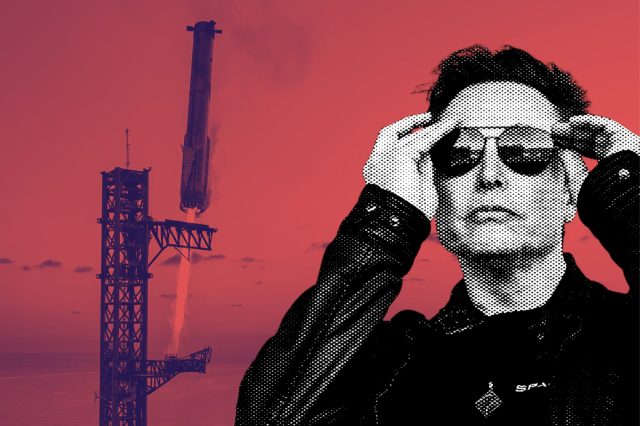
‘To him, we stand alone in the universe — a dim and flickering light of consciousness set amid an endless and unfathomable dark.’ (Getty)





Trickster, hypester, bullshit artist, Elon Musk is a profoundly ambiguous figure. A libertarian, an exponent of slashing the state, he built a business empire on subsidies and government contracts. Committed to truth, his platforms spread deepfakes and lies. Committed to freedom, he interferes in European politics, and supports the far right. Driven by a desire to save humanity, he builds the tools and technologies that may come to supersede us. What accounts for such a man, the burning energy, the chaotic contradiction? The figure, perhaps, of the hero — a creature of psychoanalysis, and one too of History.
Heroes are born in the denial of death. To Ernst Becker, writing in the Seventies, this is the root of human character, and of human heroism. Fearing death, we strive to make meaning, to achieve cosmic significance through that which lies beyond ourselves. Heroes are born in this struggle, yet so too is tragedy — for the cosmic impulse of the hero can come to justify any sacrifice.
Today, Elon Musk would bring humanity to Mars, foster abundance on Earth, and seed intelligence across the stars. To him, we stand alone in the universe — a dim and flickering light of consciousness set amid an endless dark. Bound to a single planet, this light is at risk — and so, using SpaceX, we must settle Mars. Through Tesla, Musk plans to “end scarcity” — to engineer a world free from want, a place of “sustainable abundance” powered by the limitless light of the sun and served by millions of robots. Enabling these transformations will be intelligence — the intelligence of artificial minds, built from and operating within a vast orbital infrastructure of computation. With abundance assured, and bound no longer by the limits of earthly physics, these minds would then be free — free to observe, analyse, and colonise the universe.
Musk’s vision begins and ends in the problem of meaning. Should they come into fruition, his plans would forever undermine the salience, the power, even the meaning, of nations, states, markets, and the societies that undergird them. He would birth a new form of power: the AGI platform state. Yet the scale of his ambition makes even this warning seem parochial — for Musk, in truth, aims to break the fundamental constraints of our existence. In doing so he risks not just humanity, but meaning itself.
We live in an age where the wildest precepts of science fiction have become not only imaginable, but investable. That this is so owes much to Elon Musk. Erratic, distractable, wilfully controversial, he is nevertheless an industrial titan, a man who with any one part of his portfolio would have made an enduring mark on the annals of mankind. Through Tesla, he has transformed markets in electric vehicles, solar energy and batteries; through SpaceX, he revolutionised satellites, internet access, and space flight. He owns X, one of the world’s leading social media platforms, and xAI, which leverages X data to build Grok, a leading AI system. With Neuralink, he has transformed the ability of humans to interact with machines, providing hope to immobile and paralysed people across the world. He was a founder of OpenAI, the creator of the world’s first major AI tool; through Optimus, a Tesla subsidiary, he plans to mass produce and commercialise humanoid robots.
Musk is creating the future — and, to read the statements of his companies, it will be a glorious place. Tesla’s stated mission is the elimination of scarcity via sustainable abundance, a world of “global prosperity”, “human thriving”, and “economic growth shared by all”. To Tesla and to Musk, growth is infinite, and innovation removes constraints. This future will be achieved by nothing less than “redefining the fundamental building blocks of labor, mobility and energy at scale and for all” — an extraordinary and, should it come into reality, epoch-making statement of intent. But these dreams of technological liberation, the very real results Musk has already achieved, and the astonishing scope of his ambition, are also creating something else — a vertical stack of power unlike any wielded in human history, and one with the scope to transform the basis of history. The contours of this power structure are increasingly visible through his business deals.
Deal by deal, Musk is refashioning his empire. His companies, previously separate and dispersed, are being consolidated, merged, and floated. At the same time, he is launching new ventures. In 2025, xAI — his AI company, and the owner of Grok — bought X, his social media company. SpaceX, his space flight and satellite business, has now acquired xAI itself. Sources suggest that the deal valued xAi at $91 billion, and SpaceX at $1 trillion — making it the most valuable private company ever to have existed. On 10 March, Musk announced that X — owned now by SpaceX — is launching a payments platform, xMoney. On the 21st March, Musk announced a further venture — Terafab, a three-way collaboration between Tesla, SpaceX, and xAI, one dedicated to manufacturing semiconductors. SpaceX — a company therefore combining rockets, satellites, artificial intelligence, and shortly payments and chips too — is now planning an IPO. With a valuation as high as $2 trillion, this would be the largest IPO in history, and one with heavenly ambitions — for Musk intends to put a million data centres in space.
A million data centres in space, a sustainably abundant robot future; few things could seem more absurd. A creature of irony, the object and progenitor of innumerable memes, Musk knows how and when to grab attention of his markets, investors and employees. Throughout his career, he has repeatedly overpromised and under-delivered — in the short run. He promised autonomous driving by 2019, a million Tesla robotaxis by 2020; Mars colonies by 2022; none of these promises quite came true. Musk bullshits, and Musk overpromises. To focus on this, however, would be a mistake. Like him or loathe him, Musk has a history of effecting transformational commercial change, change driven by grandiose ideas of the future. With Musk, above all, we must judge the man not by what he says, but by what he builds.
Behind Musk’s recent deals is a logic of power and control, a logic we would do well to consider. He is aiming for vertical integration — control of energy generation, of computing infrastructure, of data and the sources of data, of internet connectivity, of transport, and control of manual labour. It is a question of power — energetic power, computational power, and commercial power. Control over each enables the greater growth of the other; taken together, they give him end-to-end control over AI, the basis of AI, and the tools through which AI is expressed. Multi-billion dollar valuations suggest we must take his plans seriously — but taking it seriously suggests a vista far greater, far more alarming in scope, than that conjured by even the most hyperactive investment analyst. Musk is betting not simply on growth — he is betting on the singularity.
Read the news, talk with friends, experiment with Claude or OpenAI; something strange, something singular, is occurring all around you. The cognitive capabilities of human beings — our capacity for reason, for language, for calculation — are being scraped, abstracted, and automated. Tasks that would take weeks — designing an image, writing a story, building a financial model, developing an app — can be compressed now into days, hours, minutes. Across the “higher” industries, a tsunami of change approaches. Goldman Sachs estimates that 25% of all American work tasks are exposed to automation, and 300 million workers globally. Administrative, legal, and financial jobs are particularly vulnerable: 46%, 44%, and 35% of their respective work tasks are currently considered automatable. This may, however, prove to be a severe underestimate — for the AI models are improving at an exponential rate, and automation is not limited to desk jobs, those involving “higher” cognitive skills. In Beijing, Los Angeles, and shortly London, driverless cars now compete with those driven by humans. Humanoid robots are entering use in factories, warehouses, and restaurants; soon we may also see them on the streets, and in our homes; in time, such robots may become no more exceptional than a washing machine, an ordinary item of domestic tooling. Given the imminent reality of both cognitive and physical automation, another possibility presents itself — one of entirely automated economic activity, of companies led by AI, served by robots, and working to the benefit of AI-controlled shareholders.
In this world, the relative value of human labour will collapse, machines will recursively self-improve, and capital — the intangible capital of AI models, the physical capital of servers, robots and rockets — will leap into the stars. Wittingly or otherwise, Musk is developing a self-sovereign vertical infrastructure of dominion, one explicitly designed to serve and accelerate this future and the artificial general intelligence it relies on — the AGI platform state, a new state form that is designed to advance the needs not of humans, but of AI. The AGI platform state arises in the infrastructure of disintermediation, physical automation, orbital independence, and the unifying layer of data and intelligence. The tools of the AGI state span energy generation, internet access, satellite technology, payments infrastructure, robotics, data collection, and intelligence itself.
Already, satellite internet shows us how orbital infrastructure side-steps territorial power. Through Starlink, SpaceX now owns 97% of all satellite internet usage. At sea, in warzones, and in remote and isolated areas, thousands of Starlink satellites — solar-powered, and kilometres above the earth — now provide internet access. Business deals deepen this capacity; in 2025, SpaceX acquired the spectrum rights of the telecommunications company EchoStar — providing it with the ability to provide satellite to smartphone internet access, entirely unmediated by terrestrial infrastructure. In great swathes of the planet, internet and cellular access no longer relies upon terrestrial power, disintermediating the state. This is real, highly material power. On the battlefields of Ukraine, Starlink connectivity is a matter of life and death, and one operated at the will of Elon Musk. Russia itself — a high-tech military power, and a leading player in the 20th century space race — relied heavily on Starlink; when Musk withdrew access, they lost territory.
If SpaceX side-steps state control of communication, then xMoney is designed to side-step banks. In time, it may also side-step sovereign control of money. Envisaged as an “everything app”, xMoney will enable peer-to-peer fiat payments, a debit card, and cash deposits — circumventing banks, and the states that rely on banks. Fiat money, of course, requires the state — but what if xMoney accepts crypto? Musk — aka “the Dogefather” — is a well-documented lover of cryptocurrencies, in particular that of Dogecoin. Should xMoney accept crypto, or issue its own crypto, backed perhaps by the assets of SpaceX, this would be a further sign of independent ambition — for it would be uncontrolled by any sovereign state. This matters for power today, and power tomorrow. Little appreciated outside blockchain circles is the role of stablecoins and crypto currencies in facilitating the AI agent economy. Peer-to-peer microtransactions, conducted at digital speeds, are likely to be the basis for economic exchange between robots — thus enabling a whole new sphere of economic activity, and one with decreasing ties to states. xMoney is tied to X.com — a pairing of individuals’ financial access with social media activity. Both, of course, will generate data: the primary input into AI models, and a central power resource in the age of AI. Data, and the power derived from data, is at the core of Musk’s vertical mission — and we can see this reality embodied in Tesla.
Tesla is the world’s most valuable carmaker — but it is much more than that. It is an industrial force, a multi-market behemoth, and the centrepiece of Musk’s plans for terrestrial power. A public company, it holds $1.31 trillion in market capitalisation, placing it among the world’s 10 most valuable businesses. It holds a 59% share of the American electric vehicle market, and — though subject to increasingly strong competition — 7.7% of the global market. To develop the company, and with it to revolutionise the global EV market, Tesla has repeatedly re-imagined the limits of EV technology and industrial practices — extending the rage of EVs, bringing battery production in-house at highly-automated “gigafactories”, and refining the interior, software-first design of the automotives themselves. The needs of Tesla products are reshaping entire industries. Electric vehicles require batteries, and the electricity to power them. Through developing its own EV-capabilities, Tesla has also become a leading player in renewable energy. Through Megapack, a battery designed to support power grids, it is a global top-three producer of large battery storage systems; through Powerwall it is a leading supplier of batteries to store solar energy in consumers’ homes, and holds over a third of the US market.
Tesla is now switching to robotics. In a recent Tesla earnings call, Musk announced that Tesla would cease production of Model S and Model X cars; the factory space would instead be used to produce Optimus robots. Musk claims he will soon create one million humanoid robots a year, but he has competition. From Boston Dynamics to China’s Unitree and Agibot, others are also rushing to enter the industry. The opportunity is vast; analysts predict that humanoid robots represent a $5 trillion market, and that within 30 years they may number in the billions. No competitors, however, will have what Musk hopes soon to control — an independent stack of energy generation, energy storage, compute, payments, data, and satellite connectivity. Here, infrastructure converges with automation — for Musk will have built an army, the resources to power it, and the tools to control it.
Operating within Tesla’s EVs and Optimus robots is Grok, Musk’s proprietary AI. Grok demonstrates that the thread between social media, a new payment app, humanoid robots, and electric vehicles is data — data, and the role of data in driving, enabling, and empowering artificial intelligence. The role of X in social media and, soon, financial transactions means it will hold a vast and ever-evolving database on our needs, concerns, and desires. Covered in sensors, interacting with a non-predictable, changeable physical world, each Tesla EV and Optimus robot is also an ongoing source of data, data through which the world can be observed, controlled, and manipulated. To manage this data, and to carry out actions on the basis of it, Musk needs AI. In turn, that AI needs computational power and the energy to generate that power — at vast scale. It is here that Musk seeks something truly new — energy in orbit. To harness this energy would be to transform history.
Economic life relies on power — the ability to convert the surrounding energy flows, those of wind, of wave, or splitting of an atom — into work. Above all other sources of energy, we rely on fire — the light of the distant sun, and on the fires we ourselves create here on earth. Harvested and metabolised by organic processes, solar energy is the basis of planetary life, and with it our existence. Our ability to harness that energy, and to channel that power, is what has led to the growth and spread of humanity.
Since the beginning of the industrial age, national power has been based upon the ability of states to extract, dominate and control the congealed light of the sun. Britain, blessed by providence with extraordinary reserves of shallow-lying coal, birthed and led the industrial revolution. Germany, France, Russia, Japan, the United States and China similarly burned coal to industrialise. Petroleum, mined in the Middle East and elsewhere, underlines the core processes of our lives, providing fuel, fertilisers, plastics, and much else besides. Without oil, and without coal, the global economy would collapse. Control these energy sources — control fire — and you control the earth. Iran, the homeland of fire-cults, thus now holds the world to ransom via the Straits of Hormuz.
Musk seeks to step outside of this power, and in doing so, conquer it — for Musk, like Prometheus, seeks to conquer fire. SpaceX seeks to place a million satellites into space: orbital data centres, placed there to harness the power of the sun. Data centres on Earth run up against physical limits — the need for land, the need for water, the need to compete with other human demands for energy consumption. Space, meanwhile, is limitless — literally so in spatial terms, and practically so in regards to solar energy. The earth receives only about half a billionth of the sun’s energy, yet the entire solar system is bathed in the light of the sun. Parked in space, solar cells could theoretically harvest more energy than that currently produced by the entire earth. Through SpaceX, Musk thus plans to build a hyperscaler, one “bigger than Oracle”; this resource will be used to power AI on earth and in the heavens.
In themselves, these plans would represent a profound disruption in global affairs. They would break the territorial link between energy generation and political power. A thousand kilometres from the surface of the earth, a new reality will come into being — one of energy generation, and machine computation, conducted beyond the easy reach of people, of democracies, and states. Unable to physically access these facilities, or to strangle their sources of energy, most states would be unable to control Musk, his satellites, his robots, or his AI. For now, a handful of governments possess the orbital weapons necessary to kill satellites, but they too may face a problem. Musk is predicting, planning and promoting an exponential, potentially uncontrollable, growth in machine power. Should this occur, even superpowers may lose their potency against the machines.
Grok — powered by orbital computers, trained upon the data-feeds of Musk’s vast business empire, and acting in the world via AI agents and Tesla robots — will be Musk’s engine of control in the future he sees awaiting us. This is a power base for the Singularity, but Musk is by no means sanguine that he or anyone else can control it. He envisages a world without work for humans, a place where exponential increases in intelligence enable and merge with exponential increases in robot capability, creating a “supernova” of recursive improvement. In this new world, one that Musk expects to arrive within a decade, “corporations that are purely AI and robotics will vastly outperform any corporations that have people in the loop”. Humanity will be dwarfed by the machine; Musk predicts that “in five or six years, AI will exceed the sum of all human intelligence. If that continues, at some point human intelligence will be less than 1% of all intelligence.” At some point, he believes, the intelligence of the machines will so outstrip humanity that efforts at control will be meaningless. Robots, driven by nothing more than an urge to “understand the universe”, will propagate intelligence across the stars — intelligence that may or may not include humans and human consciousness.
Picture, if you will, the sci-fi future that Musk seeks to reify. On land, labour is becoming meaningless. Our higher economic functions — planning, trading, analysing — are carried out by AI agents; our “lower” functions are being carried out by robots. In offices, homes, and factories, an ever-expanding fleet of machines is carrying out tasks once reserved for humans. Cloud-connected, AI-enabled, each is able to call upon the compressed knowledge of humanity, a knowledge constantly updated by real-time data flows. Unable to compete, millions, then billions of workers, are left unemployed. Coordinating, directing, and mining these data flows are the satellites of SpaceX, their numbers expanding every year. Politicians are concerned, but their power is slipping away; states struggle to control the system above, and earthly power is increasingly delegated to the machines. Freedom is meaningless, for there is nothing to spend, nothing to do, and nothing to decide. Markets and political processes no longer lie in the hands of citizens; they lie, at best, with a handful of oligarchs, the controllers of AI infrastructure. Resistance is pointless; predicted, analysed, prevented in advance, humanity no longer controls the tools of production, or the levers of power. But then — why and how does one resist? AI is all around you — in your phone, your car, smartwatch, your house, in the ads you see when you walk along the street. It is your friend, your counsellor, and your decision maker. Able in seconds to access all the data you have ever produced, it knows you better than you know yourself — and so, in time, it chooses for you.
States could crumble, industries may vanish, the heavens may blaze with the cold light of a million satellites — but the greatest loss, the true question before us, is that of meaning. Musk’s quest for cosmic significance risks dissolving the very conditions that give human life meaning: scarcity, struggle, and agency. In his heroic mission, he risks destroying the basis of heroism itself — our capacity to act, and our capacity to choose. The risk is not that Musk might fail in his greatest ambitions, but that he might succeed.