




(Angela Weiss/AFP/Getty)





In November 2014, several hundred protesters marched through London’s West End before gathering in front of the old US embassy on Grosvenor Square. They were there to vent anger at a police killing that had taken the life of a black teenager, Michael Brown, nearly 5,000 miles away in Ferguson, Missouri. Their arms raised in the air, they chanted, “Hands up, don’t shoot!”, echoing a slogan of the then-nascent Black Lives Matter movement in America.
For the British Left in the “peak-woke” era, America was less a concrete place than an imaginary polity: not a constitutional republic with an admirable history of overcoming its shortcomings, but a hellhole of racist, capitalist tyranny that delighted in killing men who looked like Michael Brown and George Floyd.
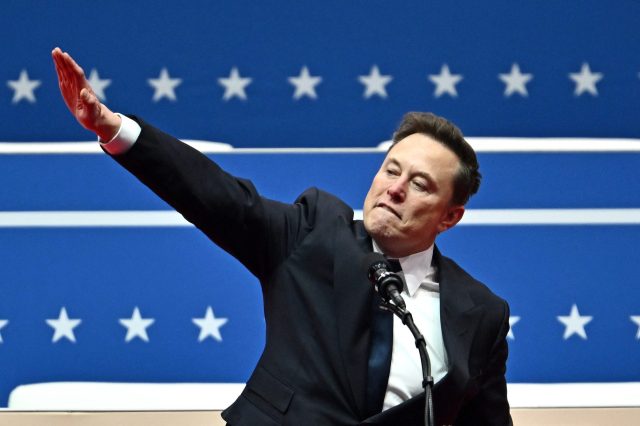
Nowadays, the mirror image is taking shape on the American Right and spreading through the influence of Elon Musk: an imagined Britain lorded over by Comrade Starmer and his totalitarian minions, bent on enabling migrant and minority criminality and silencing patriots who dare to resist.
For Musk & co., the case of Henry Nowak — the Essex student allegedly stabbed to death by a Sikh man, Vickrum Digwa, late last year — epitomises this state of affairs. Digwa claims he acted in self-defence after Nowak racially abused him; Musk’s crowd are insisting that, for this reason, the police withheld medical aid to Nowak as he bled to death on the pavement. In other words, they are constructing a reverse mythos around Nowak well before the complexities are fully understood, and with the same ideological frenzy that characterised the British Left’s understanding of American conditions in an earlier era.
With “post-woke” hindsight, it’s easy to mock the British Left’s imaginary America, where cops beholden to “systemic racism” snuffed out black lives for the kicks. But to the Britons who took up BLM, their Manichaean picture of the United States was no joke — it lent an epochal importance to their local causes.
As one observer noted at the time, the Metropolitan Police officers assigned to escorting the London protesters “seemed in no mood to hassle anyone”. They kept a polite distance and ensured that everyone could exercise their freedom of speech and assembly. Indeed, most of the London police wouldn’t have been carrying guns — a fact that lent a ludic aspect to the importation of the BLM slogan.
Even so, the London progressives seemed to identify, at an intense emotional level, with the racial oppression suffered by black folks in the American Midwest. “The London Metropolitan Police move around this city like an occupying force,” one white trade unionist complained to Vice. Just like in America, with its “system that is predicated on the oppression of black people — institutionalized racism”.
The London protesters couldn’t have known that less than a year later, the Obama Department of Justice would exonerate the police officer who killed Brown after “the most definitive account yet of the shooting”, as The New York Times reported. The testimony of some 40 witnesses belied the claim that Brown had innocently raised his arms; and the DOJ, like a Missouri grand jury earlier, couldn’t contradict the officer’s assertion that he was put in reasonable fear after Brown “leaned into his patrol car, punched him, reached for his gun, and then, after running away, turned and charged at him”, as the Times put it.
When, half a decade later, another racially charged police killing took place — George Floyd’s in Minneapolis — the entire UK establishment recalled that America is a terribly, terribly racist place. They took the knee, published columns, tabled a Black Lives Matter resolution in the House of Commons, and so on. With his bureaucratic piety, Keir Starmer intoned that Floyd’s death had “shone a light on racism and hatred experienced by many in the US and beyond”.
The upshot was more “Hands up, don’t shoot!” protests in front of police officers without guns, and vandalism targeting the Cenotaph and Churchill’s statue at Westminster. Americans moved on; the cult of Floyd didn’t survive subsequent scrutiny of his life; and the Democratic Party quietly concluded that police officers are good and necessary, actually, and that defunding their departments is a dangerous — not to mention unpopular — thing to do.
Yet the tendency of America and Britain to fantasise and jump to conclusions about each other didn’t go away. It merely shifted in direction, geographically and politically. Over the past year or so — ever since Musk decided that no one had heard of the grooming-gangs scandal until he publicised it — American Right-wingers have come to develop a picture of Britain that is no less distorted than the one that the UK Left entertained of the United States.
In the US Right’s imaginary Britain, all-too-real crises are similarly magnified to monstrous scale. This Britain isn’t a constitutional democracy, blessed with an ancient and robust tradition of rule of law, in which individual and institutional actors sometimes make mistakes and sometimes act badly, even as society as a whole attempts to uphold freedom and justice. No, this Britain is a conspiracy writ large — against its white citizens, by Leftist authorities in cahoots with malevolent foreigners.
Musk’s treatment of the Nowak case is telling. As I write on Thursday, the Tesla and SpaceX boss has published no fewer than four X posts or reposts on the case in a matter of two hours: several asking why the likes of Starmer and Angela Rayner, who took the knee for Black Lives Matter, have failed to do the same for Nowak, or even to mention his name. Another post asserts that the killing of “this innocent English boy” was “aided by police”.
Musk also pledged to fund a wrongful death suit against “these disgusting excuses for law enforcement” — that is, the police officers who initially responded to the scene. Musk’s framing of the case, hourly amplified to his quarter of a billion followers, seems to rest upon accounts offered by those such as Tommy Robinson, who insists that the police “left [Nowak] to die because they heard the word ‘racism’”. Replied Musk: “Unconscionable.”
Yet this simplistic telling — oi, you were racist, mate? Then I guess we’ll let you bleed! — is being cast into doubt as the alleged killer’s trial unfolds at Southampton Crown Court.
Nicholas Lobbenberg, the prosecutor, noted that the police did initially handcuff Nowak “and started giving him first aid when he then collapsed”, as the BBC summarised his statement. “Shortly afterwards,” the prosecutor told the court, “Henry became unconscious, then police began to set to work to give him first aid and summon an ambulance, a doctor flew in by helicopter but there was nothing that could be done to save Henry and he was declared dead.”
The prosecution’s account still leaves many questions unanswered, not least why the police handcuffed Nowak. But what we know so far — first-aid application, a physician flown in — makes it hard to believe that police “left [Nowak] to die” because they thought he was a racist.
The far more plausible interpretation is that the police initially misunderstood what was happening as they were trying to make split-second decisions amid a chaotic scene. Is it possible that progressive police training played some role in their decision-making? Maybe. The responding officers should face questioning about all of this, and no doubt will. And if ideology was a factor in their conduct, they should face consequences, and reforms must be instituted.
But that’s just the thing: very little of this has been carefully examined and analysed, while already, Musk and his local allies like Robinson are jumping to a stark conclusion: white lives don’t matter in modern Britain. Much as, a decade or so ago, British progressive activists and too many in the liberal establishment permitted a similarly ideologised lens to distort their perception of justice, race, and policing in America.
Will the reductive passion plays and martyr cults of the racial Right prove any less destructive — of institutions and truth procedures — than did those of the Left? Either way, Musk won’t be the one paying the price.
Sohrab Ahmari is the US editor of UnHerd. His next book, on The Triumph of Normal, is forthcoming from HarperCollins.
 SohrabAhmari