




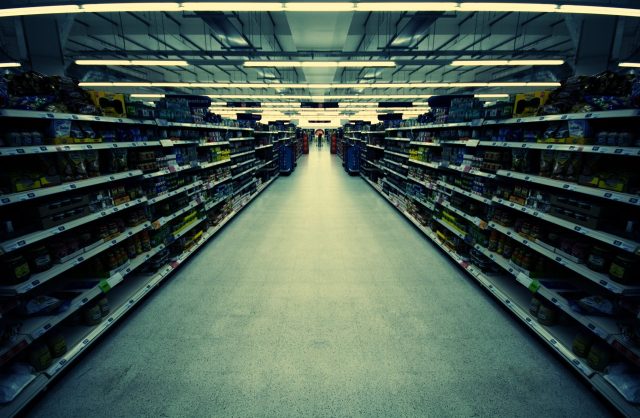
‘Our food system is incredibly fragile.’ Getty





Feeding the entire population of Britain three times a day is a Herculean task. Every week, the nation consumes around 70 million loaves of bread, around 120 million litres of milk, more than 200 million eggs, and hundreds of thousands of tonnes of fruit and vegetables. And that’s just the basics. Our food system, however, is incredibly fragile. It depends on a just-in-time logistical miracle, one that can easily be derailed by war, geopolitical fallout or a natural disaster somewhere along the global supply chain.
The Strait of Hormuz crisis has exposed the extent of Britain’s vulnerability. The Food & Drink Federation recently announced that food inflation could hit 10% by the end of the year as a result of the war. Its earlier forecast was around 3%. Food shortages are also possible: The Times reported last month that a potential shortage of carbon dioxide — essential to the process of slaughtering livestock — could lead to a scarcity of chicken, pork and other staples in UK supermarkets.
Modern agriculture requires a safe and stable flow of fossil fuels, and so is deeply affected by what is happening in the Middle East. Two of the biggest costs for British farmers are fuel and fertiliser, and the prices of both are soaring. Growing crops requires a lot of fuel — whether you’re ploughing, drilling and spraying crops or harvesting, drying and refrigerating them. Farmers are given some duty-relief on fuel in the form of red diesel, which helps to keep food prices down for consumers. But in wartime, this is not enough. Red diesel for my farm was 70-75p per litre before President Donald Trump sent in the first missiles. It is now more like £1-£1.15 per litre.
Then there’s synthetic fertiliser, which is the biggest single variable cost for many farmers. In recent decades, the world’s food production system has become heavily reliant upon ammonia and sulphur from the Middle East. Around a third of the global trade in raw materials for synthetic fertilisers flows through the Strait of Hormuz. So the crisis has caused the price of fertiliser to skyrocket.
Right now, it is crop planting season. Farmers have two choices in the face of rising expenses — buy less fertiliser and accept lower yields, or buy fertiliser at the inflated prices and pass on the higher costs to the consumer. Either way, food will become much more expensive.
The farmers I’ve spoken to this week say that the cost of growing crops in the UK has risen because of the war by as much as £150-£250 per hectare. That’s £30,000-£50,000 in extra costs for a typical 200-hectare arable farm. At this rate, some nitrogen-hungry crops, such as wheat, barley and oilseed rape, might not be worth planting this year. Farmers are nervous of borrowing tens or hundreds of thousands of pounds to get a crop in the ground when they know they’re probably not going to get a fair return on their investment. Jack Highwood, who farms in Kent, tells me he used to grow 300-400 acres of arable crops, mainly milling wheat — “enough to feed Kent for a week”. But he has stopped sowing crops because the cost of growing is now above the market price.
The dairy farmers I’ve spoken to say that the Iran war has added £200-£500 to the cost of every dairy cow, or £30,000-£75,000 to a herd of 150 cows. Many British dairy farmers were making a loss on every litre of milk even before the Iran war; they are now in a battle for survival, accruing huge debts. Even on a small beef and sheep farm like ours, the impact of the war is likely to be in the tens of thousands of pounds.
Lou Osman, a shepherd from Cambridgeshire, told me he uses three tanks of fuel a week travelling between his flocks. His fuel costs alone have gone up £180 a week. He told me he hadn’t sown any synthetic fertiliser this spring so would have less grass and raise fewer sheep this year. He is unsure whether his business can remain viable with spiralling costs. He is not alone.
All this probably means that your groceries are going to cost more. The Iran war has exposed a major flaw in our food system: after Brexit, the government stripped English farmers of their production subsidies, which up until then had ensured that producing food was always profitable — no matter the geopolitical climate. Now, the financial risk of farming falls entirely on the farmer. That means, in times of strain, farmers are likely to reduce their output to be on the safe side. And this makes the nation highly vulnerable to food shortages.
My father, who was a farmer like me, thought he had a social contract with the nation: to feed society in return for a degree of protection and support. That contract has been ripped up by successive governments; feeding the nation is no longer a political priority.
For years, politicians have turned a blind eye to farming. In fact, recent governments have made farming more difficult at every opportunity: not only eliminating production subsidies, but failing to deliver universal environmental schemes, introducing inheritance tax, raising employment taxes, rolling out more red tape, and signing free-trade deals that undermine our farmers by forcing them to compete with cheap, poor-quality produce from abroad. There is little or no understanding in government about how these changes might affect Britain’s food production.
This is pretty dangerous considering the worst threats to our food security may be yet to come. New military technologies are emerging on the battlefields of Ukraine that could profoundly alter our national security. Highly sophisticated Ukrainian drones are now regularly attacking targets up to 1,000 kilometres away. If this technology fell into the hands of our enemies, think how it could undermine our civilian infrastructure. The day may come when drones will be able to travel even longer distances in unfathomable numbers, aimed at us by an enemy intent on disabling our country, or intimidating us into submission.
Could Britain withstand a major attack on its food system? With a decent strategy it might have a chance. We have an amazingly productive land mass on the temperate edge of the Atlantic. We also have some of the best farmers in the world, who currently produce about 60% of the food we need.
The problem is that the government has allowed food production to become unprofitable for farmers, as well as highly centralised — so we have serious bottlenecks in our food system. Most supermarkets hold very little stock. And it takes tens of thousands of lorries to transport the nation’s food every week from farms to shops and food outlets: even a 10% drop in available drivers can result in empty shelves (remember Covid). The supermarket system works out of a handful of giant distribution and processing centres with incredible throughput volume, but which are highly vulnerable because they are run by computer systems that can be hacked. It also relies on refrigeration, and so is vulnerable to energy shortages.
On top of this, Britain imports lots of its food from places vulnerable to climate change, natural disasters or geopolitical chaos. Traditionally, we imported many of our fruits and vegetables from Almeria in Spain, but that region is now struggling with water shortages. So, increasingly, we’re sourcing fresh produce from West Africa instead, especially Sierra Leone. The whole system depends upon stability, peace and the free flow of goods — but can we guarantee that in West Africa? What’s more, our imports are almost all squeezed through two ports: Dover and Felixstowe. If these ports were ever taken out of action, we’d be in trouble.
The good news is that there are plenty of ways to make our food system more robust. After the Second World War, British farmers began using ammonia nitrate to grow crops; now, we are addicted. But there are ways we can wean ourselves off this addiction — at least to some extent. We can lessen our reliance upon synthetic fertilisers by using rotational and regenerative farming to improve the health of British soil. By introducing crop rotations and re-integrating livestock into arable (crop growing) systems, we can fertilise more of our land naturally.
We can also lessen our reliance upon foreign fruit and vegetables by supporting growers across the UK to make a sustainable living. We can design and develop horticulture in urban areas, with allotments and urban farms, where food production will be most needed in any future crisis. (Paris, remember, was once a leading light of food production, farming small areas intensively to feed countless urbanites.) We can stop subsidising mindless schemes to take land out of food production in order to build houses or solar farms or pursue the worst excesses of corporate “offset” rewilding. We can be way more discerning about where we import food from, and encourage farmers to produce certain foods we’re lacking. And we can shore up our supplies of synthetic fertiliser by protecting the Billingham ammonia plant in Teesside — the last plant in the country that produces ammonium nitrate.
As it stands, a large part of Britain’s cheap food system relies upon massive fossil fuel flows, and we have done way too little to insure against the risks — risks that are swiftly becoming reality. A Which? report released yesterday found that three million UK households are already being forced to skip meals to cope with the rising cost of food. We urgently need politicians of all stripes to start thinking about farming and food as national priorities.
James Rebanks is a fell farmer and the best-selling author of The Shepherd’s Life. His latest book is The Place of Tides.
 herdyshepherd1