




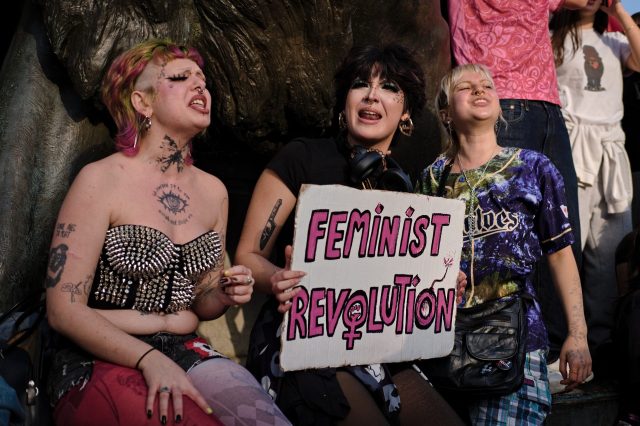
Idealists? (Djoudi Hamani / Hans Lucas / AFP/ Getty)





“We need a feminism that can enter into understanding of catastrophe and cease to prescribe false medicine for our time of grief and extinction.” As motivational slogans go, it could probably do with some workshopping; hardly likely to lure a new generation of young women off their beta-blockers and into the streets.
But then, Natasha Walter isn’t here to sugar coat things. According to her new book, Feminism for a World on Fire, fresh threats to women loom from every angle: authoritarian demagoguery, technology, capitalism, climate change. And the old threats haven’t been properly dealt with either: inequality, violence, pornography, racism. Meanwhile women are divided and distracted by arguments about immigration and trans people, as the world burns. Cumulatively, the outlook is bleak: “When women face up to the challenges around them, it is not irrational if they start to give voice to fear, and even despair.”
Most of the book is taken up with diagnosis but — as Walter reminds us — feminists don’t just want “to understand the world … the point is to change it”. Unfortunately the proposed remedies, when they come, are also depressing — clearly inadequate to the gargantuan problems just conjured up. Drawing upon familiar second wave platitudes, Walter exhorts readers to build communities, promote the value of care, engage in local green projects, make connections with other women across differences — all of which sounds nice; but also like a mere drop in the overheating ocean, assuming you take the apocalyptic predictions seriously.
The author hasn’t always felt this gloomy. Her 1999 book, The New Feminism, contained a relatively upbeat liberal message aimed at second wavers and conservative fogeys alike: stop disapproving of female sexual and sartorial choices, and put more women on boards and ballot papers instead. Do less glowering, do more empowering. Now, though, she has buyer’s remorse, reproaching her earlier self for being too individualistic, too caught up with the concerns of white middle-class women like herself. And she also regrets the way that what looked like a promising feminist protest movement in the 2000s was quickly turned into an empty fashion mag aesthetic: “even as the new wave of women’s resistance was starting to gather, it was being smartly mimicked and sold back to us”.
Walter used to be a Vogue writer in the Nineties, so she should know. She was also an elegant, fizzy member of the Late Review cultural commentariat, but then ditched the glamour and founded a charity for female asylum seekers instead. “Over the years that I worked with refugee women I came to know what it feels like when every day is a crisis”, she writes. And it seems she is still living in a permacrisis mindset, somewhat to the detriment of light and shade in her exposition. If you are the type to consider the pros as well as cons of any challenging situation — both in order to understand it, and to change it — you might find Walter’s relentless adoption of the tragic mode a little difficult to stomach.
On the other hand, if you are an “angry young woman”, trying to deal with gnawing anxiety at the state of the world by engaging in radical politics, the grim emotional register of the book will probably resonate. According to a recent investigation by the New Statesman, this demographic is particularly disaffected and prone to pessimism about the future. Walter’s boomer politics are unlikely to be radical enough for anti-imperialist Gen Z they/thems, but the general miserabilist ambiance does at least look like a good fit.
Personally I find the approach offputting: but I can’t blame either Walter or the youngsters for amping up a handwringing idiom that has been present in feminism for a long time. Just as someone is always wrong on the internet, so too is there always something wrong with some woman’s life, somewhere; and no feminist should apparently rest until the matter is resolved. Should a scintilla of optimism emerge about some particular advance for women, the subject can quickly be changed to other women thousands of miles away, with a more satisfyingly medieval set up to fret over instead.
Walter herself does a lot of this, jumping from country to country on the least fun world tour ever. Think some things are getting better? Not so fast, lady: you should hear what life is like in Kenya, or Iran. It makes me wonder what the measure of success is. Is the only acceptable outcome really the raising of four billion female people’s legal rights, practical opportunities, available goods, etc. across the globe to exactly the same male-comparable standard; or else conclude that the endlessly shape-shifting patriarchy has won?
If so, then the project is obviously doomed; and the perpetual lure of the omnicause to Lefties makes things even worse. Feminists are somehow supposed to tackle sexual violence, get rid of pornography, induce the world to recognise the true value of care work, free Palestine, and achieve net zero? Potential recruits can be forgiven for finding they have to wash her hair that night instead. In truth, the hopeless unfeasibility of the modern feminist to-do list undermines the project from within, just as much as the sight of some fashion influencer cosplaying at revolutionary chic. The age-appropriate idealism/ cluelessness of angry young women might obscure this point for a while; but more experienced organisers should know better.
Shorter lists, aiming at making local changes not global ones, are more doable. This is partly why — to take an example which will send A.Y.W. into further paroxysms of rage — British gender-critical women have had great success in fighting the incursions of transactivism into women’s spaces and resources in recent years. Walter finds herself unable to use that example, not least because she finds herself unable to pronounce definitively on what a woman is. But she is also apparently hampered by another stultifying feature of much Left-wing feminism: a horror of working with Right-wing women towards shared objectives.
She is critical of those women who “pick up on only one part of the fight for women’s rights, and dismiss other parts”; who “appropriate certain aspects of feminism, particularly the fight against street harassment, to argue against immigration, while also standing against other feminist arguments”. Of course, a more charitable interpretation is that these women are applying female-friendly principles more strictly than many leftists do themselves, determined as the latter are to put anti-racist causes higher up their actions list.
For her part, Walter seems to think that a woman has to be pro-immigration to count as a feminist at all. It’s a familiar stance on the Left, but one that makes her exhortations to women to “find solidarity” with one another over “shared experiences under patriarchy” sound rather hollow. She briefly mentions the scandal of grooming gangs, noting the failures of relevant agencies, but is silent about the omertà imposed by intersectional feminist logic, determined not to draw attention to any aspect of cultural reality that might draw racist backlash. At one point she even indulges in bit of that sort of thing herself, praising one survivor for “refusing to let her story be exploited by those who would use it to drive hatred and division”, and so implicitly positively contrasting her story with others.
Yet no grooming gang victim — a victim of a real live patriarchy, if ever there was one — has good reason to stay silent about the drawbacks of some kinds of immigration for her personally; and nor, indeed, does any inquiring female mind, concerned with scrutinising the effects of multiculturalism, both bad and good. And of course, once all these people have been ejected from the feminist club, the result is a much smaller club; so even less chance of achieving the titanic objectives set for the movement as a whole. Meanwhile, new members who are not particularly radical or angry are unlikely to flock in droves. For the bargain demanded of them — be prepared to pipe down about your own female-related interests or those of close others, wherever more urgent Left-wing causes require it — is not an attractive one.
Though shallow, the liberal feminism Walter used to espouse at least had a plausible psychological story about why women might want to be involved: namely, it was a form of self-help. Higher wages, more job opportunities, fewer disapproving looks cast by the world at your miniskirt and heels, were all things many women wanted to have at the time, and still do. In contrast, feminism as so often outlined by the Left seems like an exercise in altruism and self-abnegation, often forcing you to put the interests of distant strangers over those of yourself and the people you know. That’s fine if you have the temperament of a secular missionary or a raging masochist, but most do not. Indeed, instead of intersectionality as a paralysing ideal, there should probably be a feminist version of the Ordo Amaris: women encouraged to address issues of relevance to the self, the family, neighbours, and local communities, before mentally venturing much further afield. At least that way, they would have an incentive to participate.
Towards the end of her book, Walter writes of the importance of grassroots feminism: “as more precarious and uncertain times come closer, the work to ground our campaigns in the grassroots feels to me ever more important”. Here, I completely agree. Grassroots campaigns are often effective because the women have achievable goals in mind, of direct relevance to them or people they know. In strategising, they take account of true local conditions rather than applying a lofty ideological lens to a problem, obscuring the terrain. And in fighting, they know how to pick their battles, and are comfortable with large political differences between fellow combatants. Presumably Walter knows this, having done admirable local pro-refugee work herself.
There is nothing to stop feminists caring about anti-racism or capitalism or climate change if that is their thing, and individuals are always free to work out where they wish to direct their own political efforts. But defining feminism itself in terms of such goals is a recipe for disaster. It may sound boring in comparison, but feminists interested in actually getting things done should try to get back into the frying pan and out of the fire.
