




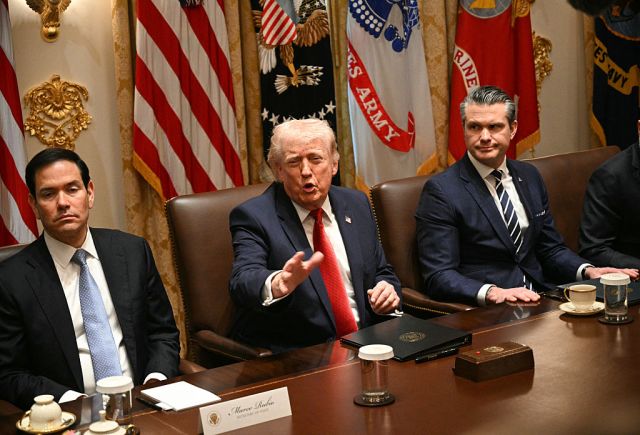
‘Trump has blundered into another Middle Eastern quagmire.’ (Jim Watson/AFP/Getty)





In 2002, when the Israeli government caught wind of America’s intention to invade Iraq, it protested. The real enemy in the Middle East, the Israelis insisted, was Iran. Their arguments failed to persuade the neoconservatives around President George W. Bush, even though many of the latter agreed that Iran was the principal danger. What they rejected was the either/or framing. With stupendous optimism, they thought: why not Iraq then Iran?
By installing democratic government in Iraq, the neocons imagined, they would set off an America-friendly movement for democracy across the region. As the influential foreign policy analyst Michael Ledeen wrote in September 2002: “it is impossible to imagine that the Iranian people would tolerate tyranny in their own country once freedom had come to Iraq.” He added that “Syria would follow in short order”. Of course, things did not quite turn out this way. Bush’s wars in Afghanistan and Iraq proved to be drawn-out, bloody and humiliating disasters.
This February, when the United States and Israel launched a new war in Iran, there was understandable speculation that the neocon agenda had been resurrected by its supposed nemesis, Donald Trump. It does appear that Trump was persuaded to take up unfinished business on behalf of Israel and hawks in the US foreign policy establishment. He may also have inferred from last year’s protests in Iran that destabilising the government could spark a popular uprising. But despite Trump’s occasional claim to be seeking freedom for the Iranian people — one among many stated rationales for the war — it is impossible to believe that he, or perhaps anyone, shares the erstwhile neocon conviction that democracy could be spread across the globe.
That conviction was an artefact of the unchallenged American hegemony of the Nineties and 2000s. Trump’s blundering sequel, in which the increasingly isolated president raves about blowing Iran off the face of the earth, even as the Iranians hold the global economy hostage via the Strait of Hormuz, only emphasises how distant we are from that world of two decades ago. We can scarcely imagine the sublime vistas glimpsed by those who dreamed of bringing about the End of History, spurring on a worldwide convergence on liberal democratic institutions. Yet there it is, in black and white, in the 2002 US National Security Strategy. This document, also known as the Bush Doctrine, pledged to “actively work to bring the hope of democracy, development, free markets, and free trade to every corner of the world”.
Does this mean that the End of History was no more than a baseless, dangerous fantasy? A new book by Ian Shapiro, After the Fall: From the End of History to the Crisis of Democracy, argues that it was not — though his vision of the End of History is more modest than that of the neocons. Shapiro, professor of political science at Yale, thinks that “different and vastly superior possibilities” were on offer after the fall of Communism in 1991, even if those possibilities did not include overthrowing authoritarian governments willy-nilly and spreading democracy to places where it had little chance of taking root. Rather, what emerged from the rubble of the Iron Curtain was “a real chance to extend and deepen the rules-based international order” through the United Nations and other multilateral institutions. According to Shapiro, this opportunity was squandered by the shortsighted and foolish decisions of Western leaders, and especially American ones, of which the War on Terror is a prime example. In pursuing their End of History fantasies, Bush and co. closed the routes that actually existed to a new and better world.
It was Bush’s father, President George H. W., who showed what that world might look like. During the first Gulf War of 1991, he carefully rallied 42 countries to eject Saddam Hussein from Kuwait, but stopped short of toppling the dictator so as to respect the parameters agreed by the UN Security Council. He thereby acknowledged the principle that, as Shapiro writes, “even great powers must negotiate with adversaries, and they often invest in norms and institutions to help manage their conflicts lest they become overextended”. The younger Bush demonstrated no such wisdom, and it was often lacking in Bill Clinton and Barack Obama too.
An amnesia has set in during the Trump era, nurturing the impression that, for all its missteps, American power before 2016 was the largely benign lynchpin of a functioning rules-based order. In fact, as Shapiro details, America’s actions since the Nineties have amounted to a steady demolition of any possibility that such an order might take shape. Trump marks a new iteration of an existing pattern, not a break with it.
The War on Terror anticipated Trump’s Iranian gambit not in its ideology but in its recklessness. Bush, like Trump, was elected on a platform of reducing foreign entanglements. He was a tax-cutting president who could not, or did not want to, cough up the resources necessary to finish the wars he started. The approach taken by both men (strategy is too generous a word) answer Shapiro’s description of “Ready! Fire! Aim!” In Afghanistan and Iraq, as in Iran today, the US started out by decapitating the leadership and decimating governing institutions; one of its first actions in Iraq was to fire 85,000 civil servants.
Then there was the Bush administration’s dismissive attitude to international legitimacy. The 9/11 attacks brought condemnation from leaders across the Muslim world, and offers of solidarity and support from, among others, China and Russia. The Taliban government was willing to assist in the hunt for Osama bin Laden, as was the Pakistani leadership. But the US spurned such cooperation, sidelined the UN, and through its actions alienated much of the world. Its preference was for “coalitions of the willing” — alliances acting outside international legal frameworks — and for the uncompromising stance captured in Bush’s phrase “either you are with us or you are with the terrorists”.
As with Trump’s misfiring tariff diplomacy, which has inadvertently revealed China’s ability to resist American pressure, the neocons demonstrated the limits of American power rather than its extent. It is little discussed today, but the 2006 election victory which preceded Hamas’s seizure of the Gaza Strip came as a result of America’s desire to show progress in its democracy agenda. The Bush administration insisted that the elections be held, despite warnings from the governing Palestinian Authority, and was then outraged at the results.
The War on Terror was not the only instance where the US thumbed its nose at the world. Shapiro is no less scathing about the humiliation of post-Soviet Russia during the Nineties and 2000s, when Russian leaders went to extraordinary lengths to show goodwill towards the United States, and were repaid with the expansion of Nato up to their borders. Whether a less antagonistic course would have avoided the Russian military aggression we see today is impossible to say, but many prominent voices at the time warned of just that outcome. Another excoriating chapter deals with the response to the eruption of civil war in Libya in 2011. In this case the UN approved a limited intervention to secure a ceasefire, only for France, Britain and the United States to flout this conditional support by aggressively pursuing regime change. This enraged countries around the world, and threw the region into anarchy, creating a breeding ground for terrorist groups and a pathway for gangs to smuggle migrants to Europe.
Trump, then, is not the aberration we make him out to be. He has extended to America’s traditional allies the imperious attitude that it has long shown towards other parts of the world (often with those same allies clinging to its skirts), and he has enlarged the scope of his predecessors’ bullying tactics to include trade. Who can miss the Trumpian overtones of Hillary Clinton’s remark at the death of Libyan dictator Muammar Gaddafi, “we came, we saw, he died”?
Yet Shapiro’s chronicle of foreign policy failure is so damning that his explanation for it — bad decision making and bad ideas — feels inadequate. Nor does it lend much credence to his counter-factual scenario, which asks us to imagine the US binding its own hands for the sake of international harmony and cooperation. As a political scientist, albeit one who has been admirably critical of his own discipline in the past, Shapiro is keen to demonstrate that an informed reading of history, empirical studies and behavioural science would have steered politicians towards better decisions. To show that he is not just indulging in hindsight, he reminds us constantly that there were people on the scene who warned against the mistakes that were made and saw the paths not taken. But this still raises the question of why the leaders in question kept listening to the wrong people, and kept misjudging their situation so badly. And here Shapiro answers more clearly than he seems to realise.
The underlying theme of After the Fall is that Western leaders were undone by short-sightedness, arrogance, imprudence, a sense of invulnerability, delusions of grandeur, and above all, by hubris. These are defects of character; not in the sense of personality, but of the habits of thought and judgment which mark the actions of individual leaders and the governing classes to which they belong. To think in this way does not fit comfortably with the analytical models and policy wonkery of contemporary political science. Though populist politicians such as Trump are routinely analysed in terms of character, we tend to treat this as a special measure demanded by the peculiar nature of populism itself.
Yet character was central to a classical understanding of political action which was still alive in the 20th century, and which stemmed ultimately from ancient Greece and Rome. One part of this understanding is simply to acknowledge the tragic nature of human fallibility. Leaders make bad decisions because they are people with vices as well as virtues. But historians and dramatists in the classical tradition also recognised that character is shaped by historical circumstance. Civilisations rise and fall because they produce people, and leaders, with particular strengths and weaknesses according to the challenges and opportunities that history presents them with. Voltaire expressed one version of this theory with his remark that “history is filled with the sound of silken slippers descending the stairs and wooden shoes coming up”. Wealth and power do not always cultivate the virtues needed to sustain them.
If we scrape away the surface of Shapiro’s narrative, where a series of politicians succumb to erroneous beliefs and stumble into one disaster after another, what we find is a familiar morality tale of imperial apogee, overreach and decline. More particularly, we find leaders demonstrating a catalogue of character flaws which were set in motion by the temptations of enormous power. Ideas matter, of course. During the War on Terror, for instance, a mistaken image of reality informed by neocon ideology had disastrous consequences. But such utopian conceits do not gain traction at random; in this case, they appealed to an American political elite which believed itself capable of reshaping the world.
Even Shapiro’s later chapters, which deal with the corrosive effects of neoliberal economic orthodoxy in the End of History period, show the same thread of wishful thinking, complacency and irresponsibility. Free trade and globalisation were held to be inevitable in much the same way as the spread of liberal democracy; politicians treated disaffected voters with a similar disregard as they did their international counterparts; and financial and business interests recognised no more restraints on their freedom than presidents and their advisors did.
The simple truth in all of this slips out belatedly in the concluding remarks of After the Fall: “they did it because they could get away with it.” Western leaders were drunk on power; they were powerful enough, in other words, to be careless of the limits of their power, a condition which invariably leads to it being exhausted in self-destructive follies. Shapiro contrasts the last 35 years of foreign policy with the more enlightened decisions of American leaders after the Second World War, who supported international institutions and helped to rebuild their vanquished enemies into allies and trading partners. The crucial difference, of course, is that those leaders did not enjoy the illusion of untrammelled power and historical inevitability; they had the threat of the Soviet Union to sharpen their minds.
The question now is whether the challenge of Chinese power will change the character of US leadership, resulting in greater prudence and restraint, as rivalry with the Soviet Union once did. The fact that Trump has blundered into another Middle Eastern quagmire, creating a fresh distraction from the long-promised pivot to Asia, is not a promising sign. Perhaps America’s prestigious universities and think-tanks should devote less attention to political science, and more to the study of character in decision making.
Wessie du Toit writes about culture, design and ideas. His Substack is The Pathos of Things.
 wessiedutoit