




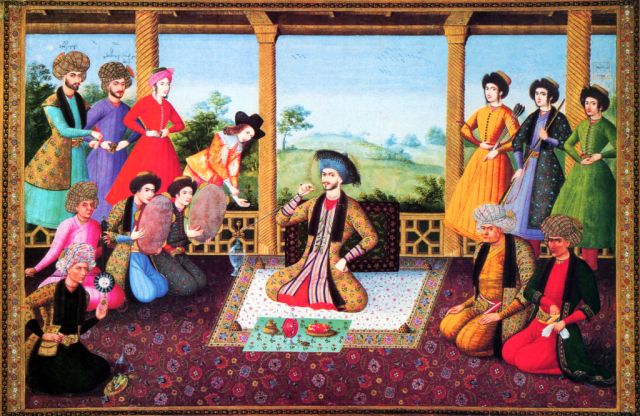
A scene from the court of the Safavid Shah Suleiman. (History/Universal Images Group/Getty Images)





Imagine, if you will, an empire. It is founded at a time of massive political upheaval, by a group of pioneers who set out from the old country in search of somewhere to practice their peculiar religious orthodoxies in peace. Quickly, these pioneers sweep across a vast landmass, from sea to shining sea, incorporating territory into their colonies and either assimilating or exterminating its native population. Eventually, they set up a government famed the world over for its complicated system of checks and balances to executive power. Within a few years, the new state’s successes are so dramatic that its leaders cannot help projecting its influence throughout the known world. At first, these forays go rather well; but gradually, particularly as the empire begins to gear up for its 250th anniversary, a few cracks start to appear. There is the ill-advised incursion into Iraq. The total humiliation in Afghanistan. By now, you may have guessed which empire I have in mind. I’m talking, of course, about the Safavids.
Safavid Iran is hardly the best known of the great Eurasian empires, but for nearly a quarter of a millennium, from 1501 to 1736, it boasted the kind of splendour that makes even the most cautious court eunuch feel almost immortal. At its peak under Shah Abbas the Great, it stretched from Baghdad and the Caspian Sea in the west to Kandahar and Bactria in the east; when the travelling jewel merchant Jean Chardin stumbled upon its capital, Isfahan, he marvelled at its geometrical architecture, its vast reflecting pools, its hundreds of bathhouses, its main plaza, the lushly landscaped Naqsh-e Jahan, which was larger than St Peter’s Square in Rome. This, despite the fact that the empire had little in the way of productive industry, no precious metals to speak of, and Isfahan itself was surrounded by a barren, rocky plateau on one side and mountains on the other. How, he wondered, had the Safavids managed it?
The Safavid Empire did have one major advantage: it was perched at the crossroads of just about every significant silk trade route in the world. Raw silk streamed down from the humid provinces near the Caspian Sea and into Isfahan, then branched off, to Europe and the Ottoman lands in the west, Mughal India and China in the east. Anyone who dared bypass the Safavid routes found themselves subject to an irresistible campaign of bribes and blandishments until they came round: Shah Abbas, sensing that Armenian merchants might try to cut through Arabia instead, built a lavish new Armenian quarter on the outskirts of Isfahan, replete with three new Christian churches, and invited his challengers to take up residence there.
So lucrative was the silk trade monopoly that by the time Abbas died in 1629, charging customs on it had become the default solution to just about every symptom of imperial decline. Isfahan needed a new dome, or bathhouse, or water garden? A new tax could be levied to finance it. The Afghan tribes were threatening the border? No need to conscript the native population: the silk duties would pay for endless battalions of mercenaries or slave-soldiers, fresh from the savage peoples of the Caucasus. The endless tariffs created bottomless demand for the Safavid currency: the imperial treasury in Isfahan could mint coin after coin without fear of debasement, since merchants would always hoover up the surplus to pay the new taxes. The Safavid empire, in other words, had discovered the heady delights of what in modern political economy is called seigniorage — the benefits that accrue when you have enough garrisons and slave-soldiers to be able to tell everyone what does and doesn’t constitute money. This magic mechanism gave them total fiscal invincibility. War after war, palace after palace: everything was possible for the Shah, the King of Kings, the Shadow of God on Earth.
I don’t know if the great minds in Washington and Langley that engineered the US’s recent foray into Iran ever opened a book on the Safavids before launching their campaign, but if they did, they might have noticed some similarities between the vanished empire of silk and their own. For one thing, both are empires built on remarkably similar systems of international seigniorage. Ever since 1974, when Richard Nixon agreed to supply Saudi Arabia with American weapons in return for the world’s largest oil producer denominating its oil trades in dollars, the US has had the privilege of a national currency that it is almost impossible to crash. Lawmakers in Washington can get away with all kinds of mad and reckless policies — running huge deficits, hollowing out domestic manufacturing, invading any nation it likes — safe in the knowledge that there will always be structural demand for what has become, thanks to the cooperation of a few lavishly bribed allies, the world’s reserve currency. Like the Safavid courtiers of the 17th century, American officials believe themselves to be somehow exempt from the normal requirement for productive national investment. Every week heralds a new, unwanted extravagance: a trade war, an actual war, a ballroom, with enough marble and gold leaf to rival anything in Isfahan.
Unfortunately for the Trump administration, however, the other important thing worth remembering about the Safavid empire is that it no longer exists. Four years before the empire was founded by Shah Ismail I, a Portuguese explorer named Vasco da Gama had managed to bypass the silk roads altogether by navigating his caravel through the ferocious waters around the Cape of Good Hope; over the next century and a half, explorers and merchants set about making this route safer — establishing waystations in South Africa where ships could dock, replacing their caravels with more nimble and capacious Dutch fluyts, and discovering ingenious routes through the Indian Ocean to evade the vicious westerly winds that had scuppered so many of their predecessors. By the late 1600s, most merchants, if faced with a Safavid customs official demanding some new, swingeing tariff, could simply shrug and choose to take the long way round. Customs revenues plummeted; the silver coins Shah Abbas had stamped with his own face were unable to withstand their progressive debasement. By the time the Afghan warlord Mahmud Hotak thundered into Isfahan on horseback in 1722, the Safavid army was so understaffed and underequipped that it could barely put up a fight.
The irony of America’s own march into Safavid lands is that it signals, perhaps more clearly than any other geopolitical development of the last 50 years, that the decline of the US is set to occur according to the Safavid model. Of course, the oil that props up the American dollar is not traded by Portuguese and Dutch merchants in caravels and fluyts. It is, however, subject to a powerful invisible infrastructure, of which the US government slowly seems to be relinquishing control. The dollar was already losing ground to the Chinese yuan before the US launched its invasion; now, up to 90% of Iran’s oil trade is conducted, in yuan, with China, and the dollar now makes up only 57% of foreign currency reserves internationally — a 25-year low. Moreover, the most exciting new applications of the Trump administration’s beloved blockchain technology all seem to revolve around cutting the US out of the oil-trading loop: the mBridge platform, for instance, has already processed RMB 387.2 billion worth of payments between China, Hong Kong, the UAE, Thailand, and Saudi Arabia, with 95% of transactions denominated in digital yuan. One by one, the significant non-aligned powers — Iran, the BRICS, ASEAN, Argentina — have begun to meet to discuss the possibility of denominating transactions in other currencies, while those countries that have toed the line seem to be demanding more from the US for the privilege. The UAE, for instance, has managed to exact a lucrative dollar-swap line after making a few threatening noises about adopting the yuan for their oil trades. In other words, the entire financial edifice on which America’s postwar hegemony was built has begun to wobble. What seemed just a few years ago like a permanent feature of the global system is starting to look very contingent indeed.
Perhaps the real lesson in all this is that there is a certain predictability to decadence. Empires sprout out from little quirks in the structure of the world: a bunch of sheep farmers find themselves sitting on top of an oil field, a trade route, or a piece of technology that renders them powerful enough to subdue all their neighbours. And then, gradually, the beneficiaries of this quirk manage to convince themselves that the real reason their empire has exploded into being rather than anyone else’s is their own inner greatness.
For the Safavids, the beginning of the end came when Abbas’s great grandson, Shah Soltan Hoseyn, began to take the pomp and ritual he had inherited a little too seriously — throwing himself into the state religion with a puritanical zeal, forcing the Zoroastrians to convert, fighting all his neighbours. If you listen carefully to the most recent dispatches of the US State Department, you can notice the same, slightly crazed air. There is talk of being chosen by God, of razing civilisations to the ground in a single evening. The wiser courtiers are muttering seditiously. And there is another sound, too. It is quite faint, but it is unmistakeable. You can hear it in the dead of night, when everyone is tucked up in bed, scrolling through X, dreaming of the next glorious invasion. Drifting through the trees on Capitol Hill, down to the black waters of the Potomac: the sound of hooves.