




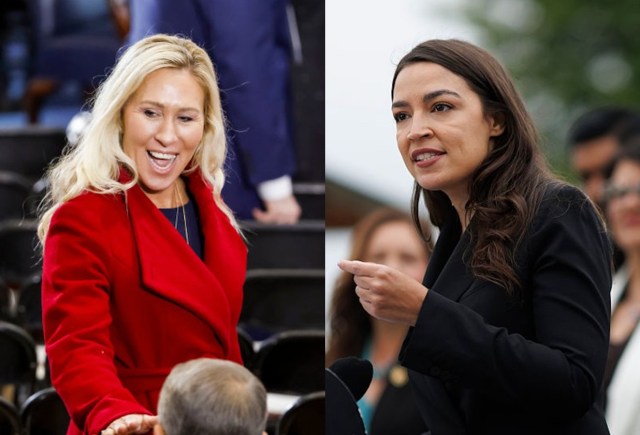
MTG and AOC have some views in common. Credit: Getty/UnHerd





Marjorie Taylor Greene gives Rep. Alexandria Ocasio-Cortez (D-NY) the ick. Asked by a student at a recent event about progressives collaborating with the Right, AOC said she was happy to work with Rep. Tim Burchitt (R-Tenn.), even though he has labeled her a “witch” and a “communist” in the past — but drew the line at Greene.
“I personally do not trust someone like Marjorie Taylor Greene,” AOC said, “a proven bigot and anti-Semite, on the issues of what is good for Gazans and Israelis. I don’t think that it benefits our movement, in that instance, to align the Left with white nationalists. I don’t think it serves us.”
AOC is one of the ablest communicators on the Left, and opponents underestimate her savvy at their peril. Still, the episode is a reminder that she has yet to master the main electoral lesson of our time: in an age of populism and meme warfare and ephemeral mass movements, politics is a game of addition, not subtraction. Leaders seeking to overthrow hegemonic establishments, especially, must build up goodwill across communities and deep divides — without losing sight of who they are and what they stand for, of course.
Instead, AOC appears stuck in the purity trap that characterized Millennial Leftism beginning in the mid-2010s and through the early 2020s. That was when progressives went out of their way to banish heretics: podcasters and politicos, writers and comedians. Their loss was President Trump’s gain. The ex-reality-TV star picked up the rejected and expelled and used them to cobble an unlikely coalition. To get across the line in 2024, for example, Trump won over pro-Israel ultras in outerborough New York — and Muslim imams in Michigan.
Key to Trump’s success, in other words, was a certain mobility: his refusal to redline potential supporters and willingness to reward anyone who was “nice” to him. AOC’s treatment of MTG as an untouchable, even if justified in some respects, is the very opposite of such a strategy. For all her professed radicalism, AOC is still beholden to a politics of respectability. This will ensure her presence in a safe matrix of elite opinion (think MS Now and the prestige papers). But it could bar her from breaking out as a genuinely counter-hegemonic force.
Greene, the former Georgia lawmaker, has emerged as one of the leading opponents of President Trump’s war on Iran and uncritical embrace of Israel. Forgetting the lesson of his own victories, Trump more or less drove her out of Congress and out of the GOP in response. Yet polls show that both stances — opposition to the war and skepticism of the US-Israel relationship — are overwhelmingly popular with Democrats and Independents, not to mention a large and growing share of younger Republicans.
Greene’s situation presented a perfect opportunity for AOC to practice Left populism. As the Belgian Left theorist Chantal Mouffe noted a decade ago, populism is all about “constructing a political frontier dividing society into two camps and calling for the mobilization of the ‘underdog’ against ‘those in power.’ ” In doing so, populist movements call forth a “subject of collective action”: people willing to mobilize in defense of their mutual interests against a given “hegemonic formation.”
Populism, Mouffe contended, is a justified, and even necessary, response to the neoliberal order that took hold of Western societies beginning in the late 1970s. That order is fundamentally “post-democracy” (Mouffe’s term): it retains vestiges of democracy like the ballot box and human rights but removes many fundamentally political questions from public deliberation and contestation, treating them as the “affair of closed elites.” Thus, for example, no matter which mainstream party popular majorities pulled for at the ballot box, they got corporate globalization; malcontents were “presented as ‘extremists’ or disqualified as ‘populists,’” as Mouffe put it.
Trumpism (and analog movements across the Atlantic) challenged this model, and achieved a measure of policy recalibration: above all, the free movement of goods, services, capital, and labor — the essence of neoliberalism — is no longer unquestioned dogma, not even among corporate elites. But in one crucially important area — war and peace — Trump lost the populist plot: he launched yet another misguided regime-change war in the Middle East without any debate, or even a bare attempt to persuade the American people.
The move fractured Trump’s counter-hegemonic coalition: suddenly, the supposedly populist president was on the same side as George W. Bush and the American Enterprise Institute. Pro-war pundits can go blue in the face insisting that the war is popular with “MAGA Republicans,” but as I’ve argued repeatedly in these pages, the broader Trump II coalition was bigger — much bigger — than MAGA Republicans alone. The anxiety roiling the GOP consultant class is Exhibit A that the discontent isn’t limited to a few populist podcasters.
Herein lies the opportunity for Left populists to pick up elements of the Trump coalition (many of which were naturally Democratic constituencies to begin with, like white-ethnic working-class Catholics in places like Pennsylvania who voted twice for Barack Obama before switching to Trump). But progressives won’t manage the maneuver if they’re quick to reach for the Left’s grab-bag of icky labels: “white nationalist,” “proven bigot.” Many of those up-for-grab voters, when they see Greene labeled in this way, will conclude that AOC is talking about them.
Greene, to be clear, has expressed some cranky-to-downright-nasty views. Such as the notion that California wildfires were triggered by space lasers controlled by the Rothschilds (she later told Bill Maher that she didn’t know “the Rothschilds” was a metonym for Jews). Or her belief more generally that “weather modification” is responsible for extreme climate phenomena. And her comparison of pandemic measures with the Holocaust. She seems to ascribe a great share of the world’s troubles to demonic activity — greater than seems rational, even from a religious point of view.
But Greene has also won praise from AOC’s mentor and spiritual predecessor, Sen. Bernie Sanders, for her resolute willingness to stand up to Trump when she felt the president ran roughshod over her Georgia constituents’ priorities. “There are good Republicans out there,” the Vermont socialist said of Greene.
Then, too, Greene has been on a journey, as Americans like to say. As UnHerd columnist Emily Jashinsky has noted, the MTG of 2026 is not the conspiracist of earlier years. Indeed, she has expressed contrition for her forays into conspiracism. In a speech last year, Greene explained that “I realized just watching CNN or Fox News, I may not find the truth. And so, what I did is, I started looking up things on the internet, asking questions, like most people do every day, using Google. And I stumbled across something and this was at the end of 2017 called QAnon.” Since then, she went on, she’s realized that her suspicion of mainstream accounts had led her to nuttery — and stepped back from the brink.
More recent interviews reveal a politician anguished by what she sees as a betrayal of a Right-wing populism that was supposed to build up roads and hospitals in the homeland, rather than seek demons abroad. A politician, moreover, who is horrified by the human cost of American and Israeli wars in the Middle East; Greene, it’s worth recalling, was the first lawmaker to join Sanders in calling on Washington to end starvation conditions in Gaza.
But even if Greene weren’t half as contrite and thoughtful as she is today, it would still behoove AOC not to treat her as an untouchable in the name of Leftist hygiene. The harder — but also more rewarding — progressive posture would be to accept common ground with Greene, while offering the latter’s followers a better account of what ails the country and how to address it. Here, AOC could learn a thing or two from her fellow democratic socialist Zohran Mamdani, who insists that Trump is a “fascist” — and maintains a better pragmatic relationship with the president than many Republicans.
A popular Left won’t come from shooing away the uncouth.
Sohrab Ahmari is the US editor of UnHerd. His next book, on The Triumph of Normal, is forthcoming from HarperCollins.
 SohrabAhmari