




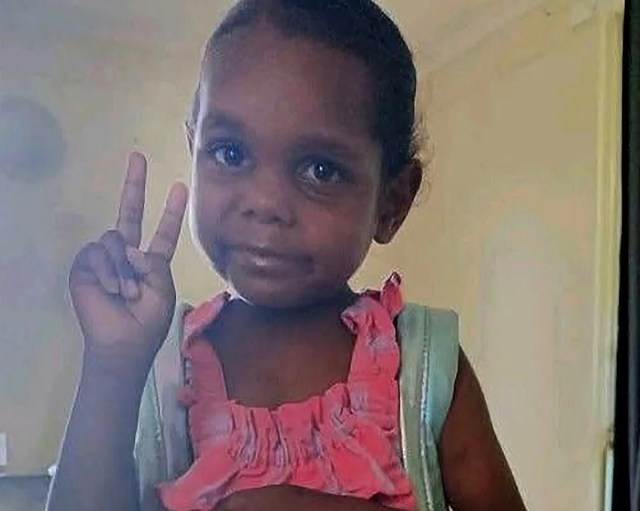
She was very much loved: Kumanjayi Little Baby. (Northern Territory Police)





Last month, as Australia commemorated Anzac Day and the disaster at Gallipoli, a very modern tragedy was unfolding in the country’s Red Centre. Kumanjayi Little Baby, a five-year-old Aboriginal girl, lived in Old Timers Creek, a town camp of nine houses on the outskirts of Alice Springs. She slept in a dilapidated building on a ripped and stained mattress, surrounded by empty bottles of bourbon. She was largely non-verbal and had also been the subject of over a dozen child safety notifications since her infancy — half since mid-March.
It is not known how many of these reports were investigated and if any were substantiated. What we do know is that on Saturday 25 April, the girl vanished. According to the child’s mother, she was put to bed at around 11.30pm that night. She was later seen outside holding the hand of a repeat violent criminal, Jefferson Lewis, an Aboriginal released from prison six days earlier after serving time for various violent offences. Apparently unwelcome in the community where he’d been ordered to go, he’d washed up in Old Timers and started drinking.
After news broke of the child’s disappearance, hundreds of people joined the search. The nation held its breath. The search turned up Lewis’s shirt, a child’s underwear and a duvet cover. Dread set in. And her body was found on 30 April, in a dry river bed a small distance from her home.
The national debate reignited our fraught argument about Aboriginal disadvantage and collective guilt. But more than that, the young girl’s shocking death reveals the political stalemate that has set in around Indigenous policy since the 2023 referendum to enshrine an Indigenous “Voice to Parliament” was voted down. While daily life brings an onslaught of symbolic gestures — land acknowledgments, Aboriginal place names — in far-off spots like Old Timers, desperate children are abandoned to their fate.
As news of Kumanjayi Little Baby’s fate spread, fear turned swiftly to rage. When police found Lewis, later the same day in another town camp, locals had beaten him unconscious (he has since been charged with murder and two other offences that cannot be published under territory law). After Lewis was transferred to hospital, about 400 angry people rioted outside demanding he be handed over for traditional justice, “payback”. Police and emergency services’ vehicles were attacked. Businesses were damaged and shops looted, according to video evidence later released by the Northern Territory’s police chief. “What you see is criminal behaviour, plain and simple,” he said.
What happened next is instructive. Asked to comment on the public disorder, Prime Minister Anthony Albanese reminded the nation that “literally hundreds and hundreds” of people had come together to search for the child. “We want to see the community come together,” he added, “but we certainly understand people’s anger and frustration.” Others agreed. Sean Kelly, a Sydney Morning Herald columnist and former Labor government adviser, reflected favourably on Albanese’s restraint because to immediately condemn the violence would have been “the easiest thing in the world”.
Only, the evidence suggests the opposite is true. For the Prime Minister, and indeed for much of the centre-left, it’s apparently the hardest thing in the world to speak plainly about violence in Aboriginal communities — and how that violence too often endures under cover of preserving Indigenous “culture”. If ever the ritual accusations of the intellectual Left about “systemic racism” in Australia were to land with moral force — accusations that erupt each time an Indigenous person dies in custody or is shot by police — it was surely now.
But political progressives have responded with little more than platitudes that this tragedy be a “turning point” on tackling Indigenous disadvantage. That, and homilies on “centring” the little girl’s family in the fallout as they observe the “sorry business”, the cultural protocols around mourning.
After meeting with Kumanjayi Little Baby’s mother, Malarndirri McCarthy, the federal Labor government’s Indigenous Australians Minister, said she wanted to say that it was clear the child was very loved. But, alas, deep love and chronic neglect have never been mutually exclusive.
It fell to the political Right to say as much, and none as powerfully as Senator Jacinta Nampijinpa Price — also, as it happens, the dead girl’s aunt. In a searing and desperate speech to Parliament last week, she described a “hands-off ideology” that meant officials were silent about alcohol abuse, dysfunction and violence in Indigenous communities for fear of being called “racist”.
“But,” Price said, “it’s not racist to speak the truth.”
The truth, in this case, invites profoundly uncomfortable questions. I’ll deal with them in roughly ascending order of sensitivity, starting with how was a violent repeat offender such as Lewis allowed anywhere near children? Do we need tougher sentencing, even though Indigenous people, especially in the Northern Territory, are already cited as the most incarcerated in the world?
What of Old Timers itself, a place so chaotic and dangerous that, even inside her home, Kumanjayi Little Baby was allegedly prey to someone like Lewis? What of the Indigenous-run, taxpayer-funded Tangentyere Council Aboriginal Corporation, responsible for managing and maintaining Old Timers and the other camps around Alice? What to make of revelations that salaries for senior management at the Corporation doubled last financial year to more than A$1 million, while residents can’t get front-door locks repaired?
And what of the other town camps, and remote communities more generally, both in the Territory and elsewhere in the country? These camps were established in the Seventies, when discrimination meant Indigenous Australians were prohibited from living in towns; others have since sprung up to accommodate people travelling from remote communities to access services in urban areas.
Around 1,000 people live in the town camps around Alice. Some are reportedly orderly, with residents travelling to and from work. Others, says Price, “can be hell-holes”. “Relics” and “separatist precincts”, says Senator Kerrynne Liddle, also from the centre-right opposition. Should governments keep funding these dysfunctional communities? Mal Brough, a former Indigenous affairs minister in John Howard’s conservative government, thinks they shouldn’t — and regrets his own decision to authorise new housing in remote communities. Though he concedes that much investment has been driven by “genuinely good intentions”, that’s “not enough if the practical outcome is that generations of children grow up exposed to violence, trauma, neglect and hopelessness”.
That leaves perhaps the hardest question of all, the one the Indigenous Australians Minister was presumably attempting to head off when she emphasised how much Kumanjayi Little Baby was loved by her family: should at-risk Indigenous children be removed from their families when they cannot be placed with Indigenous kin or carers? The centre-Right Territory government has ordered a review into the child protection department, and last week announced existing child protection laws will be changed to ensure child safety is “the primary consideration… regardless of background.” This has angered Indigenous advocates because it sparks memories of the so-called “Stolen Generations” — Aboriginal children wrenched from their families under what is widely understood to have been a policy of forced assimilation, and which left a legacy of dislocation and cultural alienation.
Taken together, these policy dilemmas are about the limits of an idea that has been central to progressive ideology since the Seventies: self-determination for the country’s Indigenous people. The push by Aboriginal Australians to control their own lives came as the nation began to reckon with its racist past, from the frontier massacres of the colonial era to the segregationist policies that forced Indigenous people onto reserves and missions, where they were often exploited as cheap labour. Later, under assimilation policies, many were displaced from their communities — while still facing restrictions on entering towns such as Alice Springs.
But critics argue that the shift to self-governance exacerbated social problems in some regions. Every few years, a scandal like Old Timers pierces through the news cycle to remind the public of the sickening daily violence visited on Aboriginal women and children in Outback communities — and the impotence of officialdom in stopping it. I’ll spare you the roll call of the children raped, in at least one instance gang raped; the toddler raped so badly she needed a blood transfusion; the women beaten to death, stabbed, repeatedly run over or set on fire, at home or in the street; the inquiries and reports with their findings of systemic failures and their urgent recommendations.
Amid these horrors, a pivotal moment came after a landmark 2007 Northern Territory report entitled “Little Children are Sacred”. It found that the scourge of Indigenous violence was widespread, and driven by cheap grog, poor school attendance and social breakdown. Indigenous leader Noel Pearson was asked on TV whether government intervention would be described as “paternalism”. He famously replied: “Ask the terrified kid huddling in the corner when there is a binge drinking party going on down the hall if they want a bit of paternalism.”
The Howard government declared a national emergency, announcing sweeping top-down measures that would become known as “The Intervention”. This involved a raft of measures, from standardised bans on alcohol and pornography, to income management, law-and-order crackdowns, a scaling up of health and employment programmes, and the temporary suspension of aspects of self-governance.
Whether The Intervention was successful is hard to measure. A common view among Indigenous advocates is that whatever the short-term gains, they weren’t enough to outweigh the damage caused from undermining the traditional authority of elders and stripping communities of their sense of agency. Some argued The Intervention’s “emergency” framing — even the army was brought in — was cover for a government agenda of socially engineering what anthropologist Melinda Hinkson, in the introduction to Coercive Reconciliation, an anthology of essays she co-edited with Jon Altman, describes as a “normalised” Aboriginal population, “one whose concerns with custom, kin and land will give way to the individualistic aspirations of private home ownership, career and self-improvement”. More than that, critics argue that the “No Pornography” signs at the communities’ entrances were themselves enough to create a debilitating legacy of “shame”.
“Shame” is a word frequently used by progressives in the Indigenous debate, as is “intergenerational trauma” in relation to past wrongs stemming from colonisation. Conservatives usually answer with concrete nouns: things like “welfare” and “grog”.
And so it is now. Following Kumanjayi Little Baby’s death, conservatives renewed their calls for federal audits of Indigenous corporations running remote communities, for national inquiries into sexual abuse and violence in Indigenous communities, for bold action. Progressives called for more government funding and resisted calls for better oversight. Governments, said the National Commissioner for Aboriginal and Torres Strait Islander Children and Young People, Sue-Ann Hunter, needed to focus not on punitive crackdowns but on “services designed by us, delivered by us and trusted by us”.
More frustrating still is that these debates are increasingly engulfed in meta-debates about the moral legitimacy of Australia — and indeed Western civilisation more generally. It sometimes feels like extreme voices are all we hear, whether that’s the hard Left re-badging Australia Day as “Invasion Day”, decrying Australia as a “settler-colonial regime”, and peddling myths of the “noble savage”; or else the chauvinistic Right booing Indigenous elders during traditional “Welcome to Country” ceremonies at the Anzac Day dawn services — an ugly spectacle that happened last month for the second year running. Both sap the body politic of the energy and goodwill needed to fix systemic problems.
But a precondition to fixing systemic problems is naming them. On the night the 2023 referendum was defeated, Anthony Albanese promised he would keep working to improve outcomes in Indigenous communities and towards reconciliation. As he told Indigenous Australians: “Maintain your hope and know that you are loved.” But Kumanjayi Little Baby, as we know, had plenty of love. What she needed, what she lacked, was protection.
