




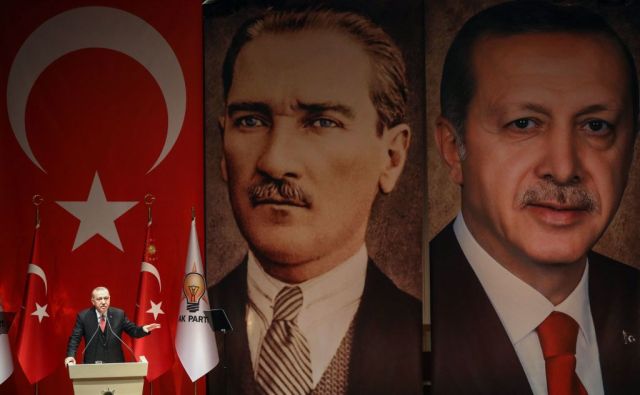
‘Turkey, once a viable candidate for EU membership, has long ceased to be the poster child for how democracy can flourish in a Muslim-majority society.’ (Adem Altan/AFP/Getty)





Four Iranian ballistic missiles ventured into Turkish airspace this spring. The collateral damage was considerable — though not to life or materiel. All four were easily intercepted by Nato defences before reaching their target. Rather, the harm done was to the confidence of pundits and policymakers who had assumed that Tehran would never turn its sights on its western neighbour.
Their reasoning was that Turkey, which has the second largest standing army in Nato, was not to be trifled with. More to the point, they saw the attacks as a category error. Turkey was just not the enemy. Ankara’s official self-image is of a natural mediator, a regional heavyweight whose cultural understanding of its neighbourhood is deeply rooted in a 600-year Ottoman past. It had loudly denounced the US-Israeli strikes while working its back channels to bring them to a halt. In other words, the missiles targeted Turkish self-esteem. For all its condemnation of US action, and despite sabre-rattling at Israel, Turkey was being lumped into the imperial camp it had so loudly refused to join. It was a cruel blow that when talks between the Trump administration and the mullahs in Tehran finally took place, they happened in Islamabad and not Istanbul.
Even before the fog of this conflict lifts, Turkey, like countries elsewhere, is busy calculating who comes out on top. The cui bono matrix is not difficult to run. By most calculations, as Iran goes down, Turkey goes up. Of course, the current high price of oil is a spanner in Turkey’s disinflation policy, and risks undoing three years of sacrifice that dragged inflation down from a high of 75% per annum to (a still staggering) 32%. Yet as with the fall of the Assad regime in Syria, a weakened Iran increases Turkey’s strategic and commercial clout. In the long term, it reinforces Turkey’s effort to be an energy and transport hub, and allows it to compete with Dubai as the regional commercial centre. That’s shadowed by opportunities further afield: just last week, Turkey’s foreign minister signed a “strategic partnership” on trade and security with Britain.
As that last deal implies, all this is also good for the Turkish defence industries — not just drones but warships and even fighter jets. Israel views this with some alarm, and Benjamin Netanyahu has warned against an “emerging radical Sunni axis” in which Turkey is, presumably, the crucial pivot. In truth, the danger of a confrontation between a US ally and a fully paid-up member of Nato is slim. Ankara’s greater fear is that a badly wounded and unstable Iran will be a running sore even greater than the Syrian civil war — prompting a refugee crisis along a common 534-kilometre border, or else fuelling Kurdish irredentism.
Thumbing back to before the 1979 Islamic Revolution, Turkey may have been suspicious of the Shah’s ambitions to turn Iran into a dominant Middle Eastern power, but relations were largely cooperative. While there was no direct causal link, it is not fanciful to think that the rise of a Shiite theocratic regime in Tehran gave confidence to the Sunni religious Right in Turkey, which was gathering strength in those years. That Turkey was in danger of becoming “another Iran” was the newspaper cliché of the day. It is now ironic to think that a preferred solution for the pious government ruling in Ankara would be a stable but weakened secular regime in Iran. The worst option would be for Iran to emerge from the current conflict as master of the Strait of Hormuz, emboldened and unbowed.
Whatever the outcome, the people of Iran may well conclude that they are classic victims of “the curse of oil”, a rueful malediction preventing nations from converting natural resources into the well-being of their citizens. The Turkish people might conclude that they suffer from a different sort of hex: “strategic significance”. Recep Tayyip Erdoğan has been at the helm of his country for well over two decades, pioneering the art of transactional international relations while Donald Trump was chasing starlets and Viktor Orbán was still Brussels’ idea of a model democrat. His governments have managed to leverage geography and regional importance to insulate Turkey from external pressures and democratic accountability at home. The question now is whether the war will finally strip away that insulation, exposing Ankara to pressures it has long managed to arbitrage. The answer lies in understanding how profoundly Turkey has changed under Erdoğan’s rule — and whether that change can still work in his favour.
It might be a stretch to say that Turkey underwent a form of regime change in the 2002 elections that brought Erdoğan’s Justice and Development Party (AKP) to power. But it is fair to say that those elections obliterated a whole generation of politicians. No party in the previous parliament managed to gain a single seat. In a result reminiscent of Hungary under Orbán, and under a system that rewards the largest party, the AKP won two-thirds of MPs with barely a third of the popular vote. Erdoğan, a former mayor of Istanbul, was still a banned politician at the time, having served a brief prison sentence for “exploiting religion to political ends” by reciting a nationalist poem at a political rally — a blatant form of judicial casuistry which he was later to apply to his own political rivals.
Erdoğan’s political instincts and impassioned rhetoric peppered with references to Islam spoke to the concerns of first- and second-generation urban migrants. His party portrayed a greater acceptance of religion in public life as part of a wider struggle to make Turkey more democratic. Until recently, an aggressively secular Turkish military was a controlling presence in political life. Still, it is important to remember that what brought the AKP to power was not so much a tide of Islamic feeling as an economic crisis. A decade averaging 70% inflation was followed in 2001 by the collapse of the Turkish lira.
Today, it is again inflation, much more than Iranian Kheibar Shekan missiles, that most threatens the Erdoğan government. The parallel with Orbán is inexact — the GDP of Istanbul alone is roughly 1.5 times larger than all of Hungary. Yet like the jobless Hungarian premier, Erdoğan faces the predicament of a populist leader who now strains to be popular. And, like autocrats everywhere, Turkey’s leader has cultivated a patronage network and a praetorian guard of cronies who will do anything to keep their champion in power. The result is an increasingly disillusioned society that watches its country drop like a stone in international indices of democratic rights and press freedoms. A common reckoning is that 90% of Turkish media is under direct government control. But here’s the rub. The AKP still suffered its worst defeat since coming to power in the 2024 municipal elections, not just failing in the big cities but losing conservative heartland strongholds such as Bursa, Kütahya and Adıyaman.
A year after Ekrem İmamoğlu — the popular Istanbul mayor widely seen as the most credible presidential challenger for the 2028 elections — won a second term by 10 percentage points in 2024, the government moved to arrest him on corruption charges. The tactic was familiar: Selahattin Demirtaş, the charismatic leader of the pro-Kurdish party, has spent years in prison despite the European Court of Human Rights repeatedly ruling his detention was politically motivated. The court issued a similar ruling for the philanthropist Osman Kavala, imprisoned since 2017. Kavala’s offence was to support civil society activism, his aggravated life sentence now a warning pour décourager les autres, or in this case other businesspeople tempted to support a dissident cause.
As the constitution stands, Erdoğan is not eligible for another presidential term, but few doubt he will overcome that obstacle. And though current polls show him unable to beat a CHP opponent, his current strategy is to use the courts to run that party into the ground. Mayor after CHP mayor is now being arrested, while the party leadership may be legally disbanded. Turkey, once a viable candidate for EU membership, has long ceased to be the poster child for how democracy can flourish in a Muslim-majority society.
The Antalya Diplomacy Forum, Turkey’s annual showcase conference held earlier this month, offered a revealing snapshot of where Erdoğan’s transactional model now stands. Dozens of heads of state attended. American and Iranian officials circled the same rooms without meeting. The mood was less about solving the Hormuz crisis than recalibrating for a world in which Washington is, to put it mildly, unpredictable. In such a world, Erdoğan’s strongman politics finds a ready audience. Tom Barrack, the US ambassador to Ankara, was explicit about the new dispensation at the public forum. “This part of the world,” he said, “respects only one thing: power. And if you don’t reflect power, if you reflect weakness, you are on your heels.” To hammer his point home, Barrack even lauded Erdoğan by name.
But as the price of food rises, as the middle classes try to send their children abroad, and as elected leaders go to jail, Turkish citizens may not be quite so sanguine about the cost to their civil liberties. Turkey pundits used to describe the country’s fault lines as lying between military and democratic politics, between secular and pious — but these binaries may have been more symbiotic than they appeared. Think of the Victorian optical toy, the thaumatrope: a bird painted on one side, a cage on the other. Spin the disc fast enough and the bird appears inside the cage. The question, as Turkey navigates the turbulence of its neighbourhood’s most dangerous war in a generation, is whether the disc is finally slowing down — and whether, when it does, the bird will still be there.