




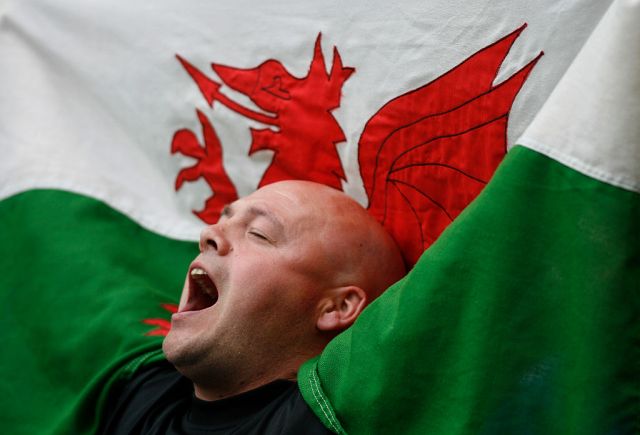
Another Plaid voter? (Ben Radford/Corbis/ Getty)





For 150 years, the red flag was the iconic banner of revolution. Yet it was first raised not in Petrograd or Pyongyang — but the Welsh town of Merthyr Tydfil. In 1831, the so-called “Merthyr Rising” saw residents attack local employers and magistrates, effectively seizing control of the town for several days. Less than a decade later, in 1839, came the Newport Rising, an insurrection just 20 miles away. A seminal moment in the history of Chartism, its defeat, with 24 people killed, marked the beginning of the end for the most radical mass movement in British history.
In time, those uprisings — the birth pangs of democracy — gave way to a wider culture of trade unions and socialism. Little wonder, then, that at every general election since 1922, Labour has triumphed in Wales. And little wonder, too, that when the party finally gained a majority in 1945, it was Nye Bevan, a Tredegar native and miner in his teenage years, who symbolised the nation’s progressive currents. Alongside Bevan was another ex-miner, Jim Griffiths, the Minister of National Insurance and responsible for introducing child benefit. Even the party’s bureaucrat-in-chief, general secretary Morgan Phillips, was a colliery surface worker from the age of 12.
The story of those three men, the triumph of Britain’s organised working class in microcosm, felt like the culmination of something: from the red flag flying in Merthyr to a workers’ government at Westminster, and all in little over a century. The arc of the moral universe was long, to paraphrase Martin Luther King, but it bent toward political power for the proletariat.
Or so we thought. Because since that moment, the apogee of British social democracy, things have curved rather differently. Within two decades of the Merthyr uprising, Wales had become the world’s first industrial country — employing more people in collieries and factories than farms. Today, though, the nation’s economy is centred on services in Cardiff, where you’re more likely to find an artisanal coffee roaster than virgin steel. Little wonder, then, that a century of being a one-party state, with the politics of organised labour at its heart, Welsh Labour is now collapsing, its red flag a source of indifference rather than popular fervour.
Remarkably, the most likely winner of this May’s Senedd elections is Plaid Cymru. Pollsters currently have Reform just behind. Regardless, a victory for either party would be extraordinary, especially when the old stalwarts of Labour and the Tories face annihilation. In their place: the electoral expression of Welsh nationalism, and a party led by a man so English he could be from a Flashman novel.
Haven’t we been here before, though? After all, in 2015 Labour collapsed in Scotland, home to the party’s founder, Keir Hardie, and birthplace of two recent Labour prime ministers. And, then, something similar happened in England’s “Red Wall” a few years later. Yet the party’s demise in Wales is different. In Scotland, it was the SNP that uniquely benefitted from an electoral slump, with Boris Johnson’s Tories likewise gaining in England soon after. But in Wales the threat is from two very different directions. Even the Greens are starting to make inroads, standing to gain from the “D’Hondt” system that will be used in May.
Last August, indeed, even before the party elected Zack Polanski, the Welsh Greens won their first councillor in Cardiff. And now, at the end of March, YouGov forecast Labour only just edging them out. Labour has been the largest party at the Senedd since its inception; it’s not entirely implausible that it’ll finish fourth next month.
Another difference is how quickly the ground has shifted. As recently as 2021, under the leadership of Mark Drakeford, Labour matched its best-ever result in Senedd elections. Plaid, for its part, slipped to third. And at the last general election, less than two years ago, Labour gained 27 of 32 Welsh seats. Electoral disintegration in Scotland and England’s North was far longer in coming.
What explains such an accelerated turn? The Labour Right, for one thing. Vaughan Gething, the favoured candidate of the Labour First faction — whose politics consist in little more than opposition to the party’s Left — was elected as Drakeford’s successor in 2024. But after just four months as First Minister, he resigned over a scandal centring on a £200,000 donation from a convicted businessman.
Four cabinet resignations finally pushed Gething out. So besides tarnishing the party’s brand, the saga also introduced something new to the nation’s body politic, with Welsh Labour engaging in a public spat. Whatever its other sins, the party’s discipline had been legendary, often proving a source of frustration for rivals. Unlike their colleagues at Westminster, Welsh Labour retained a splash of the labour movement in its DNA, meaning there was a greater respect, bordering on veneration, for collective decision-making. This not only reinforced trust, allowing identity-based voting to endure, but also meant that parties to Labour’s Left struggled. While socialists and Greens were winning seats to the Scottish Parliament as early as 1999, and Ken Livingstone became Mayor of London a year later, Welsh politics saw nothing comparable.
Beyond the Gething episode, an error as self-inflicted as the Peter Mandelson farrago, there’s also the disappointment of Labour’s return to national government. Free tickets to see Taylor Swift and gratis silk ties cut through in Bridgend as much as Blackpool. Instead of signalling a decisive change with the past, meanwhile, the Government immediately defined itself by removing the Winter Fuel Allowance from 10 million people. In response, Eluned Morgan, Gething’s successor, sought to put clear water between her party and Starmer, outlining a distinctive “Red Welsh Way”. A few months later, speaking to the Financial Times, she reminded readers that Keir Starmer wasn’t on the ballot in Wales. While the party’s chief in Scotland, Anas Sarwar, called on the Prime Minister to resign, Morgan kept her counsel. That’s evidence, again, of the Welsh party’s relatively cohesive culture — something Gething did his best to destroy.
A host of other issues are refracted through the prism of Welsh subordination. While England gets HS2, albeit with a reduced footprint, Wales gets nothing. Indeed the funding formula for the ultra-fast connection between London and Birmingham means Cardiff misses out on £4 billion. As Will Hayward has noted, despite comprising 5% of the UK’s population, Wales receives only 2% of rail enhancement funding. Besides a deficit of infrastructure spending, there is a wholesale lack of opportunity. A shocking 40% of Welsh children under five live in poverty: so perhaps it’s not surprising that, after being the largest party in the Senedd for more than a quarter of a century, Labour voters are going elsewhere.
But while Wales is set for a controlled demolition of the two legacy parties, most probably prefiguring the next general election, a strange sense of composure reigns. Watching Merthyr Town at home recently, as they lost 2-1 to in-form Macclesfield, I was struck by the calm with which punters disagreed. In a stadium of a few thousand spectators, I met Plaid, Green and Reform voters while making a documentary, and spoke to a Labour MS at full time. Although people were happy to criticise national figures, there was an underlying respect for those around them. Mark, editor of the club’s fanzine — the fabulously titled Dial M for Merthyr — will vote for Plaid, but he was only too happy to point me towards a group of Reform-inclined guys in their twenties. “That’s their point of view isn’t it?” he said cheerily. When I spoke to the group, two of whom said they intended to vote for Farage’s party, there was a similar pragmatism. They understood why others might plump for Plaid or Labour.
It hardly needs saying that such relative restraint felt a world away from England. In Runcorn, and Gorton and Denton, two earthquake byelections of recent times, such views were virtually impossible to find (I tried, recording documentaries in both). Perhaps that’s because, in places like Merthyr, you find that thing so extolled by Westminster: community. These are small places built on generations of adversity — against bosses, London, geology itself. Geographically remote, an instinctive culture of solidarity remains the default.
The data backs this up: after Northern Ireland and Scotland, Wales has the highest proportion of people who feel they belong to their neighbourhood. Indeed it’s arguably the nation’s very culture of solidarity and community — which furnished Labour with such seemingly impregnable foundations — that also explains the party’s rapid demise. Ties are thicker here, particularly in the Valleys. And if everyone you know has turned away from Labour, it suddenly seems easier, and perhaps even destined, to do the same yourself. The party’s collapse in Wales, to quote Trotsky on revolution, was impossible until it became inevitable.
That would certainly explain what happened in the Caerphilly by-election. Last October, in a seat it’s held at Westminster for a century, Labour fell to just 11% of the vote, finishing behind Plaid and Reform in a race for the Senedd. The generational ties that previously sustained the party’s hegemony meant it collapsed all at once. Expect something similar, across the country, next month.
Another problem for Labour is the underwhelming record of devolution. On key indicators, the NHS in England performs better, while child poverty is lower and employment is higher across the Severn Bridge. Such inequalities date back decades, of course, but it’s worth recalling that, before the 1997 referendum, the then-Welsh Secretary Ron Davies argued an Assembly in Cardiff would address such issues. That has simply not happened.
Yet though the Senedd has failed to deliver, there has been a growth of Welsh identity, particularly among the young. More people in Wales now say they feel more Welsh than British. Politically, that’s critical, with the nation’s electorate increasingly liable to vote on the basis of whether they feel one way or the other — the centre-right block composed of those who feel British, the centre-left block based on those who feel Welsh. Labour could ride the horse of emerging national identity while the Tories governed in London. But that has now gone, and a burgeoning sense of national identity wants more than managed decline, platitudes and nostalgia. As the writer Dan Evans puts it to me, only half joking, 7 May “could be our independence day”.
Devolution was always less about a belief in Wales’ ability to govern itself, and more an electoral calculation by New Labour to shore up votes against Plaid. Thus the former was happy to devolve power to Cardiff while having no real interest in state-building, or curiosity as to how Wales might be different politically. It’s remarkable to think that local authorities in England, via Metro Mayors, have more oversight of policing than the Senedd. Presumably Starmer has not corrected such an oversight because he doesn’t care.
Maybe, then, a precondition for Wales to interrogate what it wants, and who it is, means ditching the organisation which has defined its identity for so long. The red flag no longer flies high in Wales. In its place, the battle to define the political substance of the dragon is about to begin.
Aaron Bastani is the co-founder of Novara Media, and the author of Fully Automated Luxury Communism.
 AaronBastani