




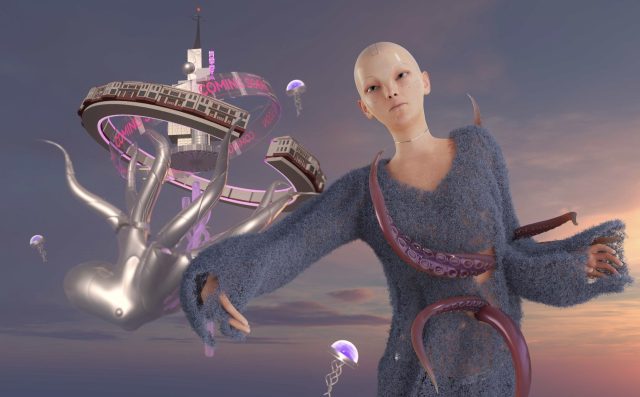
A still from the video Oz by Chinese artist Cao Fei. Credit: The New Museum





A collection of black-and-white photographs by anonymous French soldiers, of their fellows wearing gas masks and other alien-looking equipment from trench warfare, shows us men who feel that they have become more like machines, machine parts, than human beings. American sculptor Anna Coleman Ladd’s facial prostheses from the same period make the point more literally: the machines of war have stripped men of their faces; the face of the future is a fusion of wound and prosthetic.
These photographs and artifacts were among the most moving works in the four-story exhibit, “New Humans: Memories of the Future,” ongoing at the New Museum, the inaugural show after the institution’s $82 million expansion. They and other high-modernist work in the exhibition lie on one side of a divide between the time when we understood there was a meaningful distinction between man and machine, and today — when we do not. Both kinds of work are on display, which simultaneously surpassed my expectations and laid bare the deficiencies and stuckness of contemporary art.
Artists raised under the old, industrial economy, which still produced things, may have been the last to concern themselves with objects, and thus with beauty, materiality, and reality. The digital consumer economy’s production of slop and junk has formed artists interested in kitsch and pastiche. How art will survive the transition remains to be seen.
The exhibition presents an archive of responses to profound, technologically mediated shifts in our experience of the world, ourselves, and our bodies. It includes painting, sculpture, video, and illustration concerned with machines, technology, and the technologized, cyborg body. The show was curated by artistic director Massimiliano Gioni, and is effectively arranged: the viewer, traversing the works roughly chronologically, experiences the cognitive shocks that previous generations felt as the collective tempo of life increased.
Beginning around World War I, technology began to be rendered artistically as a pathogen and destroyer, rather than as it was previously, as a source of secular salvation. In the new view, technology attaches itself to the human and burrows inside: the most common visual tropes in the exhibition concern the tearing, dismembering, and re-welding of the human body by machine parts.
A 1918 gelatin silver print by Man Ray, titled “Femme,” features a simple egg-beater whose shadow on the paper makes a vaguely humanoid form — a stark and elegant lament about our replacement.
Such 20th-century artistic responses to technology are significantly more moving and complex than 21st-century art, which tends to bear, on the whole, an uncanny and unfortunate resemblance to stills from the movie Avatar: the dominant style is James Cameron. A good example is the bald woman, space stations, and octopus tentacles in Oz, a video installation on vertical phone-like screens, from Cao Fei, a Chinese video and virtual-reality artist. Elsewhere, Millennial artists employ bright, simplistic brushstrokes, occasional post-Basquiat splotches of sloganeering, and memes and internet ephemera, such as a deepfake of Kim Kardashian in the video The Finesse (2022), by Sri Lankan artist Christopher Kulendran Thomas.
None of these newer works can match the metaphysical torsion and depth of midcentury painters. Francis Bacon’s deformed, haunted face in “Study for Self-Portrait,” from 1979. shows us the suffering of humanity being violated by the anti-human. Salvadore Dalí’s “Geopoliticus Child Watching the Birth of the New Man” (1943) offers allegorical richness with a barely glimpsed figure emerging from a cracked, egg-shaped globe. Both Swiss artist Miriam Cahn and Dutch painter Jacqueline de Jong distort the human figure in different, disturbing ways, to powerful effect. In all of these paintings, the brushstrokes themselves fight off the virus of non-representation and technological nihilism.
The museum captures a clear, if non-linear, decline in artistic and conceptual ambition in representing the catastrophes of the present. The fall-off from Dalí and De Jong to Cao Fei and New Zealander Simon Denny is profound. Denny’s “Amazon Worker Cage Patent Drawing as Virtual King Island Brown Thornbill cage” (2019) makes a point but has little other impact: it is a whitewashed cage with random appendages.
“New Humans” reveals the truth that the newer humans get, the less capable they become of thinking, acting, and creating outside of the tech-supplemented paradigms of mass culture. Contemporary video looks AI generated, or like cheap visual effects in an old movie. Contemporary figurative representation looks like commercial illustration. There is no bright line between contemporary conceptual art and AI slop — and the artists’ attempts to cleverly acknowledge and incorporate this fails to be transformative.
Also, while the organization and layout of the exhibition is excellent, the design of the building is superabundant in the clichés of contemporary art: white walls, fluorescent lights, rooms where things buzz and pop and gurgle. The effect seems to suggest that contemporary art can only ever be removed from tradition, warmth, wholeness, and faith; there is no tension between the museum and what it hangs on its walls and sits on its display floors. In fact, the form of the New Museum aligns so closely with its content that it seems to take for granted that the only civilizational option is techno-gnostic religion and the transformation of the body.
I felt that the museum — and maybe all of art, and the art world, too — have internalized the melancholy of modernity and technology to such a degree that they struggles to conceive of, let alone represent, even a hint of an alternative. The world at large may be overwhelmingly fluorescent, over-stimulating, and coated in an intellectual or over-intellectualized surface, but there is no essential reason why contemporary art must present itself formally as coterminous with the regime of technocracy and biopolitical engineering. The 20th-century components of the exhibition were in critique of this social tendency; the 21st-century work is in acquiescence.
Moreover, there is still a sense that midcentury painters were in dialogue with the canon and had some ambition to connect the metaphysical trauma of the 20th century to the long chain of centuries stretching back to the late Middle Ages. The present meta-modernity — or post-post-modernity, whatever you want to call it — has little such interest in the past, except as a data set of images used to construct images of the technologized future. There is no sense of spiritual resistance or inner light or humanistic dignity; the closest thing to optimism I saw was Anicka Yi’s “In Love with the World” (2021), in which floating “aerobes,” essentially large mechanical jellyfish, ask us to imagine the whimsy and aesthetics of machine rule.
Until this century, visual artists did more than evoke the determinisms and historical conditions under which they worked. Wars, plagues, assassinations, revolutions did not prevent painters and sculptors from keeping an eye on God, towards God, and towards the beauty of the body. The emphasis of the New Museum, understandably, is on the new, but the rootlessness and literalism with which it enacts the mission is deeply boring. So while this archive is stimulating and suggestive, one is ultimately left with the feeling of having been cheated. Shouldn’t these new conceptions of humanity have to compete with those that came before, and should we not judge them by the standards of the past as well as the present?
It occurred to me, however, that the exhibition should perhaps have been called “New Humans: Memories of the Past.” No matter how thoroughly the human body is reimagined as machine-angel or machine-devil, our collective memory of wholeness remains strong. We desire to be ourselves again.
One painting arrested my attention as I was leaving: “Mud Field II” (2023), by Pol Taburet, one of the youngest painters in the show, stood out precisely because its central male figure, though slightly abstracted, conjured up psychological, moral, and physical humanity. Taburet’s painting made me hope that a cycle was ending, and that coming generations of painters may yet turn away from the now-clichéd assumptions of postmodernism and embrace what Blake called the “human form divine.”
