




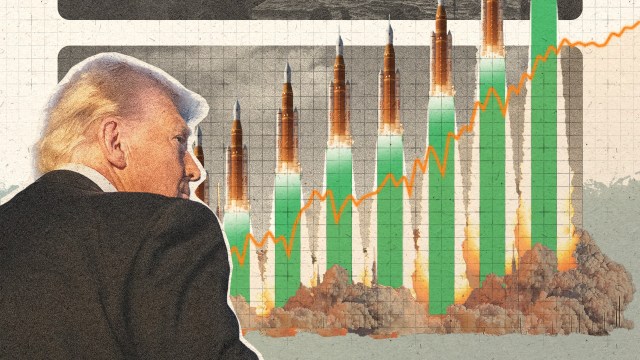
Will American GDP rocket? (JG Fox/Getty).





Over the last century, global power was defined entirely by the geography of transit. The map of energy and geopolitical power was flat, two-dimensional, and dictated by wherever molecules of oil, gas, or petroleum by-products could be scraped out of the Earth and squeezed through narrow physical passageways such as the Suez Canal and the Strait of Hormuz. Those who controlled those chokepoints — as Iran does the Strait — have wielded outsize power.
The British and the Europeans, having held back from joining the American attack on Iran, have been enjoying a sense of collective moral superiority over President Donald Trump. This leaves them unable to see that the United States is executing a geopolitical checkmate that will define the 21st century. The checkmate is that America is now quietly building a new Suez. This new Suez isn’t a trench dug in the sand; it is a pipeline of electrons and light connecting America to the stars.
As a result, the world no longer needs that two-dimensional map of Earth. The new map is three-dimensional. It connects Earth to space and renders terrestrial blockades completely irrelevant. Why are the Americans speeding up the move into space? Because that’s where we find treasures in the form of unlimited energy, unlimited resources, unlimited mining, refining and manufacturing, and control of the most important warfighting domain — space itself. After all, America is fighting the war in Iran mainly from space. The Artemis launch is not a coincidence. It is confirmation of the plan’s progress.
And the plan works like this. If Iran closes the Strait, the closure has absolutely zero impact on a Starlink V3 mesh network beaming tactical data and artificial intelligence from low Earth orbit. The US is now relocating the central arteries of the global economy — computation, communications, intelligence and even energy production — into space, permanently removing them from the reach of earthly geopolitics. Space is the new form of what Leninists called the “commanding heights”. In all, the US is bypassing the earthbound chokepoints with a new supply chain of atoms: safe nuclear energy, light that flows from the sun, and even — via small mobile modular nuclear reactors and the new materials that will make nuclear fusion possible — stars that fly in a box.
While the global media mocks and decries Trump’s warmongering, then, it fails to register the decisive moves on the geopolitical chessboard. Before cornering the Iranian leadership, the US had systematically cut off its cash flows and eliminated its key collaborators, especially across Latin America. In Venezuela, the US took control of the oil supply by removing Nicolás Maduro and cutting a pragmatic deal with his successor. In Mexico, the US removed “El Mencho”, the head of the most important energy-controlling cartel in the country. The result is that these nations don’t dare sell their oil molecules if the US doesn’t approve of it. The US didn’t do regime change; it did regime control and molecule monopoly. The world must buy American now.
The US wins both ways. It has the molecules that matter. Chip production depends on helium, and the world’s largest helium reserve is now in Abilene, Texas. While the world shuts down fertiliser plants for lack of the ammonia and nitrogen that Qatar can no longer supply, the US has pioneered in the production of green ammonia, which is produced using only water, air, and electricity. By mixing green ammonia with captured carbon, the US now produces green urea, a critical component of fertilisers. When combined, green ammonia and green urea are the first fertiliser in history that is completely delinked from the global natural gas market. That’s the holy grail of resource independence, because it represents a total decoupling of food production from the fossil fuel grid.
In addition, the US now has everything it needs to produce electric vehicles and batteries. Formerly, its supply of sulphuric acid, which is necessary for the production of these products, would have been badly affected by the bombing of Qatar’s Ras Laffan industrial hub. But today, American firms know how to capture sulphur as a byproduct of America’s new nickel and copper mines. What’s more, America can use its home-grown sulphur to turn its phosphate reserves, and those of countries such as Morocco, into even more fertiliser. America is therefore not only the only fertiliser-secure breadbasket left on Earth; it is also beginning to control other countries’ supply of fertiliser.
The demand for old-fashioned molecules of oil, gas and petroleum byproducts is currently driving a highly lucrative flow of cash into the United States. But that is merely the short-term arbitrage of a dying economic model. The true strategic demand has shifted toward a vastly more sophisticated architecture of power: one based on atoms, electrons, and photons. We are moving away from the crude combustion of dead biology and toward the mastery of next-generation nuclear fission, the pursuit of nuclear fusion, the electron-orchestration that is the essence of digital computation, and the literal beaming of solar light into American power grids. Other Western countries are chasing wind and solar power, which are plagued by intermittency and are limited by battery manufacture. America, however, is aiming to build baseload capacity fit for multiplying energy demand. In short, it is shooting for the stars.
The question is how long the new nuclear energy transition will take. People think it will take 30 years of regulatory red tape and $30 billion to build a new nuclear power plant. They missed a historic event on 15 February. Hardly any news media covered Operation Windlord, in which small modular reactors (SMRs), based on the reactors that have powered nuclear submarines for decades, were shipped on massive Globemaster C-17 aircraft from March Air Reserve Base, in California, to Hill Air Force Base, Utah. The reactors were then trucked to the Utah San Rafael Energy Lab for testing and evaluation. This was the first-ever air transport of a nuclear microreactor, and therefore a milestone demonstration of deployability.
The Americans are envisaging a world where nuclear power is mobile, distributed, and available on demand any time and anywhere. These innovations are about delinking power from geography. While the legacy world bleeds over massive, vulnerable oil tankers, the atomic future runs on TRISO fuel pellets (tri-structural isotropic particle fuel) that are entirely meltdown-proof and produce zero emissions. This fuel cannot be easily weaponised, for the radioactive material is locked inside diamond-hard poppy-seed-sized ceramic shells. These shells cannot be melted down or easily broken apart, and if they could, it would kill the engineers doing it. The Department of Energy calls it “the most robust nuclear fuel on earth”. No pipelines required. Stars in a box.
Nuclear fusion, in theory an even more transformative source of power, is still derided as being perpetually “50 years away”. But the critics are looking at the wrong bottleneck. The constraint is no longer the atomic material. It is the vessel required to hold the plasma, and the hyper-precise attosecond lasers needed to pulse and manage the hydrogen isotopes: atoms rather than molecules. By doing millions of simulations in minutes, AI is collapsing the time needed to get to fusion. As new materials and AI advance, fusion is on course to become a reality. Not that it’s the only bet being placed by Washington: DARPA, the US military’s innovation unit, recently beamed 800 watts of power across 5.3 miles of open air using a directed laser. Just to flex the absolute audacity of their success, the scientists used the wirelessly transmitted energy to pop popcorn at the other end. Wireless energy transmission is no longer a sci-fi abstraction; it is a reality.
Look at the geopolitical board: Iran is bleeding its resources to control the old, flat molecule-driven economy, while the Artemis programme aims to permanently free the US by shifting to the management of atoms, electrons and light. Conquering the cosmos requires abandoning archaic chemical rockets in favour of nuclear-powered spacecraft. Ultimately, it’s a tale of two paradigms: the Artemis generation is building an atomic architecture to entirely unshackle the global economy, while the regime in Tehran is desperately trying to keep a chokehold on the molecules that the global economy currently depends upon.
The US has been explicitly clear about this strategy, though the legacy pundits were too busy laughing at the President to notice. In late 2025, the State Department launched Pax Silica: a strategic framework declaring that if the 20th century ran on oil, steel, and vulnerable maritime chokepoints, the 21st century will run on compute, data, and critical minerals. It is the official, silicon-based replacement for Pax Americana. To physically build this new architecture, the Department of Energy unleashed the Genesis Mission. It is gathering the combined data, capabilities and technologies of the seventeen National Laboratories, including Los Alamos, Lawrence Livermore and Sandia. The goal is to double American R&D output in just 10 years. To do it, Washington is executing a two-part strategy: handing the leading scientists exascale computing power, and allowing AI to access the massive, never-before-tapped vaults of the classified, proprietary data that has been generated by America’s top scientists since the Second World War. This will turn 80 years of compartmentalised and classified science into active training data, enabling scientists to optimise the design of nuclear reactors and discover new alloys that could eliminate foreign supply chain dependence entirely.
Those supply chains are a remnant of the era in which we were bound by what we could extract. We had to shape existing materials into what we needed. A tree, for example, could become a boat. Now we can create new realities by painting with electrons and by constructing new materials, atom by atom, that never existed before. This is how new “metamaterials”, as they are called, are being built. These are artificial structures engineered at the atomic level to bend the laws of physics. For example, instead of relying on natural chemistry, scientists can now build microscopic patterns of atoms and electrons that can manipulate light, radar, and sound, allowing them to construct stealth armour that bends radar around a fighter jet. Google has already discovered over 380,000 new materials and over two million new crystals this way thanks to its new Willow chip, which can be built via similar methods. Formulas are replacing materials. Abundance is replacing scarcity.
That scale of abundance will require a vast amount of energy — and Elon Musk isn’t waiting for SMRs and nuclear fission to supplement American power grids. To sustain his AI endeavours, Musk aims to produce one terawatt of compute (that is, computational power) annually — 50 times the current global capacity. Earth does not have the land, the cooling water, or the power grids to sustain that. So he is relocating intelligence to the heavens. Musk has just announced his plans to open the world’s largest semiconductor factory; 80% of its output is designed for orbital data centres linked by Starlink lasers. Google’s Project Suncatcher is following suit, launching solar-powered satellites designed to harvest orbital energy and beam it down alongside data. The strategy is ruthlessly simple: if the Earth cannot support the future, let the Old World to duke it out on the ground while America moves its economy into space.
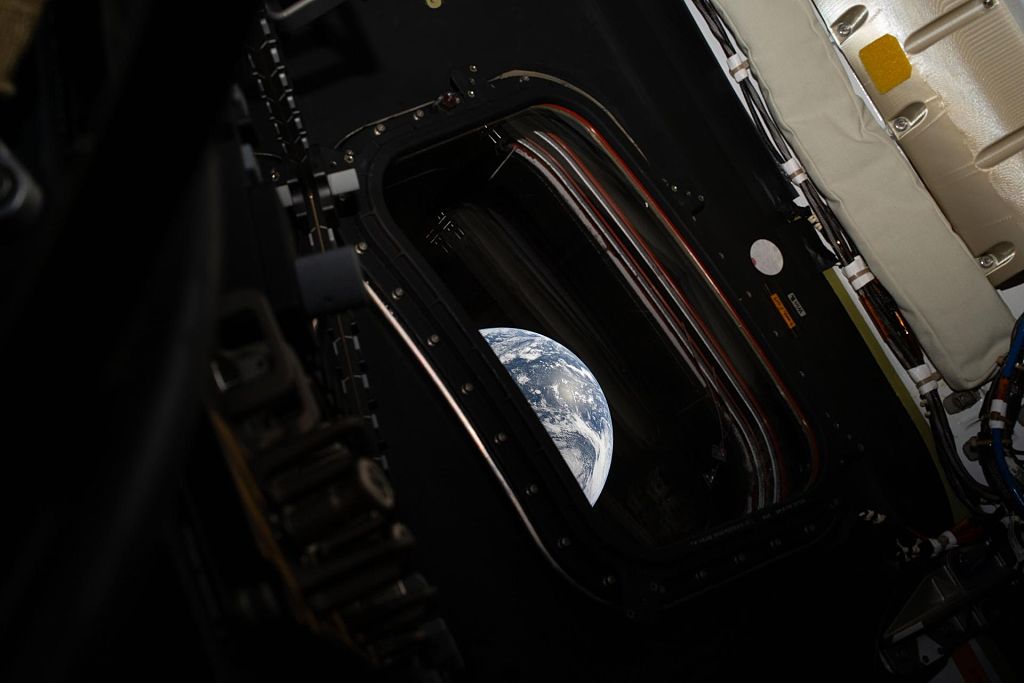
Empires are scavengers. We’ve fought brutal wars over mud, powering our civilisations by burning the molecular remains of long-dead biological matter. It was a subterranean era of power. But the Americans have stopped looking down at the old two-dimensional map of the world. By looking up, they are executing a Promethean shift: pulling the physical mechanics of the sun and the stars down to Earth and domesticating these empyrean forces. By packing the heavens into steel boxes, they are intending to power a literal “Golden Age” of human flourishing.
Pundits might laugh at the grandiosity, but they are forgetting the lessons of history. Before 1840, naval power was a hostage to the wind. The deadliest galleon was worthless once the breeze died. Then the British launched HMS Nemesis, the world’s first iron-hulled steam warship. By moving from sails to steam, Britain could power up shallow rivers, shocking military planners. Nemesis decoupled the power of the British Empire from what were thought to be the limits of nature. The Americans are simply doing it again, only this time with atoms instead of steam. Washington is merely reading from Britain’s old playbook.
The irony is that the British once possessed the exact ruthless foresight they are currently failing to recognise in the Americans. In 1911, the Royal Navy was the undisputed master of the seas, running entirely on domestic Welsh coal. It was safe, familiar, and utterly secure. But a young Winston Churchill recognised a brutal truth: comfort is the enemy of supremacy. To gain absolute speed and efficiency, he gambled the survival of the British Empire on the distant oil fields of Persia. In doing so, he helped save the Anglo-Persian Oil Company, now BP. It was, in essence, a battle between, on one side, bureaucrats and Welsh coal barons, who wanted to manage the mud they already owned; and, on the other, a visionary who was willing to trade certain security for absolute supremacy. Abandoning coal seemed madness, but Churchill was right.
Decades earlier, Prime Minister Benjamin Disraeli pulled off an even more audacious masterstroke. He saw that the new geopolitical map was not the open ocean — it was a narrow, yet unbuilt trench though Egypt. In 1875, while Parliament was in recess, Disraeli borrowed £4 million and bought the Suez Canal from a bankrupt Khedive. Disraeli didn’t just buy a canal; he secured the central artery of global power, and locked in a hundred years of naval dominance, even as his rivals were still squinting at the old map. Today, the US is doing the exact same thing with atoms and celestial compute — securing the new Suez before the Old World realizes the canal has moved. Washington is simply running Disraeli’s playbook, but in the stars instead of in the sand.
Some British entrepreneurs understand that a new era is upon us. Space Solar, a startup based in Oxfordshire, aims to beam continuous, clean energy directly from orbit to Earth. Wales-based Space Forge is currently proving that semiconductor manufacturing and in orbit refining is actually more efficient in the vacuum of space. Pulsar Fusion is making progress on the long road to fusion-powered rocketry, and it was Rolls-Royce ingenuity that created the modern SMR. Britain clearly possesses the intellectual capital to make a success of the atomic transition. Europe does too. But for now, they merely tinker on the edge of the three-dimensional map while the Americans aggressively claim the territory. The Chinese and the Saudis are also racing forward. Saudi is training a new generation of scientists at KAUST, its flagship science and technology university, and investing in a wide range of nuclear, solar and space technologies. China is on a par with the US. Others need to catch up.
The endless diplomatic handwringing over Iran’s exact proximity to a traditional nuclear warhead entirely misses the point; their capacity to create a dirty bomb was already a functional reality even if delivery on an ICBM was not. The intentions were clear. When Tehran, which had been negotiating with the US in Geneva earlier this year, finally abandoned the charade, the US delivered a kinetic reminder that its red lines were not suggestions. Iran’s retaliation was a brutal validation of the American thesis. Blindsiding neighbours like Qatar, Saudi Arabia, the UAE, Kuwait, and Bahrain, Tehran demonstrated a terrifyingly precise strike capability, reaching as far as Diego Garcia. The regime also struck desalination plants, crucial to the region’s water supply. Washington successfully eliminated the men in charge, but the molecules remain trapped: oil, gas and especially H20, water. The attacks on desalination plants gave pause to everyone in the region. The chokepoints for water, oil, and natural gas outlived the leadership because the old world economy remains a captive in this geography. Trump offered Europe the only geopolitical strategy the Old World has left: take the molecules while you still can.
The grand, cosmic irony of the current crisis is America’s response to Iran’s nuclear threats. For decades, the West has been agitated by Tehran’s atomic ambitions. Yet the ultimate American counter-move to Iran’s nuclear threat isn’t just a barrage of conventional airstrikes; it is the mass deployment of next-generation nuclear power. It is a new grand strategy of nukes on nukes. How does the US neutralise a hostile regime holding ransom the world’s oil supply? By rapidly building a new nuclear power grid, thus removing Iran’s leverage, and by building a space-based missile defence system that can down incoming Iranian warheads. The US is answering the threat of nuclear extortion with the reality of nuclear emancipation. It does not matter if the stars in a box are not yet fully operational or if nuclear fusion doesn’t happen tomorrow. What’s important is to see the value of the Suez Canal, as Disraeli did, before it is built.
Even as they build the future, the architects of this transition are capable of bungling the present. Trump’s loose lips have offended Mohammed bin Salman and alienated the Qataris, causing the Gulf states to hedge their bets and perhaps to back away from Washington. These are clumsy and avoidable errors. The war in Iran will continue to be messy. Yet the American industrial machine will persist in its celestial pivot. China, having plundered American IP, is following, and so will others once the architecture is proven to work. They’ll soon realise that these historic technological pivots are not optional, whether from sail to steam, from coal to oil, from combustion to compute, or from molecules to atoms.
The fatal flaw of the transatlantic intelligentsia is that they confuse the man with the machine. One may thoroughly loathe Donald Trump, but translating distaste for his manner into an assumption of industrial weakness is geopolitical suicide. The American innovation engine does not care about European sensibilities. While the Old World is busy looking down at the old two-dimensional map, they must soon realise that they are hostage to waterways, muddy ditches, and dictators. Washington, meanwhile, is looking up. The American empire is exchanging molecules for atoms and straits for stars.
Dr. Pippa Malmgren was an economic advisor to President George W. Bush. She is the founder and CEO of the Geopolitica Institute.
 DrPippaM